Michael Ioane
Article I
Authority Article
Balance of Power Between Government and Individuals
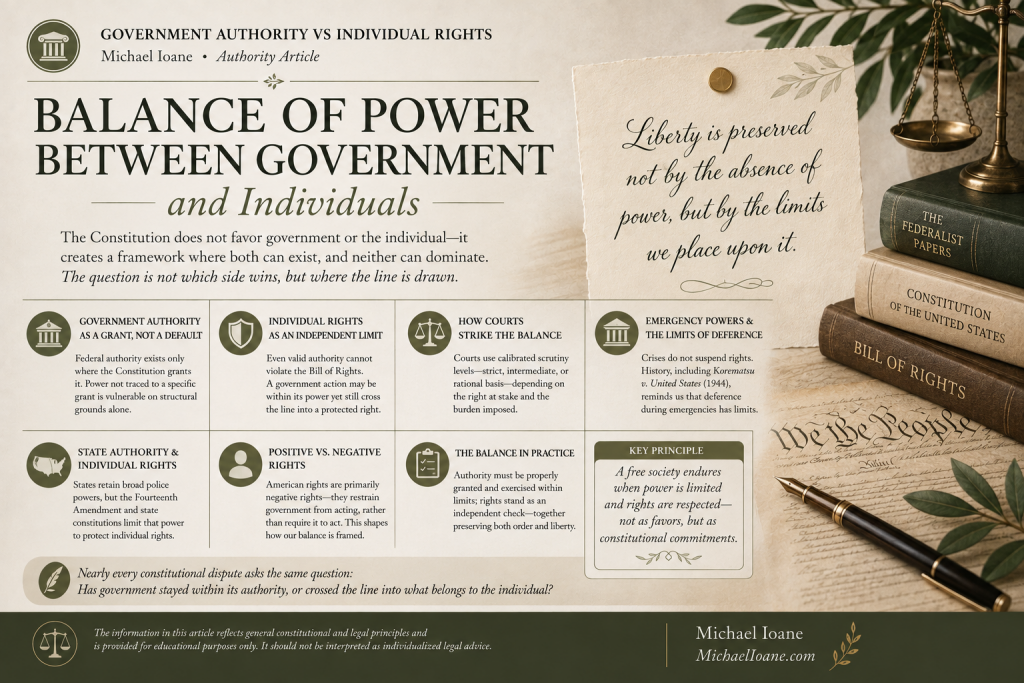
Government vs individual rights is one of the oldest and most consequential tensions in constitutional law: government needs sufficient authority to function, provide order, and protect its citizens, while individuals need protection from that same authority when it is exercised beyond its proper limits. The Constitution does not resolve this tension by favoring one side categorically; it resolves it by establishing specific authority limits and specific individual protections, and leaving courts to determine where the two meet in any given case.
Michael Ioane treats this balance as the practical center of constitutional law: nearly every significant constitutional dispute, in one form or another, is a dispute about whether a specific exercise of government authority has crossed into territory reserved for individual rights.
Government Authority as a Grant, Not a Default
As discussed in earlier reviews of constitutional structure, federal government authority is not a default; it exists only where the Constitution grants it, whether through Article I’s enumerated powers or through powers reasonably implied from them. This starting point matters directly to the rights balance: because authority must be affirmatively granted, an assertion of government power that cannot be traced to a specific grant is vulnerable on structural grounds alone, independent of any individual rights claim.
Individual Rights as an Independent Limit
Even where government authority is properly granted, the Bill of Rights and later amendments impose a further, independent layer of limitation: certain government actions are prohibited even when they would otherwise fall within an enumerated power. A tax validly imposed under Congress’s taxing power, for example, still could not be structured to punish speech protected by the First Amendment; the underlying authority is valid, but a specific application of it can still violate an individual right.
How Courts Actually Strike the Balance
Courts do not resolve this tension by treating rights as absolute or authority as unlimited; they apply calibrated legal standards, often called levels of scrutiny, that vary depending on which right is at stake and how directly government action burdens it. A law affecting a fundamental right or a suspect classification typically receives the most searching judicial review, while ordinary economic or regulatory legislation typically receives considerably more deference. This calibrated approach is what allows the same constitutional framework to accommodate both a functioning government and meaningful individual protection.
Emergency Powers and the Limits of Deference
The balance between authority and rights is tested most sharply during emergencies, when government claims of necessity press hardest against individual protections. History provides both cautionary and instructive examples: the Supreme Court’s wartime deference in Korematsu v. United States (1944), upholding the internment of Japanese Americans, is now widely recognized, including by the Court itself in later decisions, as a serious constitutional failure, illustrating that expanded government authority during a crisis does not suspend the underlying rights framework, even when courts at the time were reluctant to say so.
This history is a central reason courts today apply consistent, calibrated scrutiny rather than simply deferring to a government’s own characterization of an emergency. The framework does not change during a crisis; what changes is how urgently a court is asked to apply it.
State Authority and Individual Rights
The same balance operates at the state level, where state constitutions and the incorporated protections of the federal Bill of Rights together limit state and local government action. States often retain broader authority than the federal government in areas like general policing power, but that authority remains subject to the same individual rights limitations, applied through the Fourteenth Amendment, that constrain federal action.
Positive Versus Negative Rights
American constitutional rights are, with limited exception, negative rights: they restrain government from acting, rather than obligating government to provide something affirmatively. The First Amendment prevents government from restricting speech; it does not obligate government to provide a platform for it. This negative-rights framework distinguishes the American constitutional tradition from many other constitutional systems that recognize affirmative social and economic rights, and it shapes how the balance of power question is typically framed: as a question of what government may not do, more often than a question of what government must do.
Conclusion
The balance of power between government and individuals rests on two distinct constitutional mechanisms working together: authority that must be affirmatively granted and properly sourced, and individual rights, generally negative in character, that operate as an independent limit even on validly granted authority, a limit that holds even under emergency conditions. Understanding how these two mechanisms interact is the foundation for evaluating any specific dispute between government power and individual protection, a subject explored further in Rights vs Government Authority.
The information in this article reflects general constitutional and legal principles and is provided for educational purposes only. It should not be interpreted as individualized legal advice.
Michael Ioane | MichaelIoane.com
Continue Learning with Michael Ioane
Build your understanding of asset protection and business planning with the Asset Protection Manual . Explore taxation and private trust planning in Boston Tea Party . Both books are available on Amazon.