Michael Ioane
Article III
Practical Article
Methods of Constitutional Interpretation
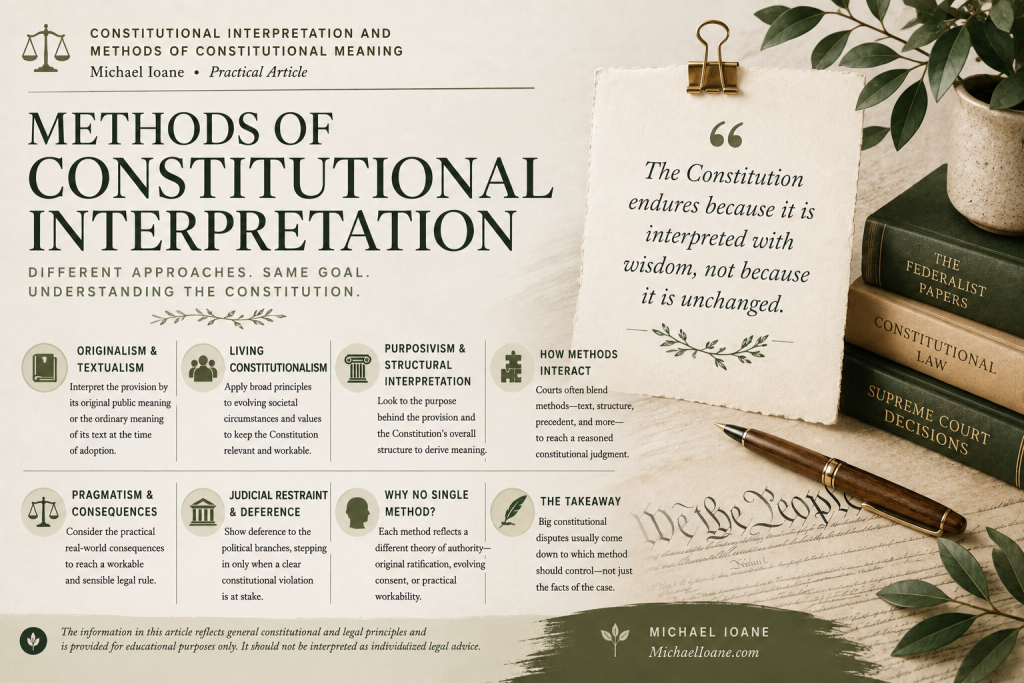
Legal interpretation methods applied to the Constitution fall into several recognized schools, each offering a different account of what should control when a provision’s application to a specific case is genuinely contested. Understanding these methods, and how they differ, is essential to following how courts actually reason through constitutional questions.
Michael Ioane treats familiarity with these competing methods as a practical necessity rather than an academic exercise: nearly every significant constitutional dispute is, at bottom, a disagreement about which interpretive method should control, not merely a disagreement about the underlying facts.
Originalism and Textualism
Originalism holds that a constitutional provision should be interpreted according to the meaning it had at the time it was adopted, either the specific intent of its drafters or, in its more commonly applied modern form, its original public meaning, how a reasonable, informed person at the time would have understood the text. Textualism, closely related, emphasizes the ordinary meaning of the words actually used, generally without extensive reliance on legislative history or the subjective intent of the drafters.
Proponents of these approaches argue that they constrain judicial discretion and preserve democratic legitimacy, since changes to the Constitution’s meaning should come through the formal amendment process rather than through evolving judicial interpretation.
Living Constitutionalism
The competing approach, often called living constitutionalism, holds that the Constitution’s broad and general provisions were deliberately designed to be applied in light of evolving societal circumstances and values, and that courts may legitimately interpret this general language differently as those circumstances change, without requiring a formal amendment for every new application. Proponents argue this approach allows the Constitution to remain workable and legitimate across changing social conditions the framers could not have specifically anticipated.
Purposivism and Structural Interpretation
Purposivism looks to the broader purpose a constitutional provision was designed to serve, asking how a given interpretation would advance or undermine that purpose, rather than focusing narrowly on original meaning or literal text alone. Structural interpretation, discussed in How to Read the Constitution, derives meaning from the document’s overall architecture and the relationships between its provisions, rather than from any single clause read in isolation.
How These Methods Interact in Practice
In actual judicial opinions, these methods are rarely applied in pure isolation. A single opinion may rely on original meaning to establish a baseline, structural reasoning to confirm that baseline is consistent with the document as a whole, and precedent to determine how the provision has already been applied to similar facts. Understanding legal interpretation methods individually is what allows a reader to identify which combination of approaches a given court actually relied on, and to evaluate that reasoning on its own terms.
Pragmatism and the Role of Consequences
A further approach, sometimes called pragmatism or consequentialist interpretation, gives explicit weight to the practical real-world consequences of adopting one interpretation over another, asking which reading produces a more workable and sensible legal rule. Critics argue this approach risks substituting judicial policy preference for legal analysis, while proponents argue that some consideration of practical consequences is unavoidable, and more honest, than pretending an interpretation was reached through text and history alone when consequences plainly influenced the outcome.
Judicial Restraint and Deference
Separate from any specific interpretive method, courts also apply varying degrees of deference to decisions made by the political branches, an approach often described as judicial restraint. Under this approach, a court may decline to substitute its own constitutional judgment for that of Congress or a state legislature except where a constitutional violation is clear, reserving the most searching form of review for cases involving fundamental rights or discrimination against particular groups. This deference operates alongside, rather than as a substitute for, the interpretive methods used to determine what the Constitution actually requires in the first place.
Why No Single Method Commands Universal Agreement
No single interpretive method has achieved consensus acceptance among judges, scholars, or the public, and this disagreement is not simply a matter of political preference. Each method rests on a different underlying theory of what gives the Constitution its legitimate authority, whether that authority derives from the original democratic act of ratification, the ongoing consent of the governed as expressed through evolving practice, or the practical workability of the resulting legal rules. Understanding this deeper disagreement is often more useful than treating the choice of method as an arbitrary preference.
Conclusion
Methods of constitutional interpretation, originalism, textualism, living constitutionalism, purposivism, structural interpretation, pragmatism, and judicial restraint, offer genuinely different accounts of how constitutional meaning should be determined, and most significant constitutional disputes trace back to a disagreement among these methods rather than a disagreement over the underlying facts. Recognizing which method or combination of methods a given argument relies on is the key to following, and evaluating, constitutional reasoning accurately.
The information in this article reflects general constitutional and legal principles and is provided for educational purposes only. It should not be interpreted as individualized legal advice.
Michael Ioane | MichaelIoane.com
Continue Learning with Michael Ioane
Build your understanding of asset protection and business planning with the Asset Protection Manual . Explore taxation and private trust planning in Boston Tea Party . Both books are available on Amazon.