Michael Ioane
Article III
Practical Article
Strategic Positioning for Risk Mitigation
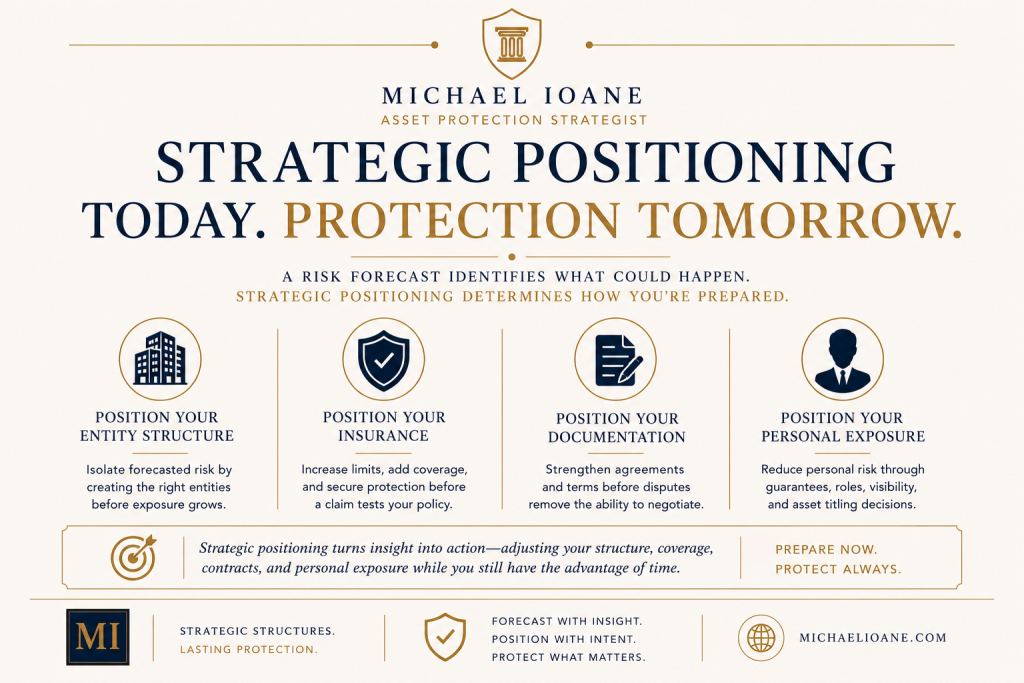
Strategic positioning is the practical application of a risk forecast: once likely future exposures have been identified, positioning refers to the specific structural, insurance, and documentation decisions made now to ensure that when a forecasted risk actually materializes, the client’s assets and structure are already arranged to minimize its impact. Positioning is distinct from forecasting itself; forecasting identifies the risk, and positioning determines how the client responds to that identification before the risk becomes an actual claim.
Michael Ioane treats positioning as the practical bridge between a risk forecast and an operating protection structure, because a well-researched forecast provides no benefit if it is not translated into specific, executed positioning decisions, while there is still time to act deliberately rather than under the pressure of an active dispute.
Positioning Entity Structure Ahead of Forecasted Risk
Where a forecast identifies a specific category of elevated risk, such as anticipated growth in a particular business line or an increase in employee count, positioning involves adjusting the entity structure in advance to isolate that specific risk, potentially forming a new entity for the higher-risk activity before it becomes a significant part of the business, rather than waiting until the activity has already grown to a scale where separating it becomes more disruptive.
This proactive entity positioning is particularly valuable when a forecasted risk is industry-driven and therefore highly predictable, such as a construction business anticipating a large new contract with correspondingly larger liability exposure. Positioning a dedicated entity for that specific contract before work begins isolates the exposure from the company’s other ongoing operations.
Positioning Insurance Ahead of Forecasted Risk
Insurance positioning involves adjusting coverage limits, adding specific endorsements, or securing additional umbrella coverage in anticipation of a forecasted increase in risk, rather than waiting until a claim occurs to discover that coverage was inadequate for the business’s actual current risk profile. Insurance is generally far more available and more favorably priced before a claim history develops, making early positioning materially more effective than attempting to secure comparable coverage after a loss.
Michael Ioane recommends reviewing insurance coverage specifically against the risk forecast, not merely against historical claims experience, because a forecast-driven review identifies coverage needs the business has not yet experienced but is reasonably likely to face given its trajectory and industry.
Positioning Documentation Ahead of Anticipated Disputes
Where a forecast identifies a specific relationship or transaction type as a likely source of future dispute, such as a business partnership with an increasing likelihood of eventual disagreement or a contractor relationship in an industry prone to payment disputes, positioning includes strengthening the underlying documentation, including partnership or operating agreements, indemnification provisions, and dispute resolution clauses, before any actual disagreement arises and while all parties can still negotiate cooperatively.
Documentation positioned in this way is negotiated on more favorable and balanced terms than documentation drafted or amended after a dispute has already begun, since the parties’ incentives to cooperate are strongest before any specific conflict has crystallized their competing interests.
Positioning Personal Exposure Ahead of Anticipated Risk
Strategic positioning also addresses an individual’s personal exposure in anticipation of forecasted risk, including reducing reliance on personal guarantees as a business’s creditworthiness improves, reconsidering board or advisory positions that carry disproportionate personal liability relative to their benefit, and adjusting public visibility or asset titling where a forecast identifies increasing personal exposure, such as growing public prominence or an anticipated increase in litigation-prone activity.
These personal positioning decisions are most effective when made incrementally and well in advance, allowing changes such as removing a personal guarantee or restructuring a board role to be negotiated on ordinary business terms rather than, if made abruptly after a specific risk has emerged, appearing as a reaction to that risk.
Strategic positioning converts a risk forecast into concrete protective action, adjusting entity structure, insurance, documentation, and personal exposure while there is still time to act deliberately. A forecast without positioning identifies risk without addressing it; positioning is what changes the client’s exposure before a forecasted risk becomes an active claim.
The information in this article reflects general structural principles and practical observations from consulting experience and is provided for educational purposes only. It should not be interpreted as individualized legal or tax advice.
Michael Ioane | MichaelIoane.com
Continue Learning with Michael Ioane
Build your understanding of asset protection and business planning with the Asset Protection Manual . Explore taxation and private trust planning in Boston Tea Party . Both books are available on Amazon.