Michael Ioane
Article IV
Summary Guide Article
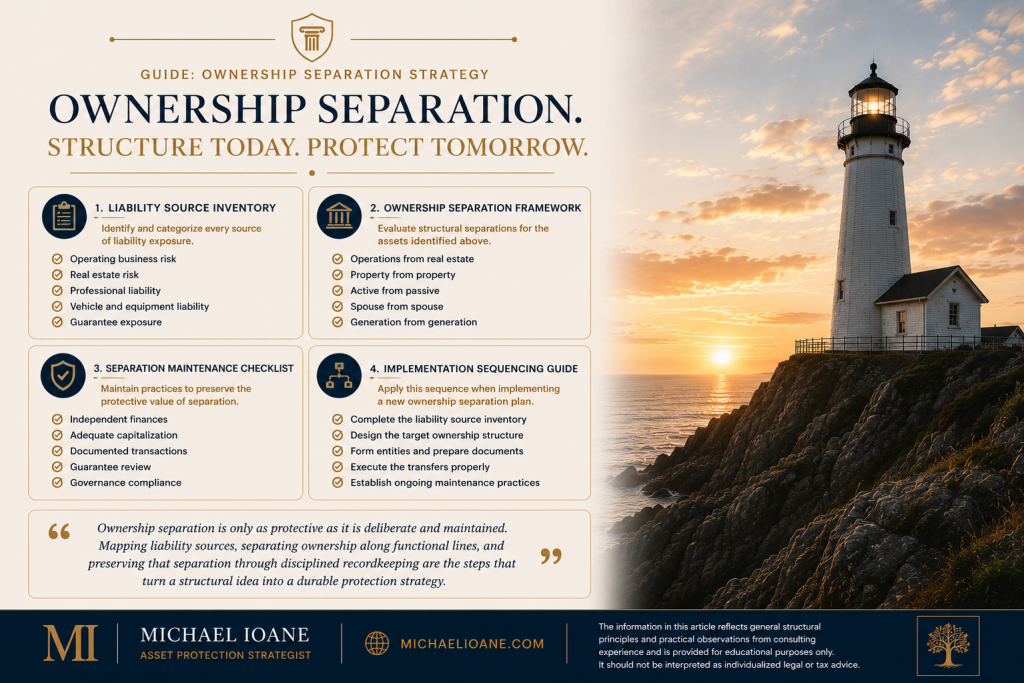
Guide: Ownership Separation Strategy
This guide provides a practical reference for designing and implementing an ownership separation strategy. The frameworks here reflect Michael Ioane’s approach to mapping liability sources, separating ownership along functional lines, and maintaining the separation over time so the structure continues to provide the protection it was designed to deliver.
Liability Source Inventory
Identify and categorize every source of liability exposure:
- Operating business risk: liability arising from day-to-day business operations, employees, contracts, and customer or client interactions
- Real estate risk: premises liability, tenant claims, and financing exposure connected to each property held
- Professional liability: exposure arising from licensed professional activities or specialized services the owner personally performs
- Vehicle and equipment liability: exposure arising from the ownership or operation of vehicles, machinery, or equipment
- Guarantee exposure: personal guarantees, co-signed loans, or other obligations that reintroduce personal liability despite entity separation
Ownership Separation Framework
Evaluate the following structural separations for the assets identified above:
- Operations from real estate: hold the operating business and the real estate it occupies in separate entities, connected by an arm’s-length lease
- Property from property: hold each property, or each small group of related properties, in its own separate holding entity
- Active from passive: separate actively operated, higher-risk assets from passive, income-producing, or personal-use assets
- Spouse from spouse: evaluate allocation of ownership between spouses according to differing liability profiles, consistent with applicable marital property law
- Generation from generation: structure ownership so that succession can occur along family lines without entangling unrelated assets and liabilities
Separation Maintenance Checklist
Maintain the following practices to preserve the protective value of separation:
- Independent finances: maintain separate bank accounts, books, and records for each separated entity, with no commingling of funds
- Adequate capitalization: ensure each entity maintains capital and insurance appropriate to the risks of its specific activity
- Documented transactions: document all transactions between separate entities, including leases, loans, and service agreements, on arm’s length terms
- Guarantee review: periodically review outstanding personal guarantees and negotiate limits or releases where possible
- Governance compliance: maintain required formalities, filings, and governance documentation for each separated entity
Implementation Sequencing Guide
Apply the following sequence when implementing a new ownership separation plan:
- Complete the liability source inventory and identify the assets connected to each source
- Design the target ownership structure, assigning each asset category to its appropriate entity or ownership arrangement
- Form the required entities and prepare governing documents tailored to each category of assets
- Execute the transfers required to place each asset within its designated ownership, following proper documentation and timing practices
- Establish ongoing maintenance practices, including separate recordkeeping and periodic guarantee review, before considering the separation complete
Ownership separation is only as protective as it is deliberate and maintained. Mapping liability sources, separating ownership along functional lines, and preserving that separation through disciplined recordkeeping are the steps that turn a structural idea into a durable protection strategy.
The information in this article reflects general structural principles and practical observations from consulting experience and is provided for educational purposes only. It should not be interpreted as individualized legal or tax advice.
Michael Ioane | MichaelIoane.com
Continue Learning with Michael Ioane
Build your understanding of asset protection and business planning with the Asset Protection Manual . Explore taxation and private trust planning in Boston Tea Party . Both books are available on Amazon.