Michael Ioane
Article III
Practical Article
Managing Risk During Asset Transfers
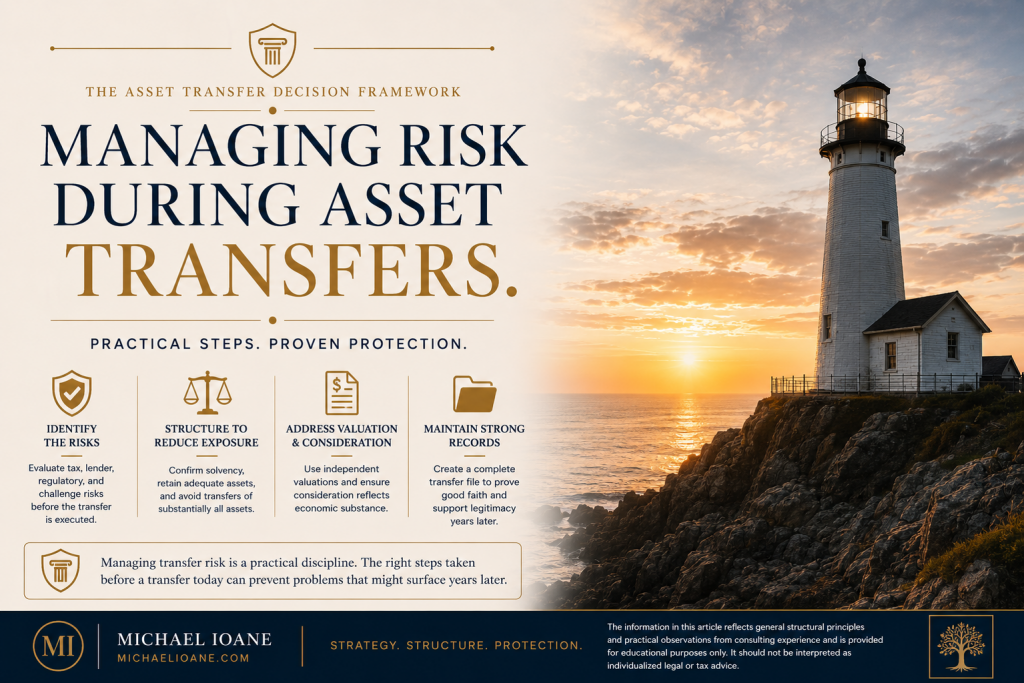
Every asset transfer within a protection structure carries risk that exists independently of whether the underlying plan is well-designed. Tax risk, valuation risk, challenge risk, and administrative risk each arise at the moment of transfer, and each can be substantially reduced through specific, practical steps taken before the transfer is executed, rather than addressed after the fact once a challenge or an audit has already begun.
Michael Ioane approaches transfer risk management as a checklist applied to every transfer individually, because the risks presented by moving a piece of real estate into an LLC are not the same as the risks presented by assigning a membership interest to a trust, and treating every transfer with the same generic precautions leaves some categories of risk unaddressed while over-engineering others.
Identifying the Specific Risks a Transfer Creates
Before executing any transfer, the specific risks it introduces should be identified individually: whether the transfer triggers a reassessment or transfer tax at the state or local level, whether it accelerates a due-on-sale clause in an existing mortgage, whether it constitutes a taxable gift requiring a gift tax return, and whether it creates or eliminates a basis step that affects future capital gains exposure. Each of these risks is manageable when identified in advance and becomes substantially harder to manage once the transfer has already occurred.
A due-on-sale risk in particular is frequently overlooked in transfer planning involving mortgaged real estate; while transfers to a revocable trust are generally protected under federal law, transfers to an LLC or an irrevocable trust do not carry the same statutory protection and can trigger a lender’s right to accelerate the loan, making lender notification or a Garn–St. Germain Depository Institutions Act of 1982 analysis a necessary step before the transfer, not after.
Structuring Transfers to Minimize Challenge Exposure
Practical risk management for challenge exposure starts with confirming solvency before the transfer, retaining adequate assets outside the transfer to meet then-known and reasonably anticipated obligations, and avoiding transfers that constitute substantially all of the transferor’s non-exempt assets. Retaining sufficient assets outside a transfer, even a modest reserve, materially changes how a subsequent examination characterizes the transferor’s intent, because a transferor who retained adequate means to meet obligations presents a fundamentally different picture than one who transferred everything of value.
Where a transfer is made to a related party, obtaining an independent valuation and documenting the basis for any consideration exchanged converts a potential vulnerability, the absence of arm’s-length pricing, into a documented, defensible position. The cost of a professional valuation at the time of transfer is minor relative to the risk it forecloses in a later challenge.
Valuation and Consideration Risk
Transfers involving less than full and adequate consideration are the most common basis for a constructive fraud challenge, and the risk is not limited to transfers with no consideration at all; a transfer for a below-market price, or a transfer where the consideration consists of a note that is unlikely to be enforced or collected, carries similar exposure. Practical risk management requires evaluating the substance of the consideration exchanged, not merely confirming that a number appears in a purchase agreement.
Where a transfer is structured as a sale rather than a gift specifically to avoid gift tax exposure, the consideration should reflect genuine economic substance, including realistic payment terms, an appropriate interest rate if the consideration is a note, and a demonstrated intent and ability to collect on that note, since a note that is never serviced functions, in substance, as a gift regardless of its label.
Recordkeeping as a Risk Management Tool
The most frequently underutilized practical risk management step is straightforward recordkeeping: maintaining a transfer file for every transaction that includes the executed instrument, supporting valuation or consideration documentation, a contemporaneous solvency assessment where relevant, and confirmation of any required regulatory or lender notifications. This file, assembled at the time of the transfer, is the primary tool available to demonstrate the transferor’s good faith and financial position years later, when memories have faded, and the original participants may no longer be available to testify to the circumstances.
Michael Ioane treats the transfer file as a standard deliverable of every transfer engagement, not an optional add-on, because the practical value of thorough recordkeeping is realized only when a transfer is challenged, and by then it is too late to reconstruct documentation that should have been created contemporaneously with the transaction itself.
Managing transfer risk is a practical discipline, not a legal abstraction. Confirming solvency, documenting valuation, addressing lender and tax consequences, and maintaining a contemporaneous transfer file are concrete steps that materially reduce exposure for every transfer within a protection structure.
The information in this article reflects general structural principles and practical observations from consulting experience and is provided for educational purposes only. It should not be interpreted as individualized legal or tax advice.
Michael Ioane | MichaelIoane.com
Continue Learning with Michael Ioane
Build your understanding of asset protection and business planning with the Asset Protection Manual . Explore taxation and private trust planning in Boston Tea Party . Both books are available on Amazon.