Michael Ioane
Article I
Authority Article
Legal Asset Transfer Strategies
Moving assets between owners, entities, or structures is one of the most legally sensitive actions a business owner or family can take, because a transfer that appears routine from a planning perspective can be reconstructed by a court or creditor as a deliberate attempt to place assets beyond reach. The legal validity of a transfer is not determined by the planner’s intent alone; it is determined by the objective circumstances surrounding the transfer, including the transferor’s solvency, the adequacy of consideration received, the relationship between the parties, and the timing relative to any known or reasonably anticipated claim.
Michael Ioane approaches asset transfer strategy as a discipline distinct from entity formation or trust design, because a properly structured holding entity or trust provides no protection if the transfer of funds it holds can be unwound as a fraudulent conveyance. Building the strategy around the legal standards that govern transfers, rather than around the mechanics of moving title from one name to another, is what separates a durable transfer from one that increases exposure rather than reducing it.
Distinguishing Legitimate Transfers from Fraudulent Conveyances
The Uniform Voidable Transactions Act and its predecessor, the Uniform Fraudulent Transfer Act, adopted in some form by nearly every state, give courts two independent theories for unwinding a transfer: actual fraud, where the transferor acted with intent to hinder, delay, or defraud a creditor, and constructive fraud, where the transferor received less than reasonably equivalent value while insolvent or rendered insolvent by the transfer. A legal transfer strategy has to satisfy both standards simultaneously, because a transfer that avoids one theory can still be unwound under the other.
Courts evaluating actual intent look to a recognized set of badges of fraud, including a transfer to an insider, retention of possession or control by the transferor, concealment of the transfer, transfer of substantially all of the transferor’s assets, and transfer shortly after a substantial debt was incurred. A transfer strategy built without reference to these factors, even one that is otherwise well-documented, remains vulnerable to a challenge built on the accumulation of several badges of fraud considered together.
Transfer Mechanisms for Entity-Held Assets
Assets held within an entity, including real property, business interests, and investment accounts titled to an LLC or corporation, are treated under a different mechanism than assets held individually. A capital contribution, a distribution, a membership interest assignment, and an entity-to-entity sale each carry distinct tax consequences and distinct evidentiary requirements, and selecting the wrong mechanism for a given transfer can create an unintended taxable event even when the transfer itself withstands a creditor challenge.
A membership interest assignment, properly documented under the operating agreement’s transfer provisions and reflected in updated capital accounts, is generally the most defensible mechanism for moving an ownership stake between related parties, because it preserves a clear chain of title that a subsequent examination can trace directly to the governing document. Transfers that bypass the entity’s governing provisions, even when the underlying business relationship is legitimate, create a documentation gap that a creditor’s counsel will quickly identify.
Documentation Standards That Support Transfer Validity
Every transfer within a protection structure should be supported by a written instrument that identifies the parties, the asset transferred, the consideration exchanged, and the effective date, and that is executed contemporaneously with the transfer rather than reconstructed afterward. Where consideration is exchanged, the transaction should be supported by a valuation or a documented basis for the price, particularly for transfers between related parties, where the absence of arm’s-length pricing is itself a factor courts consider in evaluating reasonably equivalent value.
Michael Ioane emphasizes that the strength of a transfer’s documentation is tested only when the transfer is challenged, often years after it occurred, which means the standard for adequate documentation must be set at the time of the transfer rather than adjusted retroactively once a dispute has already arisen. A transfer file that would satisfy a skeptical examiner reviewing the transaction cold, without the benefit of the parties’ explanation, is the appropriate benchmark.
Sequencing Transfers Within a Broader Structure
Where a protection plan involves multiple transfers, including funding a holding LLC, assigning membership interests to a trust, and retitling specific assets into the entity structure, the sequence in which these transfers occur affects the legal characterization of the plan. Transfers executed well before any claim exists, in a logical order that mirrors ordinary business and estate planning practice, are evaluated differently than the same transfers executed in rapid succession immediately after a triggering event.
A legal transfer strategy accounts for sequencing as a planning variable in its own right, treating the order and spacing of transfers as part of the overall design rather than as an administrative detail to be resolved after the structural decisions have already been made. Sequencing decisions made early, before any specific liability is on the horizon, carry substantially less legal risk than the same transfers attempted under pressure.
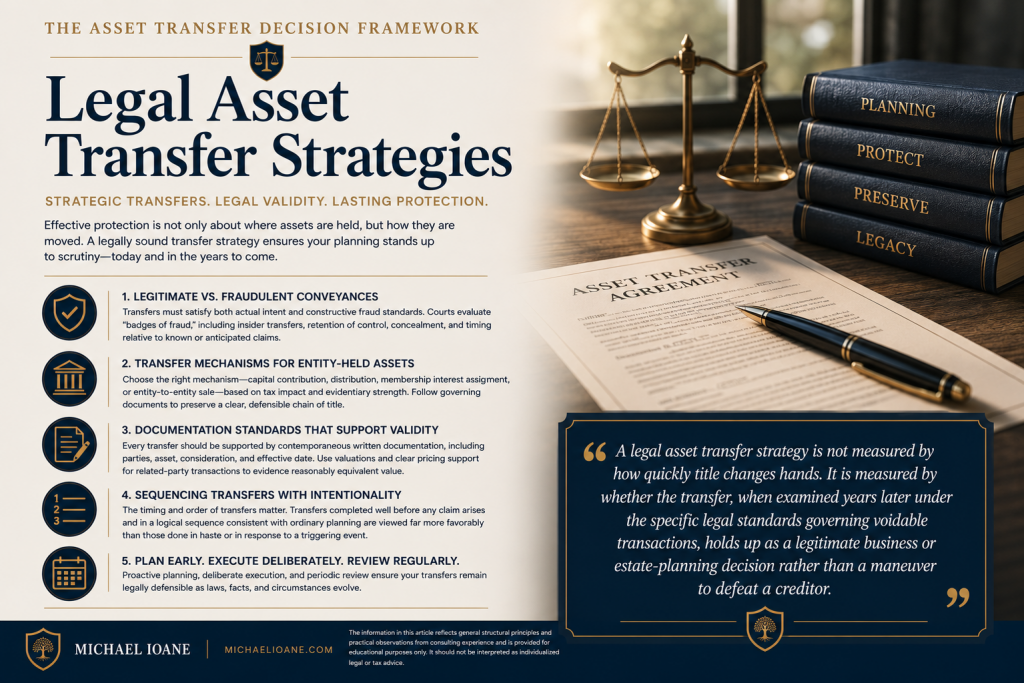
A legal asset transfer strategy is not measured by how quickly title changes hands. It is measured by whether the transfer, when examined years later under the specific legal standards governing voidable transactions, holds up as a legitimate business or estate-planning decision rather than a maneuver to defeat a creditor.
The information in this article reflects general structural principles and practical observations from consulting experience and is provided for educational purposes only. It should not be interpreted as individualized legal or tax advice.
Michael Ioane | MichaelIoane.com
Continue Learning with Michael Ioane
Build your understanding of asset protection and business planning with the Asset Protection Manual . Explore taxation and private trust planning in Boston Tea Party . Both books are available on Amazon.