Michael Ioane
Article I
Authority Article
Layered Entities in Asset Protection
Multi-entity structure design is the practice of organizing a business owner’s assets and activities across multiple legal entities arranged in deliberate relationships, rather than holding everything within a single entity or holding assets personally. The protection logic behind layered entity structures is straightforward: each additional genuine entity layer a creditor must overcome to reach a specific asset increases legal costs, procedural complexity, and the uncertainty of successful collection, while the owner bears only the administrative cost of maintaining the additional structure.
Michael Ioane designs layered entity structures for business owners whose asset value, risk profile, or planning objectives warrant the additional complexity, because the protection that genuine multiple layers provide substantially exceeds what any single entity, regardless of how well formed and maintained, can deliver on its own.
Why Single-Entity Structures Reach Their Limits
A single-entity structure, however well-designed, concentrates all of a business’s assets and activities within a single legal person. This concentration creates a single point of legal vulnerability: a successful veil-piercing claim, a successful fraudulent transfer challenge, or a judgment directly obtained against the entity exposes everything the entity holds. For businesses with modest asset value and uniform risk profiles, this concentration may be an acceptable trade-off for the administrative simplicity of a single entity.
As a business grows in asset value, expands into multiple categories of activity with different risk profiles, or as the owner’s personal exposure grows alongside the business, the single-entity structure’s concentration of risk becomes a more significant vulnerability. Asset protection design at this stage requires moving beyond the single-entity baseline to a layered approach that distributes assets and activities across multiple legal persons, each genuinely independent of the others.
The Foundational Two-Entity Layer
The most common and most widely applicable layered entity strategy is the separation of operating activities from asset holding through a two-entity structure: an operating entity that conducts the active business and bears the operational liability exposure, and a holding entity that owns the valuable assets and leases or licenses them to the operating entity under documented arm’s-length terms. A creditor of the operating entity must overcome the operating entity’s separate status, then overcome the holding entity’s separate status, before reaching the assets the holding entity protects.
This foundational layer is appropriate for any business with significant asset value, whether in real property, equipment, intellectual property, or accumulated cash reserves, that is currently concentrated within a single operating entity alongside the operational liability exposure that entity generates. Implementing this separation is often the highest-value structural improvement available to a business owner whose current structure is a single entity that holds both operational risk and significant asset value.
Adding Activity-Specific Entities
For businesses that conduct multiple distinct categories of activity with materially different risk profiles, a layered entity strategy extends to activity-specific entities dedicated to each category. A business that provides both a high-liability professional service and a lower-risk product line benefits from separating these into distinct operating entities, so that a claim arising from the high-liability activity does not reach the assets or expose the lower-risk line.
The decision to add activity-specific entities should reflect a genuine difference in risk profile between the activities being separated, not merely an administrative preference for separation. Activities with similar risk profiles may not warrant the additional complexity of separate entities; activities with materially different risk profiles, particularly where one carries significantly elevated liability exposure, present a clear case for activity-specific entity separation.
Adding a Trust Layer Above the Entity Structure
The most comprehensive layered entity structures add a trust layer above the entity layers, with a trust holding the ownership interests in the holding entity or in multiple entities within the structure. This trust layer adds protection for the ownership interests themselves: a personal creditor of the owner must overcome the trust’s independent legal status before reaching the membership interests and, through those interests, the underlying entity’s assets.
Michael Ioane designs this comprehensive layering for business owners whose risk profile, asset value, and planning objectives justify the full multi-layer investment: typically, business owners with substantial accumulated wealth, elevated personal liability exposure independent of the business, or specific estate planning objectives that the trust layer simultaneously serves. The decision to extend the layering to include a trust component should reflect a deliberate evaluation of whether the additional protection justifies the additional administrative complexity for the specific owner’s circumstances.
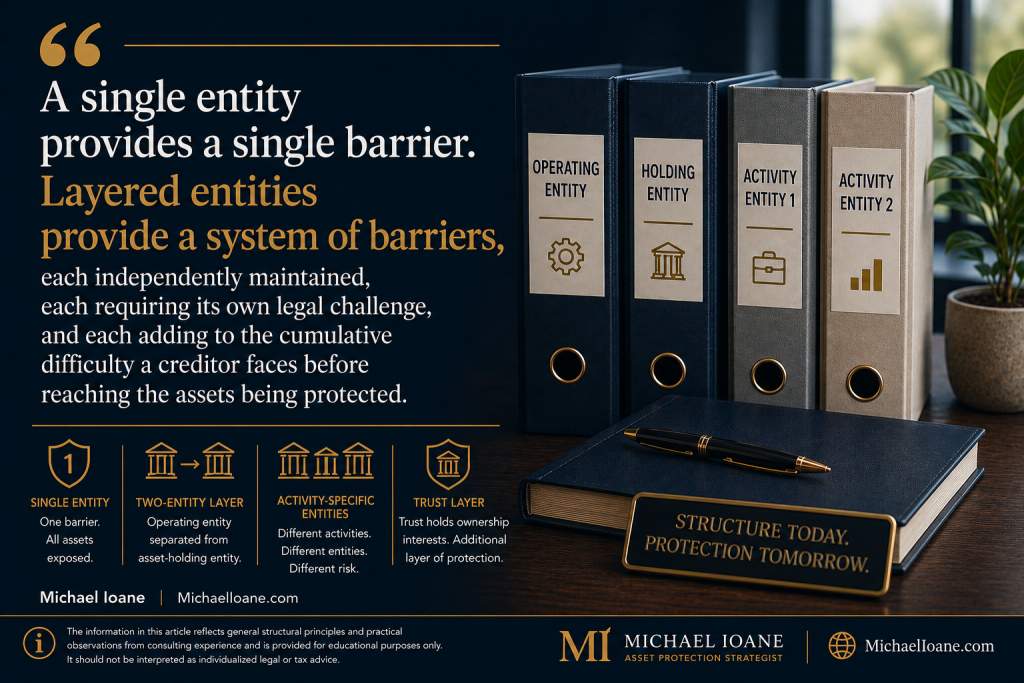
A single entity provides a single barrier. Layered entities provide a system of barriers, each independently maintained, each requiring its own legal challenge, and each adding to the cumulative difficulty a creditor faces before reaching the assets being protected.
The information in this article reflects general structural principles and practical observations from consulting experience and is provided for educational purposes only. It should not be interpreted as individualized legal or tax advice.
Michael Ioane | MichaelIoane.com
Continue Learning with Michael Ioane
Build your understanding of asset protection and business planning with the Asset Protection Manual . Explore taxation and private trust planning in Boston Tea Party . Both books are available on Amazon.