Michael Ioane
Article II
Deep Topic Article
Reactive vs Proactive Asset Protection
Proactive asset protection and reactive asset protection are not different versions of the same activity. They are categorically different approaches that produce categorically different legal outcomes. Proactive asset protection, implemented before any creditor claim arises, creates structures that courts and creditors must accept as legitimate planning. Reactive asset protection, implemented in response to a known or imminent claim, creates structures that courts and creditors are legally empowered to dismantle.
Michael Ioane treats the proactive versus reactive distinction as the most important conceptual boundary in asset protection analysis, because clients who do not understand this boundary regularly make planning decisions that expose them to greater risk than the risk they are attempting to address.
The Legal Architecture of Proactive Planning
Proactive asset protection operates within the legal framework that governs voluntary structural planning in the absence of creditor claims. An owner who has no existing creditors, no pending litigation, and no specific known liability has the broadest available freedom to structure ownership of assets in ways that minimize future creditor exposure. Transfers made in this environment are evaluated under the standard fraudulent transfer analysis, which requires an existing or future creditor to establish that the transfer was made with actual intent to defraud or was constructively fraudulent.
In the absence of any specific creditor relationship, the fraudulent transfer analysis has nothing to connect to. A transfer made to a legitimate entity or trust, for a legitimate planning purpose, documented with contemporaneous records establishing the business rationale, is extremely difficult to challenge on fraudulent transfer grounds when no creditor existed at the time. This is the environment in which proactive planning operates, and it is the environment in which the most effective protective structures can be implemented.
The Legal Architecture of Reactive Planning
Reactive asset protection operates in the legally hostile environment created by the existence of a creditor claim. Once a creditor’s claim has arisen, whether by the filing of a lawsuit, the service of a demand letter, or the occurrence of an event that will predictably give rise to a claim, any subsequent transfer of assets is evaluated under a presumption of fraudulent intent. The creditor does not need to prove that the owner intended to defraud them; the timing of the transfer relative to the creditor’s claim creates a circumstantial case that courts find persuasive.
Reactive planning also triggers the badges of fraud analysis that courts use to identify fraudulent transfers. Transfers made to insiders, transfers of substantially all assets, transfers made in exchange for inadequate consideration, and transfers made while the transferor is facing financial difficulty are all badges of fraud that courts use to infer fraudulent intent. In a reactive planning scenario, several of these badges will typically be present simultaneously, making the fraudulent transfer analysis particularly unfavorable.
Risk Prevention Through Early Implementation
Risk prevention through proactive planning requires identifying and addressing exposure risks before they materialize into specific creditor claims. The business owner who recognizes that their industry carries significant liability exposure can implement entity structures before the liability events occur. The professional who knows that their practice creates ongoing malpractice risk can implement protective arrangements before any specific claim arises. The investor acquiring assets that will be managed by others can structure ownership defensively before the management relationship creates liability.
Each of these scenarios represents an opportunity for proactive planning that will not be available once the liability materializes. The window for proactive planning is always open before the risk event occurs and closes at the moment a specific creditor claim arises. The discipline of proactive planning is recognizing which windows are currently open and implementing protective structures while those windows remain available.
What Reactive Planning Can and Cannot Accomplish
Reactive planning is not entirely without value. Some protective measures remain available even after a creditor claim has arisen, including the maximization of statutory exemptions, which do not carry timing vulnerability in the same way that structural arrangements do. A debtor who has not been maximizing contributions to exempt retirement accounts can increase those contributions even after a creditor claim has arisen, subject to applicable limits, without creating fraudulent transfer exposure.
However, the structural arrangements that provide the most robust protection, including entity structures, trust structures, and ownership transfers to protective arrangements, are substantially impaired in their availability and effectiveness once a creditor claim has arisen. A debtor who attempts to implement these arrangements after a creditor claim has arisen will find that the arrangements are subject to fraudulent transfer challenge and may be voided, leaving the debtor in a worse position than if no transfer had been made.
Converting Reactive Thinking to Proactive Planning
The most common obstacle to proactive planning is the human tendency to address risks only after they have materialized. Business owners who have operated without significant creditor problems often defer protective planning until a specific risk appears, at which point the most effective planning tools are no longer fully available. Converting reactive thinking to proactive planning requires a change in planning orientation: from responding to present risk to anticipating future risk.
Michael Ioane addresses this conversion by anchoring planning discussions with the owner’s exposure profile rather than to any specific creditor or claim. The relevant question is not whether a creditor exists today but whether the owner’s activities, assets, and relationships create the conditions under which a creditor could exist in the future. Planning conducted with reference to future exposure rather than present claims operates in the proactive environment where the most effective structures can be implemented.
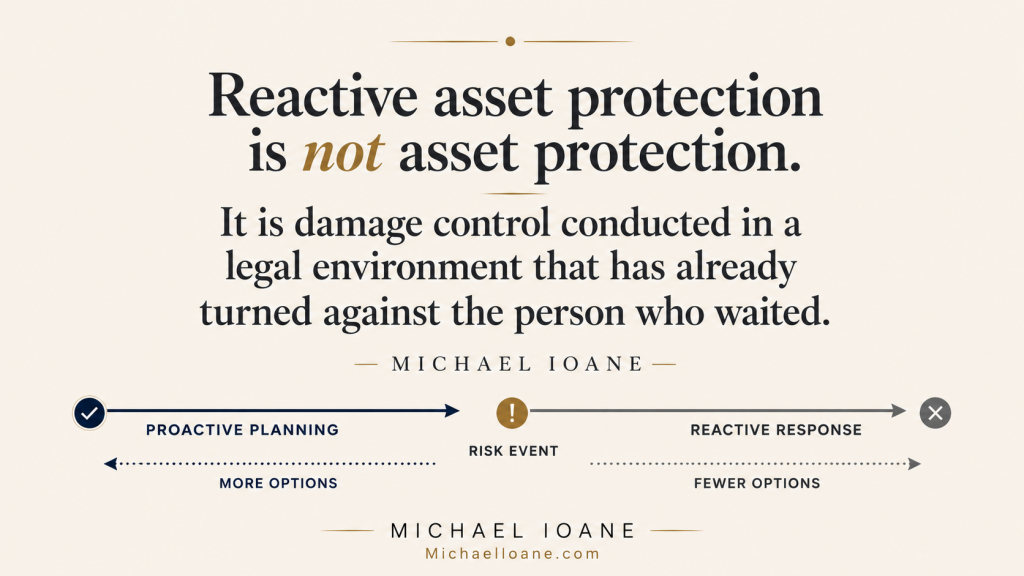
Reactive asset protection is not asset protection. It is damage control conducted in a legal environment that has already turned against the person who waited.
The information in this article reflects general structural principles and practical observations from consulting experience and is provided for educational purposes only. It should not be interpreted as individualized legal or tax advice.
Michael Ioane | MichaelIoane.com
Continue Learning with Michael Ioane
Build your understanding of asset protection and business planning with the Asset Protection Manual . Explore taxation and private trust planning in Boston Tea Party . Both books are available on Amazon.