Michael Ioane
Article IV
Summary Guide Article
Guide: Creditor Protection Strategies
This guide provides a practical reference for designing and maintaining creditor protection strategies across the full range of creditor collection mechanisms. The frameworks here reflect Michael Ioane’s approach to structural shields, defense mechanisms, and governance maintenance as integrated components of a comprehensive creditor protection system.
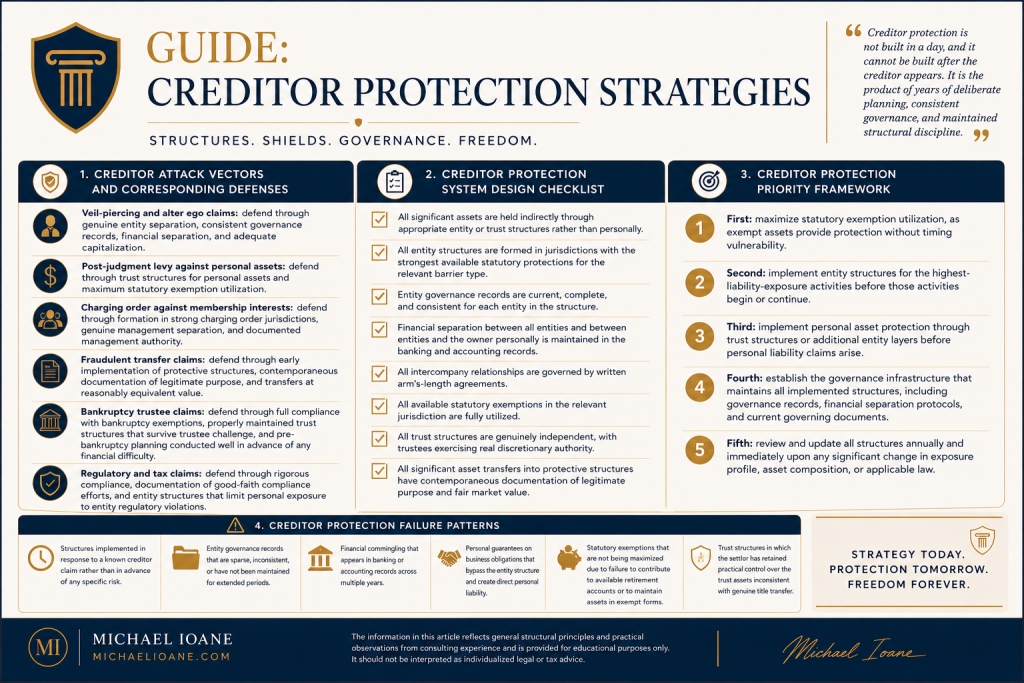
Creditor Attack Vectors and Corresponding Defenses Design the creditor protection system to address each of the following attack vectors:
- Veil-piercing and alter ego claims: defend through genuine entity separation, consistent governance records, financial separation, and adequate capitalization
- Post-judgment levy against personal assets: defend through trust structures for personal assets and maximum statutory exemption utilization
- Charging order against membership interests: defend through formation in strong charging order jurisdictions, genuine management separation, and documented management authority
- Fraudulent transfer claims: defend through early implementation of protective structures, contemporaneous documentation of legitimate purpose, and transfers at reasonably equivalent value
- Bankruptcy trustee claims: defend through full compliance with bankruptcy exemptions, properly maintained trust structures that survive trustee challenge, and pre-bankruptcy planning conducted well in advance of any financial difficulty
- Regulatory and tax claims: defend through rigorous compliance, documentation of good-faith compliance efforts, and entity structures that limit personal exposure to entity regulatory violations
Creditor Protection System Design Checklist
Confirm the following elements of the creditor protection system are in place and properly maintained:
- All significant assets are held indirectly through appropriate entity or trust structures rather than personally
- All entity structures are formed in jurisdictions with the strongest available statutory protections for the relevant barrier type
- Entity governance records are current, complete, and consistent for each entity in the structure
- Financial separation between all entities and between entities and the owner personally is maintained in the banking and accounting records
- All intercompany relationships are governed by written arm’s-length agreements • All available statutory exemptions in the relevant jurisdiction are fully utilized • All trust structures are genuinely independent, with trustees exercising real discretionary authority
- All significant asset transfers into protective structures have contemporaneous documentation of legitimate purpose and fair market value
Creditor Protection Priority Framework
Prioritize creditor protection planning investments in the following sequence:
- First: maximize statutory exemption utilization, as exempt assets provide protection without timing vulnerability
- Second: implement entity structures for the highest-liability-exposure activities before those activities begin or continue
- Third: implement personal asset protection through trust structures or additional entity layers before personal liability claims arise
- Fourth: establish the governance infrastructure that maintains all implemented structures, including governance records, financial separation protocols, and current governing documents
- Fifth: review and update all structures annually and immediately upon any significant change in exposure profile, asset composition, or applicable law
Creditor Protection Failure Patterns
Address the following failure patterns before they are identified by a creditor:
- Structures implemented in response to a known creditor claim rather than in advance of any specific risk
- Entity governance records that are sparse, inconsistent, or have not been maintained for extended periods
- Financial commingling that appears in banking or accounting records across multiple years • Personal guarantees on business obligations that bypass the entity structure and create direct personal liability
- Statutory exemptions that are not being maximized due to failure to contribute to available retirement accounts or to maintain assets in exempt forms
- Trust structures in which the settlor has retained practical control over the trust assets inconsistent with genuine title transfer
Creditor protection is not built in a day, and it cannot be built after the creditor appears. It is the product of years of deliberate planning, consistent governance, and maintained structural discipline.
The information in this article reflects general structural principles and practical observations from consulting experience and is provided for educational purposes only. It should not be interpreted as individualized legal or tax advice.
Michael Ioane | MichaelIoane.com
Continue Learning with Michael Ioane
Build your understanding of asset protection and business planning with the Asset Protection Manual . Explore taxation and private trust planning in Boston Tea Party . Both books are available on Amazon.