Michael Ioane
Article III
Practical Article
Structural Barriers to Liability
Liability protection structure creates the legal barriers that stand between a creditor’s judgment and the assets that judgment seeks to reach. These barriers operate through the specific legal mechanisms of entity law, trust law, and statutory exemption, and their effectiveness depends on how well those mechanisms have been designed, implemented, and maintained. Understanding what each barrier is, how it works, and what is required to maintain it is the foundation of designing a structural barrier system that performs under pressure.
Michael Ioane designs structural barriers as components of an integrated protection system, because a barrier that stands alone without the supporting structures and governance practices that maintain it will not perform when tested. The barrier system is only as strong as its weakest component, and identifying and addressing the weak components is the work of structural barrier maintenance.
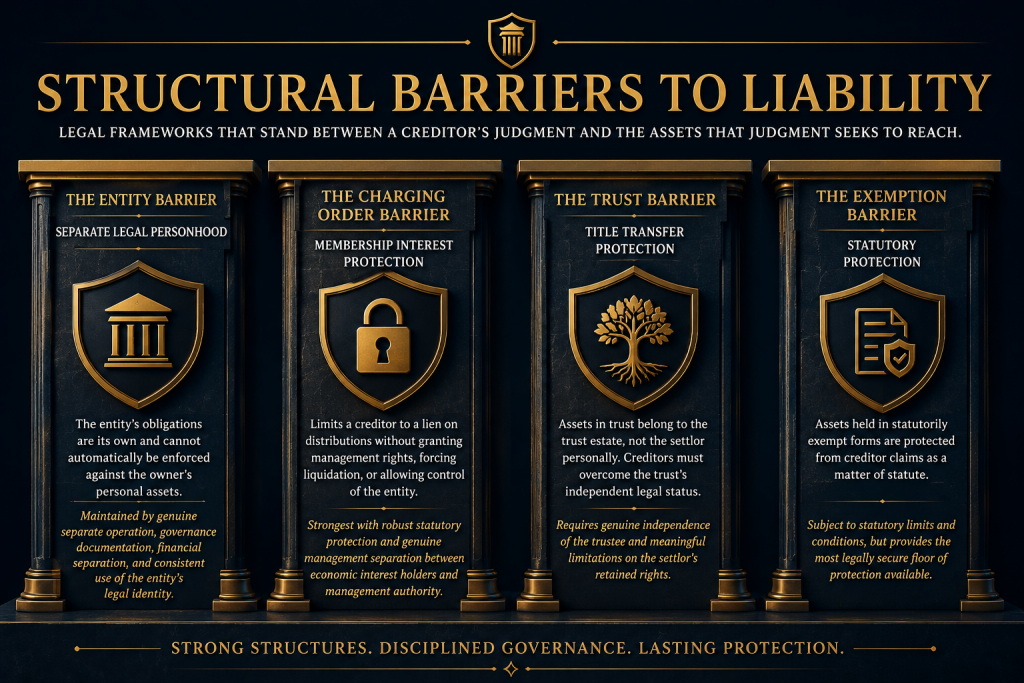
The Entity Barrier: Separate Legal Personhood
The entity barrier is created by the separate legal personhood of the business entity: the principle that the entity’s obligations are its own and cannot automatically be enforced against the entity’s owners. A judgment against the entity is a judgment against the entity; the creditor must take additional legal steps, including establishing a claim against the owner personally or pursuing a veil-piercing theory, to reach the owner’s assets.
The entity barrier is breached when the entity is not treated as a genuine separate legal person. The legal standard for determining whether a veil-piercing claim should succeed varies by jurisdiction, but the core inquiry is consistent: was the entity operated as a genuine separate enterprise, or was it merely a shell that the owner used as an extension of their personal affairs? The entity barrier is maintained by the governance practices that demonstrate genuine separate operation: documented decision-making, financial separation, adequate capitalization, and consistent use of the entity’s legal name in all business dealings.
The Charging Order Barrier: Membership Interest Protection
The charging order barrier is specific to LLC membership interests and, in some jurisdictions, limited partnership interests. It operates by limiting a personal creditor of a member to a lien on the member’s right to receive distributions, without giving the creditor the right to take over management, force a liquidation, or otherwise act as a substitute member. In jurisdictions where the charging order is the exclusive remedy for personal creditors, this barrier can make an LLC membership interest effectively unreachable as a practical collection mechanism.
The charging order barrier is strongest in jurisdictions with strong statutory charging order protection and in entities with genuine management separation between the economic interest holders and the management authority. An LLC where the member and the sole manager are the same individual, with no documented management structure or decision-making process, presents a weaker charging order barrier than one where a corporate manager holds documented management authority independent of the membership interest holders.
The Trust Barrier: Title Transfer Protection
The trust barrier operates through the transfer of legal title from the owner to the trustee. Assets held in trust belong to the trust estate, not to the settlor personally, and a creditor of the settlor must overcome the trust’s independent legal status to reach those assets. The strength of the trust barrier depends on the trust being genuinely independent, on the trust having been established before the creditor relationship that is being addressed, and on the applicable trust law providing the specific protection the structure relies upon.
The trust barrier is breached when the settlor retains practical control over the trust assets in ways that courts treat as inconsistent with genuine title transfer. A trust whose settlor can revoke it at will, direct the trustee’s investment and distribution decisions, or benefit from it without meaningful restriction is a trust whose barrier against the settlor’s creditors is minimal. The trust barrier requires genuine independence of the trustee and genuine limitations on the settlor’s retained rights.
The Exemption Barrier: Statutory Protection
The statutory exemption barrier is the most legally secure of the structural barriers because it does not depend on the timing of the protective arrangement or on the governance discipline required to maintain entity or trust separation. Assets held in statutorily exempt forms, including qualified retirement accounts, homestead equity within applicable limits, and life insurance and annuity products in states with robust exemption provisions, are protected from creditor claims as a matter of statute.
The exemption barrier is subject to its own limitations: the exemption amounts are limited, the categories of protected assets are defined by statute and may not include all asset categories the owner holds, and the specific conditions for exemption eligibility vary by jurisdiction. The exemption barrier is most valuable as a floor of protection that remains available even when other structural barriers are challenged or limited, and its maximization is a baseline priority in any structural barrier system.
Structural barriers to liability are not walls. They are legal frameworks that require creditors to satisfy specific legal conditions before they can reach the assets on the other side, and they are only as strong as the governance practices that support them.
The information in this article reflects general structural principles and practical observations from consulting experience and is provided for educational purposes only. It should not be interpreted as individualized legal or tax advice.
Michael Ioane | MichaelIoane.com
Continue Learning with Michael Ioane
Build your understanding of asset protection and business planning with the Asset Protection Manual . Explore taxation and private trust planning in Boston Tea Party . Both books are available on Amazon.