Michael Ioane
Article III
Practical Article
Structural Benefits of Ownership Design
The ownership structure benefits of a well-designed asset-holding arrangement extend beyond creditor protection to include operational efficiency, tax planning, estate planning, and business succession. An ownership structure designed with all of these objectives in mind from the outset delivers value across multiple dimensions that a structure designed solely for protection cannot replicate. Understanding and designing for the full range of structural benefits yields the most durable and valuable asset-holding arrangements.
Michael Ioane approaches ownership design as an integrated planning discipline that accounts for all relevant objectives simultaneously, because the decisions made in the design stage determine whether the structure delivers its full potential value over its intended lifespan.
Protection Benefits of Ownership Design
The protection benefits of deliberate ownership design are the most commonly understood. An ownership structure that places operational assets within properly maintained entities, that separates liability-generating activities from valuable asset holdings, and that uses available statutory exemptions to the fullest extent provides a comprehensive layer of creditor protection that directly held assets cannot match. The asset protection benefits of the structure are realized through the legal mechanisms described throughout this cluster: entity separate legal personhood, charging order limitations on membership interests, trust law separation of title from beneficial ownership, and statutory exemption protection for qualifying asset categories.
The protection benefits of ownership design are most fully realized when the structure is designed comprehensively rather than addressing one exposure category at a time. A structure that protects business assets from business creditors but leaves personal assets exposed to personal creditors provides incomplete protection for a business owner whose personal and business risk profiles are both significant. A comprehensive ownership design addresses both categories and ensures that neither creates a path to the assets protected by the other.
Tax Planning Benefits of Ownership Design
The ownership structure design has significant tax-planning implications that, when properly accounted for, can provide substantial additional value beyond the protection benefits alone. The choice of entity type determines how the entity’s income is taxed: a single-member LLC or a grantor trust is typically a disregarded entity for income tax purposes, while a partnership or S corporation may provide pass-through taxation with additional planning flexibility, and a C corporation may provide specific tax planning opportunities in certain contexts.
The design of the ownership structure also affects the estate tax treatment of the assets held within it. An LLC membership interest that includes valuation discounts for lack of marketability and lack of control may be valued at a discount to the underlying asset value for estate tax purposes, thereby reducing the owner’s taxable estate while the full economic value remains within the family. These valuation discount strategies require careful design and consistent operational support, including genuine restrictions on transferability and genuine management separation, to withstand IRS scrutiny.
Estate Planning Benefits of Ownership Design
Ownership design that incorporates estate planning objectives allows assets to pass to the next generation efficiently, with minimal estate tax exposure and with the governance protections that prevent assets from being dissipated or mismanaged after transfer. A structure that holds family assets within a trust or a family limited partnership can provide for the gradual transfer of economic interests to the next generation while maintaining the current generation’s management control, creating a transfer that serves both the estate planning objective of reducing the taxable estate and the operational objective of maintaining governance continuity during the transition.
The estate-planning benefits of ownership design are most valuable when incorporated into the structure’s design from the outset, rather than retrofitted into an existing structure designed only for protection. An ownership structure that serves both protection and estate planning objectives requires governance documents that explicitly address both dimensions and may require more sophisticated design work than a structure serving only one objective. However, the combined value delivered justifies the additional design investment.
Succession Planning Benefits of Ownership Design
Ownership structures that include explicit succession provisions facilitate the transfer of management control and economic interests at the appropriate time, without the governance vacuums and legal complications that unplanned successions create. A business owner who holds business interests through an entity structure with well-defined succession provisions for the managing role, clear documentation of how the membership interests should be transferred at death, and governance records that provide a successor manager with a complete picture of the business’s legal and operational history is building a succession asset as well as a protection asset.
Michael Ioane designs ownership structures with succession planning as a standing design requirement, because the structure that is not designed for succession is not a complete structure. The operational discipline that maintains the structure’s protection value over its lifespan is the same discipline that ensures a successor can take over effectively: current governing documents, consistent governance records, and documented processes that do not depend on any single individual’s personal knowledge of how the structure works.
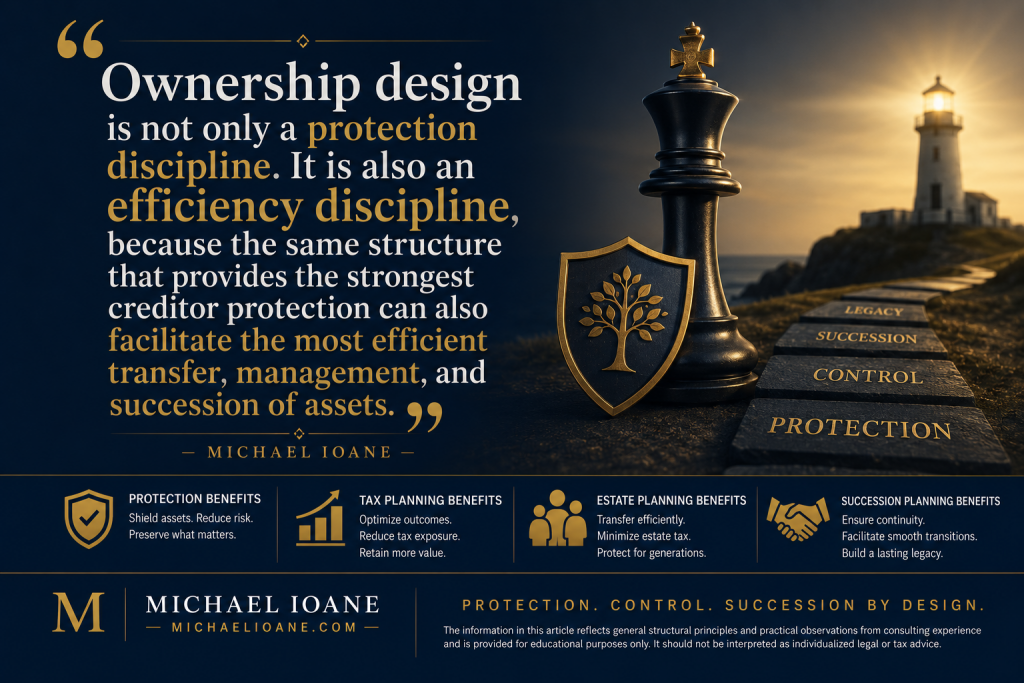
Ownership design is not only a protection discipline. It is also an efficiency discipline, because the same structure that provides the strongest creditor protection can also facilitate the most efficient transfer, management, and succession of assets.
The information in this article reflects general structural principles and practical observations from consulting experience and is provided for educational purposes only. It should not be interpreted as individualized legal or tax advice.
Michael Ioane | MichaelIoane.com
Continue Learning with Michael Ioane
Build your understanding of asset protection and business planning with the Asset Protection Manual . Explore taxation and private trust planning in Boston Tea Party . Both books are available on Amazon.