Michael Ioane
Article II
Deep Topic Article
Layering Ownership for Protection
Ownership layering is the practice of designing an asset ownership structure that establishes one or more intermediate legal levels between the ultimate owner and the assets being protected. Rather than holding an asset directly or through a single entity, an ownership layering strategy creates a chain of ownership in which the asset is owned by an entity, that entity is owned by another entity or trust, and the ultimate ownership interest is held in a form that is difficult for creditors to reach or to convert to cash.
Michael Ioane designs ownership layering strategies for clients whose risk profile warrants the additional complexity, because the protection that multiple genuine layers provide substantially exceeds what any single layer of indirect ownership can deliver. The additional cost and administrative complexity of a layered structure are justified when the potential claims it must withstand are large enough to warrant the investment.
The Basic Two-Layer Structure
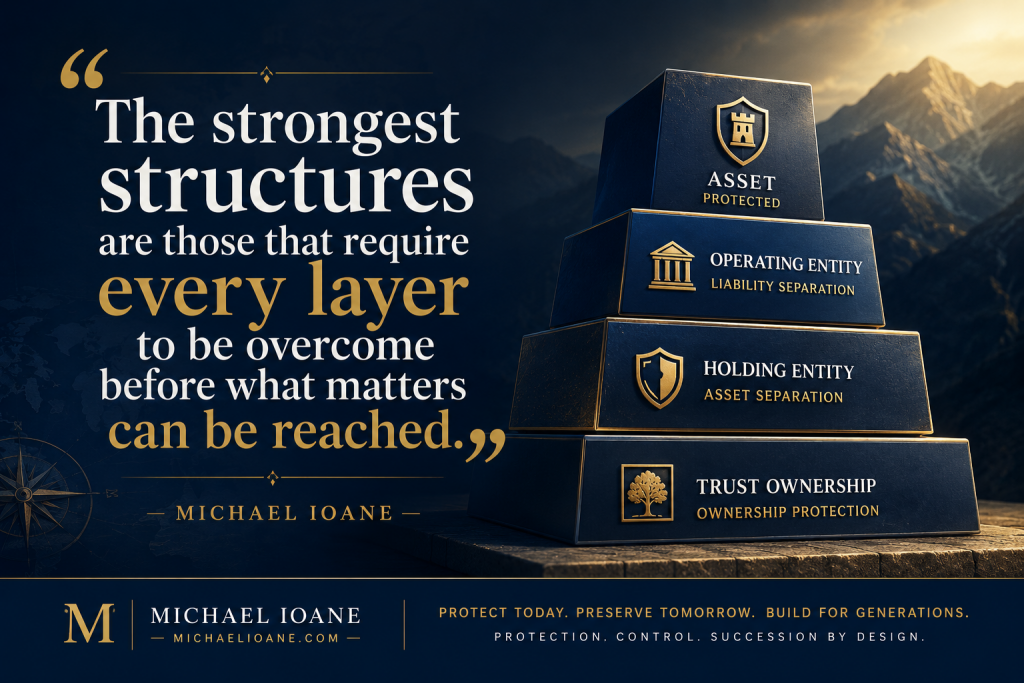
The most common ownership layering structure for business assets is the two-layer holding-and-operating arrangement: an operating entity that conducts the active business and bears operational liability exposure, owned by a holding entity that holds the valuable assets and provides one layer of separation between those assets and the operating entity’s creditors. A creditor of the operating entity must overcome the separation between the operating entity and the holding entity before reaching the assets held by the holding entity.
The asset layering strategy built on a two-layer structure is effective when both entities are properly formed, adequately capitalized, and operated with genuine independence from each other. The holding entity must not be the mere puppet of the operating entity’s owner; it must have its own governance structure, financial records, and documented decision-making process. The intercompany relationship between the operating entity and the holding entity must be governed by written agreements at arm’s-length terms. The layer of protection the holding entity provides is real only if the separation between the two entities is real.
Adding a Trust Layer
Adding a trust layer above the holding entity creates a third level of separation, providing additional protection for the ownership interests themselves. When a trust holds the membership interests in the holding entity, a creditor of the individual who established the trust must overcome both the charging order limitations on the membership interest and the trust’s independent legal status before reaching the holding entity’s assets. In jurisdictions with strong asset-protection trust statutes, the trust layer may render the ownership interest effectively unreachable by the individual’s personal creditors.
The trust layer provides the most protection when it is genuinely independent: when a professional or institutional trustee holds the membership interests and exercises real discretionary authority over how those interests are managed, and when the individual who established the trust lacks the practical ability to direct the trustee’s decisions. A trust layer that is nominally independent but, in practice, is directed by the individual provides minimal additional protection compared to a direct holding of the membership interests.
Geographic Layering Across Jurisdictions
For business owners with substantial assets and elevated risk profiles, ownership layering may span jurisdictions, placing different layers of the structure in states or countries that offer the most favorable legal environments for each layer. An operating entity formed in the state where the business primarily operates, a holding entity formed in a state with the strongest charging order protection, and a trust administered in a state with a strong domestic asset protection trust statute is an example of a geographically layered structure that takes advantage of the strongest available legal framework at each level.
Geographic layering requires careful attention to choice-of-law principles, because the legal framework governing each component of the structure is determined not only by where the entity was formed but also by where its principal activities are conducted, where its assets are located, and where the owner is domiciled. Asset ownership planning that relies on geographic layering must be designed with an understanding of how courts in the relevant jurisdictions will characterize the applicable law, and must be maintained with the governance discipline that justifies the choice-of-law designations in the governing documents.
Maintaining Genuine Separation Across Layers
The protection value of an ownership layering structure depends entirely on the genuine separation between each layer rather than nominal ones. A court examining a multi-layer structure will not honor the protections that structure provides if the layers are not operated as genuinely independent legal persons: if the owner controls all layers informally despite their formal structure, if the financial records do not clearly reflect the separate financial position of each layer, or if the governing documents do not accurately describe how authority is actually exercised at each level.
Michael Ioane addresses genuine layer separation as the central operational requirement of any layered ownership structure, because the theoretical protection provided by multiple layers is realized only through the consistent maintenance of genuine independence at each level. The layered structure, correctly designed but inconsistently implemented, creates administrative complexity without the protection those layers are supposed to provide.
Ownership layering is the structural practice of placing assets within multiple levels of legal separation, so that each layer must be overcome independently before the asset itself can be reached.
The information in this article reflects general structural principles and practical observations from consulting experience and is provided for educational purposes only. It should not be interpreted as individualized legal or tax advice.
Michael Ioane | MichaelIoane.com
Continue Learning with Michael Ioane
Build your understanding of asset protection and business planning with the Asset Protection Manual . Explore taxation and private trust planning in Boston Tea Party . Both books are available on Amazon.