Michael Ioane
Article I
Authority Article
Direct vs Indirect Ownership
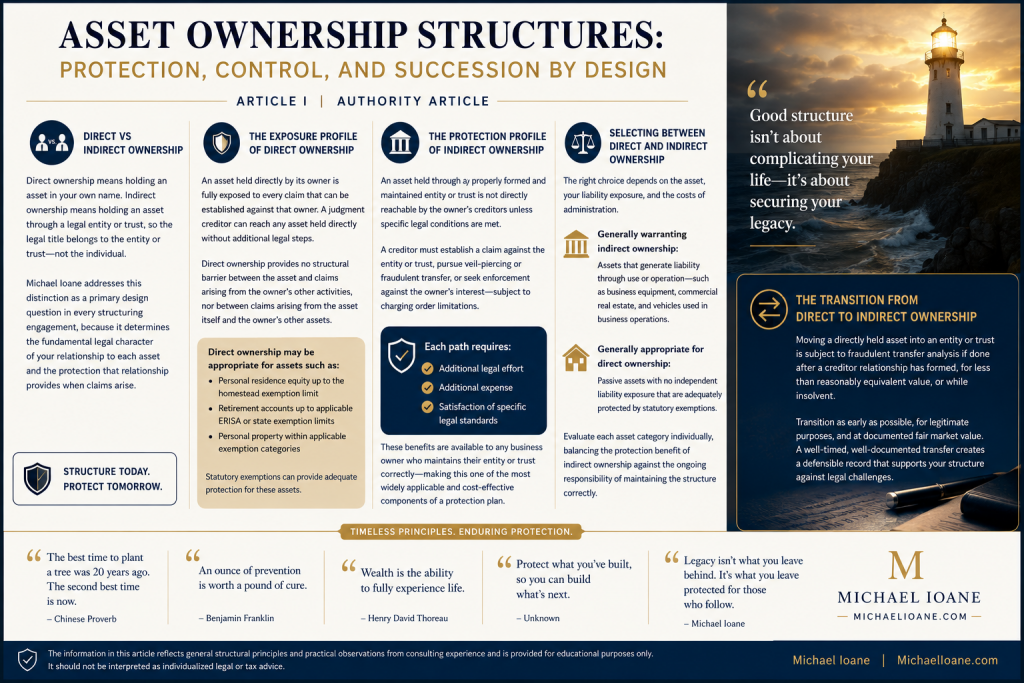
Direct vs. indirect ownership is a foundational distinction in asset protection and business structuring that determines how exposed each asset category is to creditor claims and how efficiently those assets can be transferred, managed, and protected over time. Direct ownership means holding an asset personally, in the owner’s own name, without any intervening legal structure. Indirect ownership means holding an asset through a legal entity or trust, so that the legal title to the asset belongs to the entity or trust rather than to the individual owner.
Michael Ioane addresses this distinction as a primary design question in every structuring engagement, because the choice between direct and indirect ownership is not merely an administrative preference; it determines the fundamental legal character of the owner’s relationship to the asset and the protection that relationship provides when legal claims arise.
The Exposure Profile of Direct Ownership
An asset held directly by its owner is fully exposed to every claim that can be established against that owner. A judgment creditor who obtains a personal judgment against the owner can reach any asset held directly, without the need for any additional legal theory or additional legal proceedings. Direct ownership provides no structural barrier between the asset and claims arising from the owner’s other activities, nor between claims arising from the asset itself and the owner’s other assets.
For many asset categories, direct ownership is appropriate and provides adequate protection when combined with other elements of a comprehensive protection plan. Personal residence equity up to the applicable homestead exemption limit, retirement account assets up to the applicable ERISA or state exemption limit, and personal property within applicable exemption categories are examples of assets that may be held directly with adequate statutory protection. The asset structure for these categories does not require indirect ownership, as the statutory exemption provides the necessary protection regardless of the asset’s title.
The Protection Profile of Indirect Ownership
An asset held indirectly through a properly formed and maintained legal entity or trust is not directly reachable by the owner’s creditors unless the owner satisfies specific legal conditions. A creditor of the owner must establish a claim against the entity or trust, pursue a veil-piercing or fraudulent transfer theory to reach the entity’s assets through a personal claim against the owner, or pursue enforcement against the owner’s interest in the entity, subject to applicable charging order limitations.
Each of these paths requires additional legal effort, additional expense, and the satisfaction of specific legal standards that a well-maintained structure can resist. Ownership structure benefits at this basic level of indirect holding are available to any business owner who holds assets through a properly formed and maintained entity or trust, and represent the most widely applicable and most cost-effective component of a comprehensive protection plan.
Selecting Between Direct and Indirect Ownership
The selection between direct and indirect ownership for each asset category should reflect the specific protection needs, the nature of the asset, and the administrative requirements of the indirect holding arrangement. Assets that generate active liability exposure through their use or operation, such as business equipment, commercial real property, and vehicles used in business operations, generally warrant indirect ownership through an entity structure that separates the liability arising from the asset’s operation from the owner’s personal assets and from other assets in the portfolio.
Assets that are purely passive, that do not generate independent liability exposure, and that are adequately protected through statutory exemptions may not require the additional complexity of indirect ownership. The decision should be made on a case-by-case basis for each significant asset category, weighing the protection benefit of indirect ownership against the administrative cost of maintaining the indirect holding structure correctly over time.
The Transition from Direct to Indirect Ownership
When an asset is currently held directly and needs to be moved to an indirect holding structure, the transition itself is subject to fraudulent transfer analysis. A transfer of a directly held asset into an entity or trust is subject to challenge if it occurs after a creditor relationship has formed, is made for less than reasonably equivalent value, or the transferor was insolvent at the time of the transfer. The timing of the transition is therefore as important as the design of the indirect holding structure.
Michael Ioane addresses transition planning as a component of the broader timing analysis that applies to every structural implementation. An asset that should be moved to indirect ownership should be moved as early as possible, before any specific creditor relationship has formed that could give rise to a fraudulent transfer challenge. The transition executed at the appropriate time, for documented, legitimate purposes, and at documented fair market value creates a defensible evidentiary record that supports the indirect holding structure against the full range of potential legal challenges.
Direct ownership is the simplest arrangement and the most exposed. Indirect ownership through appropriate structures provides the legal separation that direct ownership cannot.
The information in this article reflects general structural principles and practical observations from consulting experience and is provided for educational purposes only. It should not be interpreted as individualized legal or tax advice.
Michael Ioane | MichaelIoane.com
Continue Learning with Michael Ioane
Build your understanding of asset protection and business planning with the Asset Protection Manual . Explore taxation and private trust planning in Boston Tea Party . Both books are available on Amazon.