Michael Ioane
Article I
Authority Article
How Lawsuits Develop
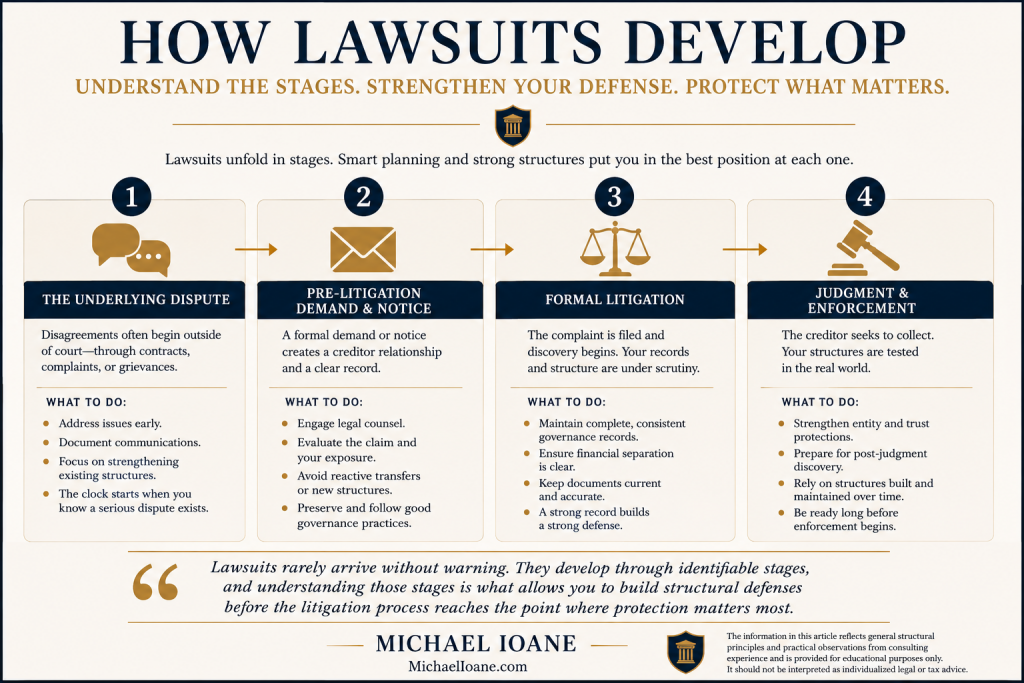
Understanding how lawsuits develop is foundational to effective litigation risk management and structural defense planning. Most business owners think of a lawsuit as a discrete event: a complaint is filed, litigation proceeds, and a judgment is entered. In practice, the litigation process is a sequence of identifiable stages, each presenting different risks and opportunities for structural preparation. The owner who understands this sequence can design their affairs to be in the strongest possible legal position at each stage rather than responding reactively as each stage arrives.
Michael Ioane addresses litigation risk as a structural planning consideration from the outset of every protection engagement, because the structures most effective at protecting assets during active litigation are those implemented and consistently maintained long before litigation began. A lawsuit challenging the effectiveness of a structure that has been in place for five years presents a fundamentally different legal challenge to a creditor than one challenging a structure implemented in the preceding months.
Stage One: The Underlying Dispute
Most lawsuits begin not with the filing of a complaint but with an underlying dispute that may or may not escalate to formal litigation. A breach of contract dispute, a customer complaint, an employment grievance, or a professional liability claim begins as a disagreement between parties that may be resolved through negotiation, contractual dispute-resolution mechanisms, or regulatory processes, without ever reaching the courthouse. Many legal disputes that could become significant lawsuits are resolved at this stage if the parties have the incentive and the means to reach agreement.
From a structural planning perspective, the underlying dispute stage is important because it establishes the existence of a potential creditor relationship that affects the timing analysis for any protective structuring that occurs after this point. A business owner who becomes aware of a significant unresolved dispute should treat that awareness as a signal that the optimal window for implementing new protective structures has narrowed and should focus protective planning attention on maintaining and strengthening existing structures rather than implementing new ones that could be challenged as responsive to the known dispute.
Stage Two: Pre-Litigation Demand and Notice
When a dispute is not resolved informally, the next stage typically involves formal demand: a demand letter from the opposing party or their attorney, a regulatory notice, or a formal notice of claim. This stage establishes the creditor relationship formally and creates an evidentiary record of when the owner became aware of the specific claim. From a fraudulent transfer perspective, the receipt of a formal demand or notice is one of the clearest markers of an existing creditor relationship, and any asset transfers or structural implementations that occur after this point will be scrutinized under the fraudulent transfer standard.
Pre-litigation demand and notice is also the stage at which legal counsel should be engaged to evaluate the claim’s merits, assess potential liability exposure, and advise on the legal strategy for responding. The response to a formal demand, including the communications and negotiations that follow, creates a record that may become relevant in subsequent litigation. Engaging experienced legal counsel at this stage, rather than attempting to negotiate informally, is a component of sound litigation risk management.
Stage Three: Formal Litigation
Formal litigation begins with the filing of a complaint in a court of competent jurisdiction. Once a complaint is filed, the litigation process is governed by procedural rules that define the timeline for responses, the scope of discovery, and the path to resolution through settlement, motion practice, or trial. Discovery is the stage of formal litigation most directly relevant to asset protection structures: the opposing party has the right to conduct broad financial discovery, including bank records, entity records, governance records, and any asset transfers that occurred within the applicable look-back periods.
The quality of the governance records that a protective structure has maintained prior to litigation determines how the structure appears under discovery scrutiny. A structure with years of consistent governance records, current governing documents, and clearly documented financial separation provides a coherent, defensible picture. A structure with sparse or inconsistent records, outdated governing documents, and financial practices that do not clearly reflect the formal structure presents a picture that supports veil-piercing or fraudulent transfer claims.
Stage Four: Judgment and Enforcement
If litigation proceeds to judgment, the enforcement stage begins. A creditor who has obtained a judgment must then pursue the collection of that judgment against the debtor’s assets. This is the stage at which the structural defenses built into the owner’s asset protection arrangements either hold or fail. A judgment creditor pursuing collection will conduct post-judgment financial discovery, seek charging orders against membership interests, pursue veil-piercing theories if the entity structures appear vulnerable, and challenge any asset transfers within the applicable fraudulent transfer look-back periods.
The most effective structural defense at the enforcement stage is the one built, maintained, and documented over the years preceding the judgment. Michael Ioane designs structures with the judgment enforcement stage explicitly in mind, because the protection value of a structure is ultimately measured by how well it performs when a creditor is actively attempting to collect a judgment, not by how well it appeared to perform in the abstract when it was designed.
Lawsuits rarely arrive without warning. They develop through identifiable stages, and understanding those stages is what allows a business owner to build structural defenses before the litigation process reaches the point where protection matters most.
The information in this article reflects general structural principles and practical observations from consulting experience and is provided for educational purposes only. It should not be interpreted as individualized legal or tax advice.
Michael Ioane | MichaelIoane.com
Continue Learning with Michael Ioane
Build your understanding of asset protection and business planning with the Asset Protection Manual . Explore taxation and private trust planning in Boston Tea Party . Both books are available on Amazon.