Michael Ioane
Deep Topic Article
Legal Positioning Strategies
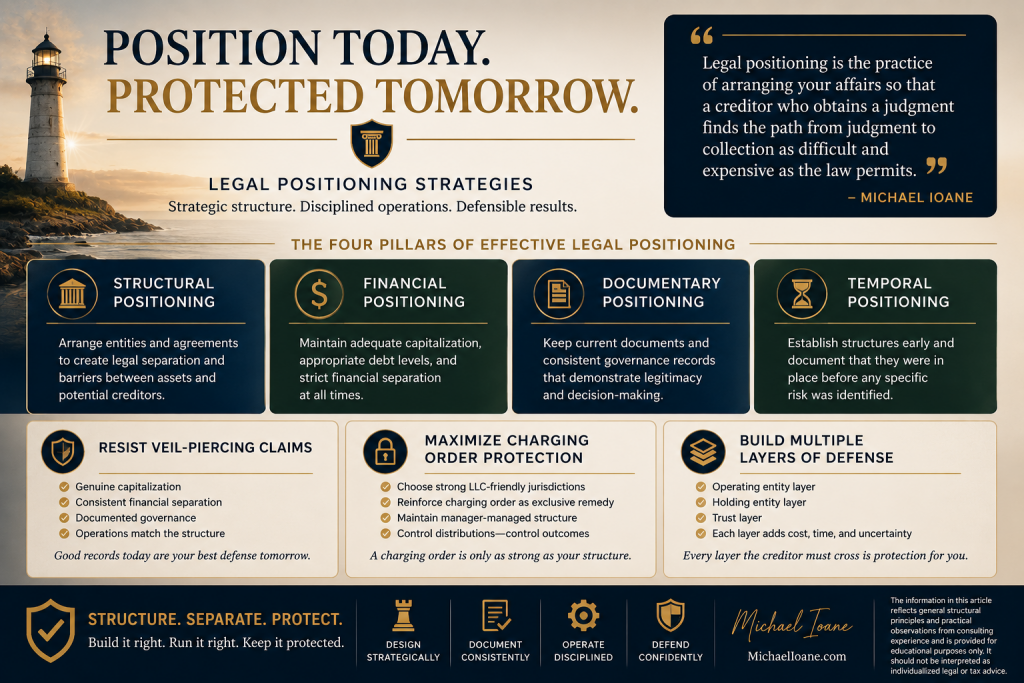
Legal positioning strategy is the discipline of arranging a business owner’s legal affairs to maximize the difficulty of creditor enforcement while maintaining full compliance with all legal obligations. It is distinct from fraudulent avoidance, which involves concealing assets or violating legal disclosure and reporting requirements. Legal positioning operates entirely within the law, using the structural tools that the legal system provides to create legitimate barriers between assets and potential creditors.
Michael Ioane addresses legal positioning as a discipline that requires both structural design and operational discipline, because positioning that is correctly designed but poorly maintained loses its effectiveness over time. The most sophisticated structural positioning cannot overcome consistent governance failures that give creditors the evidentiary foundation to challenge the structure’s legitimacy.
The Components of Effective Legal Positioning
Effective legal positioning for asset protection planning comprises four primary components: structural, financial, documentary, and temporal. Structural positioning addresses which entities and arrangements hold which assets, and how those entities and arrangements interact to create legal barriers to potential creditors. Financial positioning addresses each entity’s financial profile, including adequate capitalization, appropriate debt levels, and the consistent maintenance of financial separation between entities and between entities and the owner personally.
Documentary positioning addresses the quality and completeness of the governance records that demonstrate the legitimacy of the structural arrangements: current governing documents, consistent governance records, and documentation of the decision-making processes through which significant decisions were made. Temporal positioning addresses the timing of structural implementations relative to the formation of creditor relationships, ensuring that the structures are established at the earliest legally and practically feasible point and that their establishment is documented as having occurred before any specific risk was identified.
Positioning Against Veil-Piercing Claims
One of the most important dimensions of legal positioning strategy is positioning the entity structures to withstand veil-piercing challenges. Veil-piercing is the legal theory through which a creditor of an entity seeks to hold the entity’s owner personally responsible for the entity’s obligations, by arguing that the entity is not a genuine separate legal person but merely an alter ego of the owner. The legal factors that make veil-piercing difficult are the same as those that make any entity structure effective: genuine capitalization, consistent financial separation, documented governance, and operations that reflect the entity’s formal governance structure.
The positioning question with respect to veil-piercing is not just whether these elements are present but how they appear in the evidentiary record that will be examined in litigation. The entity whose governance records show a consistent pattern of documented decision-making over multiple years, whose financial records show a consistent pattern of financial separation, and whose governing documents are current and accurate presents a compelling evidentiary case that the entity is genuine. The entity whose records tell a different story provides the evidentiary foundation for a veil-piercing claim regardless of what the formal documents say.
Positioning to Maximize Charging Order Protection
In states that provide strong charging-order protection for LLCs, a legal positioning strategy includes designing the entity structure to maximize the availability and effectiveness of that protection. Charging order protection limits a creditor of an LLC member to a lien on the member’s right to receive distributions, without giving the creditor the right to take over management or force a liquidation. In the most favorable jurisdictions, this protection is the exclusive remedy for a member’s personal creditors, meaning the creditor cannot pursue any other path to the LLC’s assets through the member’s interest.
Positioning to maximize charging order protection includes forming entities in jurisdictions with the strongest statutory charging order protection, ensuring that the operating agreement explicitly reinforces the charging order as the exclusive remedy, and maintaining the entity as a genuine manager-managed structure with genuine management separation. An entity that is correctly positioned for charging order protection presents a creditor who obtains a charging order with a lien on distributions that the manager may never authorize, rendering the charging order practically useless without the management’s cooperation.
Positioning for Multiple Layers of Defense
The most sophisticated legal positioning strategy creates multiple independent layers of defense that a creditor must overcome sequentially to reach the owner’s assets. A creditor pursuing a claim against the operating entity must first establish liability against that entity, then must overcome the entity’s separate legal status to reach the holding entity’s assets, then must overcome the holding entity’s separate legal status to reach the trust that holds the holding entity’s membership interests, and at each layer must satisfy the specific legal requirements that apply to the barrier being overcome.
Each layer of defense adds legal cost, legal uncertainty, and practical difficulty to the creditor’s path to collection. The cumulative effect of multiple genuine structural layers is a protection profile that makes collection so uncertain and expensive that many creditors will settle for substantially less than the full judgment value, or will decline to pursue enforcement at all. Michael Ioane designs multi-layer positioning as the standard approach for clients whose risk profile warrants the administrative complexity, because the protection that multiple genuine layers provide substantially exceeds what any single layer can deliver.
Legal positioning is the practice of arranging your affairs so that a creditor who obtains a judgment finds the path from judgment to collection as difficult and expensive as the law permits.
The information in this article reflects general structural principles and practical observations from consulting experience and is provided for educational purposes only. It should not be interpreted as individualized legal or tax advice.
Michael Ioane | MichaelIoane.com
Continue Learning with Michael Ioane
Build your understanding of asset protection and business planning with the Asset Protection Manual . Explore taxation and private trust planning in Boston Tea Party . Both books are available on Amazon.