Michael Ioane
Article III
Practical Article
Long-Term Planning in Asset Protection
Long-term wealth protection requires a planning approach that is fundamentally different from transactional asset protection. Transactional planning addresses specific, immediate needs: entity formation before a business launch, trust implementation ahead of a significant asset transfer, and governance updates triggered by specific events. Long-term planning addresses the full arc of a client’s financial life, designing structures that will remain effective through business growth and transition, family evolution, changes in law, and the client’s eventual succession.
Michael Ioane addresses long-term planning as a distinct discipline that requires both initial design precision and an ongoing commitment to maintenance and adaptation. A correctly designed plan that is never revisited will gradually diverge from the reality it was designed to address. A correctly designed and regularly maintained plan will compound in effectiveness over time, as its structures become more established, its governance record becomes more credible, and its design is refined to reflect the evolving reality of the client’s situation.
The Lifecycle of a Protection Plan
A long-term asset protection plan has a lifecycle that mirrors the client’s financial and personal lifecycle. In the foundation phase, during the early stages of wealth accumulation, the priorities are entity formation, governance establishment, and proactive structuring before significant creditor relationships have formed. This is the period when protection is most legally defensible and cost-effective to implement, because the structures are established before any specific risk has materialized.
In the growth phase, as the client’s wealth increases and the complexity of their financial situation deepens, the protection plan must be reviewed and updated to reflect the changed reality. New assets require new structural decisions. New business activities create new liability exposures that existing structures may not address. New family circumstances, including marriage, divorce, the birth of children, and the aging of parents, create new planning dimensions that must be integrated into the overall design. Asset protection planning conducted in isolation from these life changes will gradually develop gaps that leave the client more exposed than their current structures suggest.
Building Structures That Adapt
The hallmark of effective long-term wealth protection is structures that adapt to changing circumstances without requiring complete reconstruction at each transition. This means governing documents with amendment mechanisms that allow updates without dissolution and reformation, succession provisions for every governance role that ensure continuity when individuals are unavailable, and intercompany arrangements that can be renegotiated as the relationships between entities evolve.
It also means a planning relationship that includes periodic review as a standard component. Financial strategy and asset protection planning are most effective when the advisor who designed the structures is also engaged to review them regularly, because that advisor understands the design logic and can identify when changed circumstances create vulnerabilities or opportunities that the original design did not address. A plan reviewed annually by its designer is more likely to remain current and effective than one reviewed episodically by advisors who were not involved in its original design.
Coordination With Tax and Estate Planning
Long-term wealth protection cannot be designed in isolation from tax and estate planning, because decisions made in each discipline affect the others in ways that create either coherence or conflict. An asset protection structure that creates favorable liability protection but produces adverse tax consequences, or that achieves protection objectives while creating estate planning complications, is optimized for one dimension at the expense of the overall plan.
Michael Ioane treats the coordination of asset protection with tax and estate planning as a baseline requirement in long-term planning engagements. The client whose advisors in each discipline work from a shared understanding of the overall plan is in a substantially stronger position than one whose advisors operate independently and whose plans may conflict at transition points. The integration of these disciplines is what distinguishes a comprehensive long-term strategy from a collection of individual techniques assembled without a unifying design logic.
The Governance Commitment of Long-Term Planning
The most demanding aspect of long-term asset protection planning is not its initial design but its ongoing governance commitment. A structure that is correctly designed but carelessly operated over the years will lose its legal effectiveness due to accumulated governance failures. A structure that is correctly designed and consistently maintained, with governance records kept current, governing documents updated as circumstances change, and financial separation practices maintained without exception, will build an evidentiary record of genuine independent operation, providing the most durable foundation for the protection it affords.
This governance commitment requires that the client and their advisors treat the maintenance of the protection plan as a standing priority, not a task that can be deferred when other demands compete for attention. The cost of maintaining a structure in good governance is a fraction of the cost of defending it against a creditor challenge that finds governance failures accumulated over years of neglect. Long-term wealth protection is ultimately a discipline of consistent attention to detail, applied over the full lifespan of the structures that provide the protection.
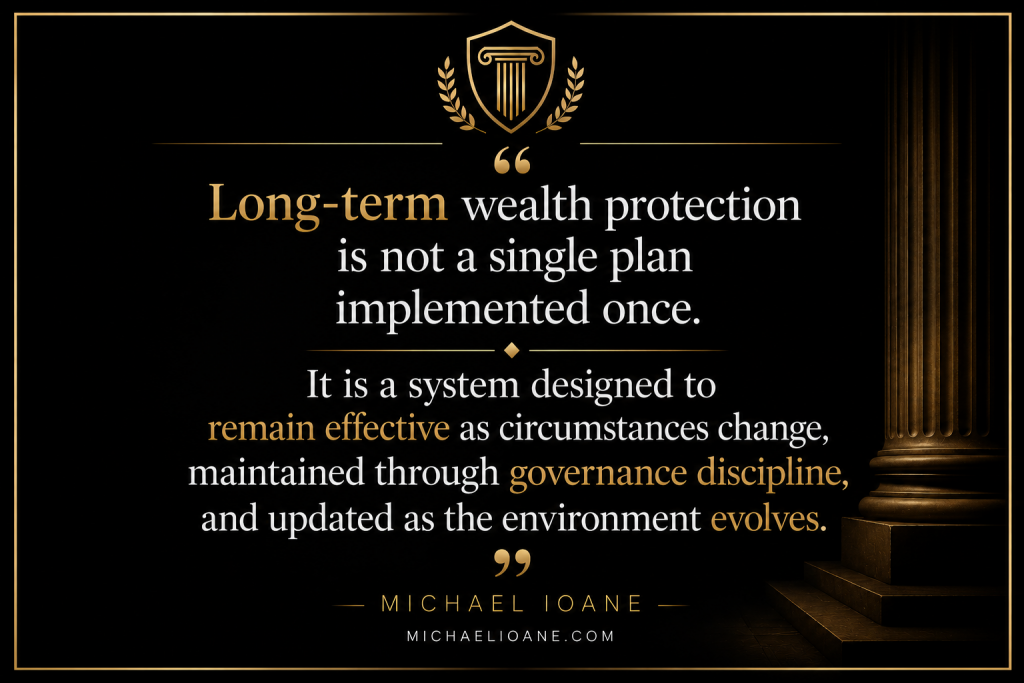
Long-term wealth protection is not a single plan implemented once. It is a system designed to remain effective as circumstances change, maintained through governance discipline, and updated as the environment evolves.
The information in this article reflects general structural principles and practical observations from consulting experience and is provided for educational purposes only. It should not be interpreted as individualized legal or tax advice.
Michael Ioane | MichaelIoane.com
Continue Learning with Michael Ioane
Build your understanding of asset protection and business planning with the Asset Protection Manual . Explore taxation and private trust planning in Boston Tea Party . Both books are available on Amazon.