Michael Ioane
Article III
Practical Article
Structural Defense Against Legal Risk
Legal defense in asset protection is the design and implementation of legal structures that interpose barriers between the owner’s assets and potential creditors. These barriers are not concealment mechanisms; they are legal frameworks recognized and enforced by courts that require creditors to satisfy specific legal conditions before they can reach assets within those frameworks. The effectiveness of structural defense depends on the legitimacy of the legal framework used, the timing of its implementation, and the consistency with which it is operated.
Michael Ioane designs structural defenses in response to specific, identified risks rather than as generic protective arrangements, because the most effective structural defense is one calibrated to the specific legal mechanisms through which the owner’s actual exposure could be pursued.
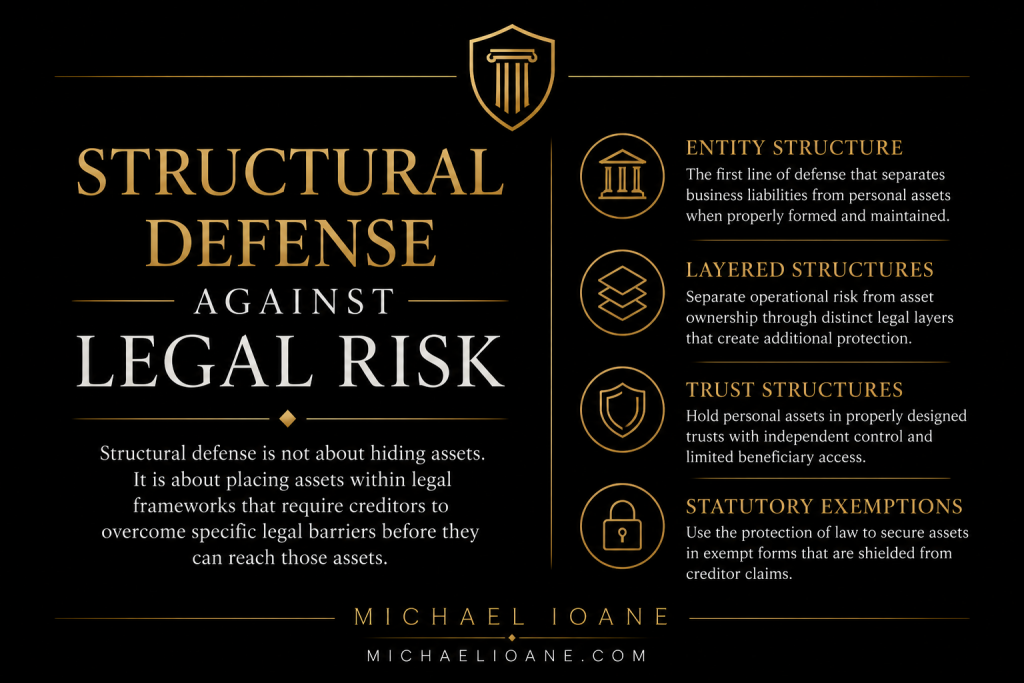
Entity Structure as the First Line of Defense
The entity structure is the most accessible and most widely applicable tool in structural defense. An LLC corporation, or limited partnership that is properly formed, adequately capitalized, and consistently operated as a genuine separate legal person provides a structural barrier between the entity’s obligations and the owner’s personal assets. A creditor of the entity must establish a claim against the entity specifically; a creditor of the owner must pursue additional legal theories to reach the entity’s assets.
The risk mitigation strategy built on entity structure requires attention to two categories of exposure that entity law alone does not address: personal guarantees, which bypass the entity structure entirely, and veil-piercing claims, which can disregard the entity’s separate status if it has not been properly maintained. Structural defense through entity structure is therefore not passive protection; it is an active discipline that requires ongoing governance, financial separation, and documentation to remain effective.
Layered Structures for Elevated Exposure
When the owner’s risk profile warrants more than a single-entity layer, a layered structure that separates operational liability exposure from asset value provides substantially stronger protection. A holding entity that owns the valuable assets, combined with a separate operating entity that conducts active business and bears the operational liability exposure, creates a structural barrier that requires a creditor of the operating entity to overcome two distinct legal separations before reaching the assets held by the holding entity.
The asset protection defense provided by layered structures depends on the same requirements as single-entity structures: genuine separation, proper governance, and consistent operation in accordance with the governing documents. Layered structures that are not operated with genuine separation between the layers provide the appearance of structural defense without its substance, and courts will disregard layers that are not treated as genuinely independent.
Trust Structures for Personal Asset Protection
Trust structures provide structural defense for personal assets in ways that entity structures cannot fully replicate. When assets are held in a properly designed and administered trust, those assets belong to the trust estate rather than to the settlor personally. Creditors of the settlor must establish specific legal theories to reach trust assets, and in jurisdictions with strong spendthrift trust provisions, the beneficiary’s interest in a discretionary trust may be effectively unreachable by the beneficiary’s creditors as long as the trustee exercises genuine independent discretion.
The asset protection defense that trust structures provide is most reliable when the trust is genuinely independent: when a professional or institutional trustee exercises real discretionary authority, when the settlor’s ability to direct or benefit from the trust is genuinely limited to what the trust document authorizes, and when the trust was established before the creditor relationship that is now being addressed. A trust that was established in response to a known creditor relationship, or that gives the settlor practical control over the trust assets despite formal language suggesting otherwise, will provide minimal structural defense when tested.
Statutory Exemptions as Structural Defense
Statutory exemption planning is the most legally secure form of structural defense because it does not carry the timing vulnerability that entity and trust planning carries. Assets held in exempt forms, such as qualified retirement accounts, homestead equity up to applicable limits, and life insurance cash values in states with robust insurance exemptions, are protected from creditor claims as a matter of statute, regardless of when they were placed in those forms and regardless of when the creditor relationship arose.
Michael Ioane includes statutory exemption maximization as a component of every structural defense plan, because it provides a floor of protection that remains available even when other structural options are constrained by timing or other factors. The business owner who has maximized their contributions to qualified retirement accounts, maintained their homestead equity within the applicable exemption limits, and holds appropriate insurance and annuity products in states with strong exemptions has built a substantial layer of statutory protection that complements whatever structural arrangements are in place.
Structural defense is not about hiding assets. It is about placing assets within legal frameworks that require creditors to overcome specific legal barriers before they can reach those assets.
The information in this article reflects general structural principles and practical observations from consulting experience and is provided for educational purposes only. It should not be interpreted as individualized legal or tax advice.
Michael Ioane | MichaelIoane.com
Continue Learning with Michael Ioane
Build your understanding of asset protection and business planning with the Asset Protection Manual . Explore taxation and private trust planning in Boston Tea Party . Both books are available on Amazon.