Michael Ioane
Article II
Deep Topic Article
Strategic Intent in Wealth Protection
A wealth preservation strategy is a deliberate, structured approach to maintaining and transferring wealth over time, through the full range of risks that threaten it, not merely those arising from legal claims. It requires a clear articulation of what the client is trying to preserve, over what time horizon, through what governance mechanisms, and for whose benefit. Without this clarity of strategic intent, even technically sophisticated structures produce outcomes that diverge from the client’s actual objectives.
Michael Ioane argues that strategic intent should be the starting point for any comprehensive wealth protection engagement, because a structure that is technically correct but strategically misaligned does not serve the client well. The best technical execution of the wrong strategy produces the wrong result, and correcting it later is more expensive than designing it correctly from the beginning.
Defining the Preservation Objective
The preservation objective in a wealth protection strategy is the specific outcome the client seeks: retaining a certain level of wealth for personal financial security, transferring assets to the next generation with minimal tax erosion, maintaining a family business across generations, or preserving charitable assets for defined purposes. Each of these objectives implies different structures, governance mechanisms, and trade-offs among control, protection, and efficiency.
A client whose primary objective is personal financial security in retirement has different structural needs than one whose primary objective is multigenerational family wealth transfer. The retirement security objective emphasizes liquidity, accessibility, and reliable income; the family transfer objective emphasizes tax efficiency, fair distribution of wealth across generations, and structures that can operate effectively without the founder’s ongoing involvement. Asset protection intent must be calibrated to these objectives, not applied as a uniform framework regardless of what the client is actually trying to achieve.
The Time Horizon as a Strategic Variable
The time horizon of a wealth preservation strategy is one of its most consequential design variables. A structure designed to protect wealth over a five-year horizon has very different requirements than one designed to operate across generations. Short-horizon structures can be simpler, more liquid, and more easily adjusted; long-horizon structures must be designed for personnel independence, governance succession, and adaptability to changing legal and regulatory environments.
Long-term planning in wealth protection must account for changes in the client’s personal circumstances, the composition and value of the assets being protected, applicable law, and the family or business context in which the structures operate. A structure designed only for current conditions without consideration of how conditions might change over its intended lifespan will require reactive intervention at each transition point, which is precisely the reactive planning that strategic intent is supposed to prevent.
Aligning Structure with Intent
The alignment of structure with strategic intent is the test that every wealth protection plan must pass. Each component of the structure should serve a defined purpose in the overall strategy, and the overall strategy should be traceable to the client’s clearly articulated objectives. A structure that cannot be explained in terms of what it is designed to accomplish and why it is the appropriate tool for that purpose lacks an adequately defined strategic intent.
This alignment test is also the most reliable way to identify gaps in an existing plan. If a component of the structure cannot be connected to a specific strategic objective, it may be unnecessary complexity. If a strategic objective is not served by any component of the current structure, it is an unaddressed gap that creates vulnerability. Regular review of the alignment between structure and intent is what keeps the plan coherent over its lifespan.
Strategic Intent in Multi-Generational Planning
Multi-generational wealth preservation requires the most explicitly articulated strategic intent of any planning context, because the structures that serve this purpose must operate effectively across time horizons extending beyond the founder’s lifetime and balance the interests of multiple generations whose priorities and circumstances will evolve in ways that cannot be fully anticipated.
The strategic intent in multi-generational planning must address not only what assets are being preserved but also how governance authority over those assets will transition across generations, how conflicts between the interests of different generations will be resolved, and how the structures will adapt to members of future generations whose relationship to the family’s wealth may be very different from the founder’s. Asset protection planning, business structuring, and estate planning must all be integrated into the multi-generational strategy, because each dimension of the plan affects the others in ways that require coherent overall design.
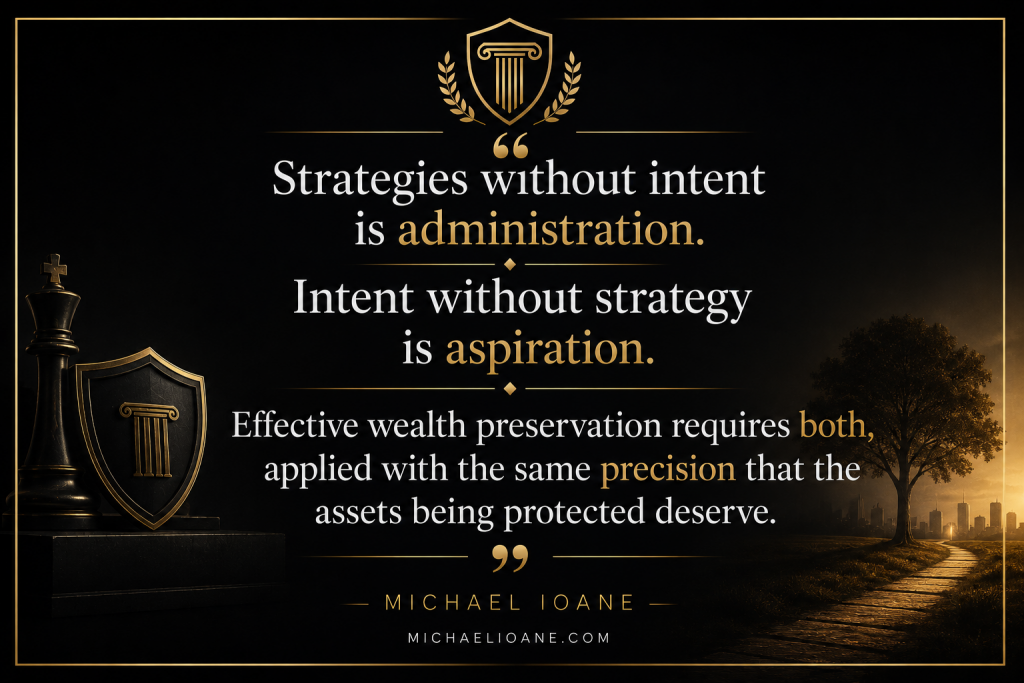
Strategies without intent is administration. Intent without strategy is aspiration. Effective wealth preservation requires both, applied with the same precision that the assets being protected deserve.
The information in this article reflects general structural principles and practical observations from consulting experience and is provided for educational purposes only. It should not be interpreted as individualized legal or tax advice.
Michael Ioane | MichaelIoane.com
Continue Learning with Michael Ioane
Build your understanding of asset protection and business planning with the Asset Protection Manual . Explore taxation and private trust planning in Boston Tea Party . Both books are available on Amazon.