Michael Ioane
Article II
DEEP TOPIC ARTICLE
Independent Oversight
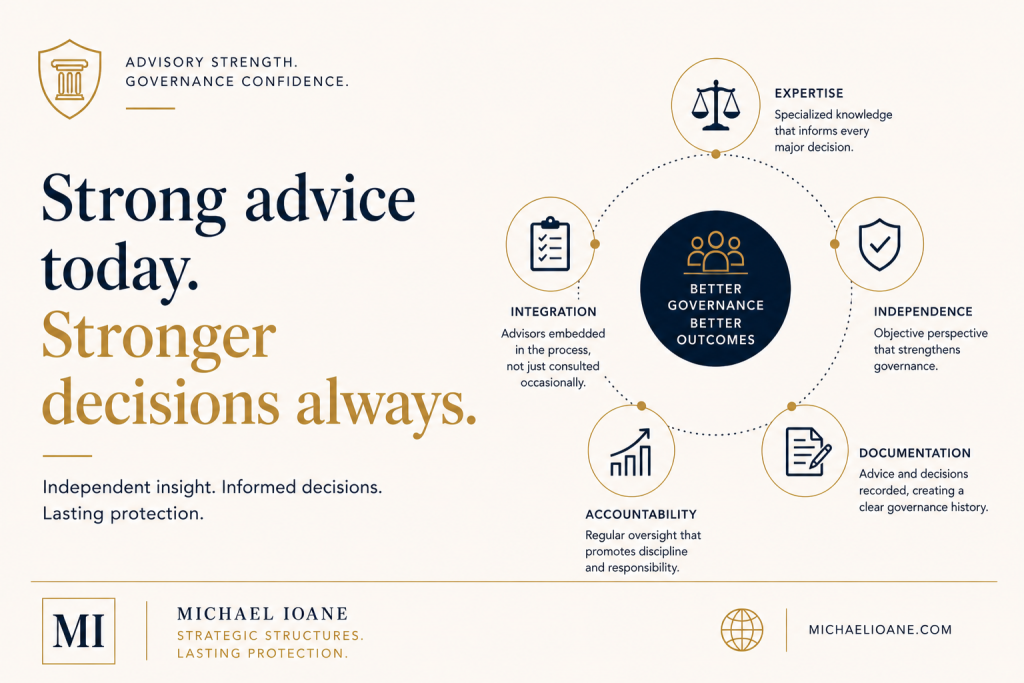
Independent governance oversight is the practice of having persons who are genuinely independent of the primary governance actor review the governance decisions, financial records, and operational practices of a structure on a periodic basis. It is a structural mechanism rather than an advisory relationship: independent oversight is built into the governance design of the structure, with defined scope, authority, and reporting relationships, rather than an episodic engagement that the primary governance actor can choose to invoke or decline.
Michael Ioane addresses independent governance oversight as a governance design requirement for structures of sufficient complexity and value to warrant it, not as an optional enhancement for structures that prefer additional accountability. The threshold for warranting independent oversight is determined primarily by the governance risk that the structure carries and by whether the primary governance actor has genuine accountability to any other party who would identify and respond to governance failures.
Why Independent Oversight Matters in Trust Structures
Independent oversight is particularly important in trust structures because the trustee’s fiduciary obligations run to the beneficiaries rather than to the settlor, and because the beneficiaries are frequently not in a position to monitor the trustee’s performance effectively on their own. Minor beneficiaries, beneficiaries who are not financially sophisticated, or beneficiaries who are geographically distant from the trustee’s operations, may have limited ability to identify governance failures until they have become significant.
A trust protector with a defined oversight mandate provides independent governance oversight in trust structures by reviewing the trustee’s performance, evaluating whether the trustee is administering the trust in accordance with its governing document and applicable law, and taking defined corrective action when governance failures are identified. The protector’s effectiveness depends on having a clearly defined scope of authority, access to the information required to conduct a meaningful review, and genuine independence from the trustee and from beneficiaries whose interests might bias the trustee’s judgment.
Independent Oversight in Entity Structures
In entity structures, independent oversight may be provided through several mechanisms. An independent director on a corporate board provides oversight of management decisions and executive performance that the company’s other directors, who may have relationships with management that compromise their objectivity, may not consistently provide. An independent manager in an LLC can oversee the managing member’s exercise of management authority. An advisory committee with defined review authority can provide periodic oversight of governance practices without holding formal governance authority.
The chosen mechanism should reflect the structure’s governance design and the specific oversight needs arising from its risk profile. A corporation with a concentrated ownership structure and a dominant shareholder who also serves as chief executive officer has a different independent oversight need than a corporation with a diverse shareholder base and a professional management team. The oversight mechanism must be calibrated to the specific governance risk the structure carries, not applied generically.
Defining the Scope and Authority of Independent Oversight
Independent oversight that lacks a clearly defined scope and authority is not effective oversight; it is the appearance of oversight without its substance. The governing documents or oversight engagement agreement must specify what the independent overseer is authorized to review, what information they are entitled to access, how frequently they are expected to conduct reviews, what they are required to do when they identify a governance problem, and what authority they have to require corrective action.
Oversight authority that stops at the ability to identify problems without any mechanism for compelling corrective action is weaker than oversight that includes defined remedies, including the authority to remove and replace the primary governance actor in defined circumstances. The appropriate level of oversight authority depends on the structure’s risk profile and the practical consequences of governance failure, but the principle that oversight without enforcement authority is incomplete applies at every level of structural complexity.
Documenting Independent Oversight Activity
The governance value of independent oversight is fully realized only when the oversight activity is documented in a way that becomes part of the governance record. An independent director who attends board meetings and votes on resolutions creates a governance record through the board minutes. A trust protector who conducts periodic reviews of trustee performance should document those reviews in writing and maintain that documentation as part of the trust’s governance record. An independent advisor who reviews governance decisions and provides written opinions creates a documentary record of the quality of the decision-making process.
This documentation serves multiple purposes simultaneously. It demonstrates that the oversight was genuine and substantive, not merely formal. It creates an evidentiary record that the governance actor’s decisions were subject to independent review, which is relevant in any challenge to those decisions. And it provides a historical record that allows subsequent overseers to understand the structure’s governance history and identify patterns that might not be apparent from reviewing individual decisions in isolation.
Independent oversight is the governance mechanism that prevents small failures from accumulating into large ones. Its value is inversely proportional to how often it finds serious problems: when it works well, it catches issues early, when they are still correctable.
The information in this article reflects general structural principles and practical observations from consulting experience and is provided for educational purposes only. It should not be interpreted as individualized legal or tax advice.
Michael Ioane | MichaelIoane.com
Continue Learning with Michael Ioane
Build your understanding of asset protection and business planning with the Asset Protection Manual . Explore taxation and private trust planning in Boston Tea Party . Both books are available on Amazon.