Michael Ioane
Article I
AUTHORITY ARTICLE
Identifying Structural Weaknesses
Structural risk analysis is the discipline of evaluating a business or personal asset protection structure to identify the specific points at which it is vulnerable to legal challenge, creditor attack, or operational failure. It is distinct from the initial design of a structure because it asks not what the structure was intended to accomplish but whether it is actually accomplishing that in its current state, given how it has been operated, how circumstances have changed, and what legal developments have occurred since it was implemented.
Michael Ioane approaches structural risk analysis as a periodic discipline rather than a one-time assessment. A structure that was sound at implementation accumulates vulnerabilities over time through governance failures, document obsolescence, changes in ownership or personnel, and shifts in the legal landscape. Identifying these vulnerabilities before they are exploited by a creditor is the purpose of structural risk analysis, and the earlier they are identified, the broader the range of corrective options available.
The Most Common Categories of Structural Weakness
Structural weaknesses cluster in predictable categories. The most common is governance failure: the structure was correctly designed, but has not been operated in accordance with its governing documents. Meeting minutes have not been kept, operating agreements have not been updated to reflect changes in ownership or management, and the formal governance framework has been bypassed in favor of informal decision-making. This pattern creates an evidentiary record that contradicts the formal structure, and courts examining that record will not honor protections built on a foundation of governance neglect.
A second common category is documentation obsolescence: the governing documents were drafted for the structure as it existed at formation and have never been updated to reflect subsequent changes. An operating agreement that names a manager who is no longer involved, that allocates ownership interests that have since been transferred, or that describes a business purpose that is no longer the entity’s primary activity is a governing document whose legal effect may diverge significantly from the owner’s current intentions.
Financial Separation Failures
Financial separation failures are among the most damaging structural weaknesses because they are among the easiest for creditors to identify and exploit. When business and personal finances have been commingled, when the entity’s bank accounts have been used for personal expenses or vice versa, or when intercompany transfers between related entities have not been documented and categorized correctly, the evidentiary foundation for the entity’s separate legal status is undermined.
Courts examining veil-piercing claims will review banking records, accounting records, and financial statements in detail. A pattern of commingling that appears consistently in those records over multiple years is compelling evidence that the entity was not operated as a genuine separate legal person. Structural risk analysis must examine the financial records of each entity in the structure with the same scrutiny that a creditor’s attorney would apply, because the vulnerabilities visible in that examination are the vulnerabilities that will be exploited in litigation.
Timing and Transfer Vulnerabilities
Timing vulnerabilities arise when assets are transferred into a protective structure at a time that exposes the transfer to a fraudulent transfer challenge. The analysis requires identifying when each significant transfer occurred, what creditor relationships existed at the time, and whether the transfer was made for reasonably equivalent value. Transfers made in response to a known or reasonably foreseeable creditor claim are the most vulnerable; transfers made years before any creditor relationship formed are the most defensible.
Transfer vulnerabilities also arise from inadequate documentation of the purpose and consideration for transfers between related entities. A transfer made for legitimate business reasons but not contemporaneously documented leaves the transferor unable to demonstrate its legitimate purpose when the transfer is later challenged. Structural risk analysis must examine the documentation supporting each significant transfer in the structure’s history, not just its legal form.
Succession and Continuity Gaps
Succession gaps are structural weaknesses that become apparent only when the person holding a critical governance role is no longer available to exercise it. An LLC whose operating agreement designates a single managing member with no succession provision, a trust whose governing document names a trustee but provides no mechanism for replacing that trustee, or a corporation whose sole director has died without a replacement mechanism: each of these is a structure that faces a governance crisis at exactly the moment when continuity matters most.
Michael Ioane addresses succession gaps as a primary finding category in structural risk analysis, because they are both extremely common and extremely dangerous. The governance vacuum created by the death or incapacity of a critical governance actor without a succession mechanism may require expensive court intervention to resolve, and the period during which the structure lacks effective governance may expose assets to risks that the structure was designed to prevent. Every structural risk assessment should identify all governance roles within the structure and verify that a documented succession mechanism exists for each.
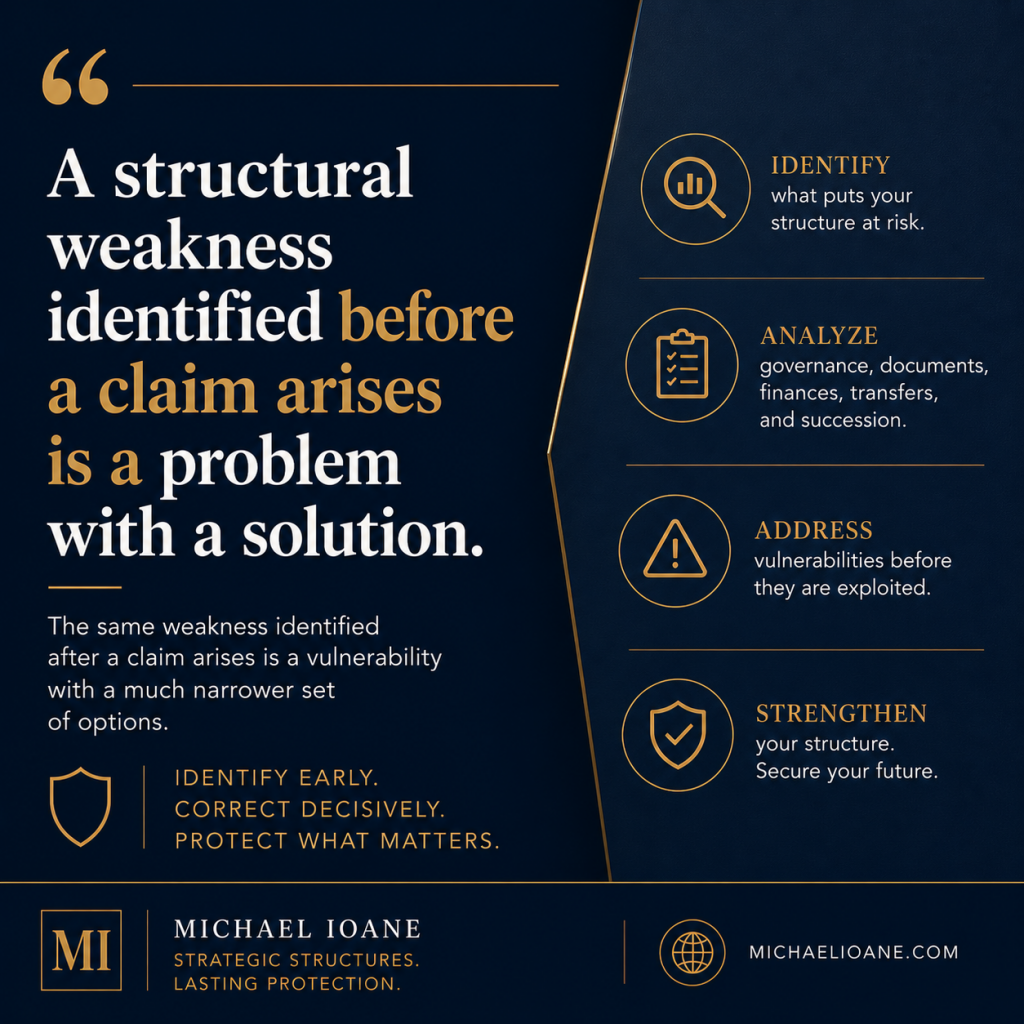
A structural weakness identified before a claim arises is a problem with a solution. The same weakness identified after a claim arises is a vulnerability with a much narrower set of options.
The information in this article reflects general structural principles and practical observations from consulting experience and is provided for educational purposes only. It should not be interpreted as individualized legal or tax advice.
Michael Ioane | MichaelIoane.com
Continue Learning with Michael Ioane
Build your understanding of asset protection and business planning with the Asset Protection Manual . Explore taxation and private trust planning in Boston Tea Party . Both books are available on Amazon.