Michael Ioane
Article III
PRACTICAL ARTICLE
Layering Business Activities
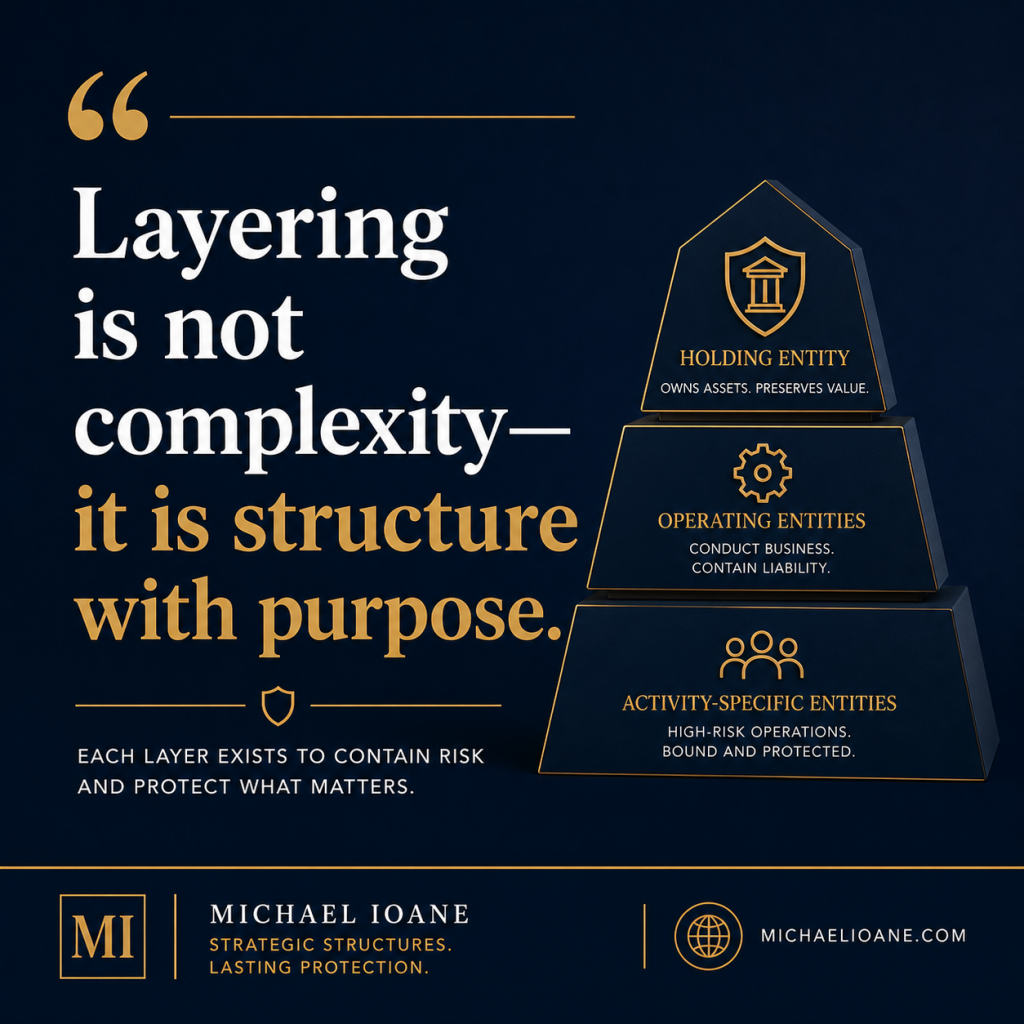
Business structure layering is the practice of organizing a business’s activities, assets, and personnel across multiple entities arranged in a deliberate hierarchy, so that the liability exposure generated by each activity category is contained within the entity most appropriate for that risk and separated from the entities that hold assets with long-term value. Layering is not complexity for its own sake; each layer in a well-designed structure serves a specific function and contributes to the overall risk distribution in a way that a single entity or an uncoordinated collection of entities cannot replicate.
Michael Ioane designs layered structures as integrated systems rather than collections of independent entities. The relationship between each layer, the governance connections, the financial flows, and the contractual arrangements that link them, must be designed with as much care as the individual entities themselves. A layered structure that is not coherently designed is not a protection asset; it is an administrative burden that provides the appearance of sophistication without its substance.
The Basic Two-Layer Structure
The foundational layered structure consists of two entities: a holding entity that owns the assets and an operating entity that conducts the business. This two-layer arrangement is appropriate for businesses with a single primary operating activity, a single category of valuable assets, and a risk profile that does not require additional separation within the operating or holding layers.
In a two-layer structure, the holding entity typically owns the real property, the equipment, the intellectual property, and the equity interests in the operating entity. The operating entity conducts the business, employs the personnel, and enters the customer contracts. The holding entity leases the real property and equipment to the operating entity and licenses the IP under written agreements at arm’s length terms. The operating entity’s creditors can reach the operating entity’s assets; they cannot directly reach the holding entity’s assets without piercing the separation between the two entities. This basic structure provides meaningful protection for businesses that currently hold all of their assets and conduct all of their activities in a single entity.
When to Add Additional Layers
Additional layers become appropriate when the business has multiple distinct operating activities with materially different risk profiles, when specific asset categories require separation from each other as well as from operating risk, or when the business operates in multiple jurisdictions that each warrant their own entity.
A business that provides both a high-liability professional service and a lower-risk product sale benefits from separating these activities into distinct operating entities, because a claim arising from the professional service activity should not reach the assets of the product sale entity. A business that owns both real property and intellectual property may benefit from holding each in a separate entity, because the risk profiles of real property ownership and IP licensing are distinct and the optimal entity structure for each may differ. Additional layers create additional administrative obligations, and the decision to add a layer should be driven by a specific protection or operational purpose, not by a general preference for complexity.
Activity-Specific Entities for Elevated Risk Operations
Certain business activities carry liability exposure that is so elevated that they warrant containment in a dedicated entity, even if the overall business structure is otherwise a standard two-layer arrangement. Construction operations, which carry significant workers compensation, contractor liability, and property damage exposure, are a common example. Medical or professional services, where individual practitioners face personal liability alongside entity liability, are another. Retail or hospitality operations with high customer foot traffic and premises liability exposure are a third.
An activity-specific entity is formed specifically to conduct the high-liability activity, with its own governance, its own insurance, and its own asset base limited to what that activity requires. Claims arising from the high-liability activity are contained within the activity-specific entity. The valuable assets of the broader business, held in the holding entity or in separate asset-holding entities, are not directly exposed to claims arising from the contained activity. This arrangement requires that the activity-specific entity be operated with the same governance discipline as any other entity in the structure.
Coordination Within a Layered Structure
A layered structure functions effectively only when the relationships between its layers are coherently designed and consistently administered. Intercompany agreements between each pair of related entities must document the commercial terms of their relationship. Financial flows must be correctly categorized and recorded in the financial records of each entity. Governance decisions must be made through the appropriate entity’s governance process and documented in that entity’s records.
The coordination demands of a layered structure increase with the number of layers, and the administrative discipline required to maintain a three-layer or four-layer structure is substantially greater than that required for a simple two-layer arrangement. Michael Ioane designs layered structures with the client’s administrative capacity in mind, calibrating the complexity of the structure to the protection value it delivers and the client’s realistic ability to maintain the required governance discipline over time. A structure that is theoretically optimal but practically unmaintainable will accumulate the governance failures that undermine its protection over time.
Business structure layering is not complexity for its own sake. Each layer serves a defined purpose, contains a defined category of risk, and contributes to a structure whose overall protection is greater than the sum of its individual components.
The information in this article reflects general structural principles and practical observations from consulting experience and is provided for educational purposes only. It should not be interpreted as individualized legal or tax advice.
Michael Ioane | MichaelIoane.com
Continue Learning with Michael Ioane
Build your understanding of asset protection and business planning with the Asset Protection Manual . Explore taxation and private trust planning in Boston Tea Party . Both books are available on Amazon.