Michael Ioane
Article I
AUTHORITY ARTICLE
Why Business Owners Are High Risk Targets
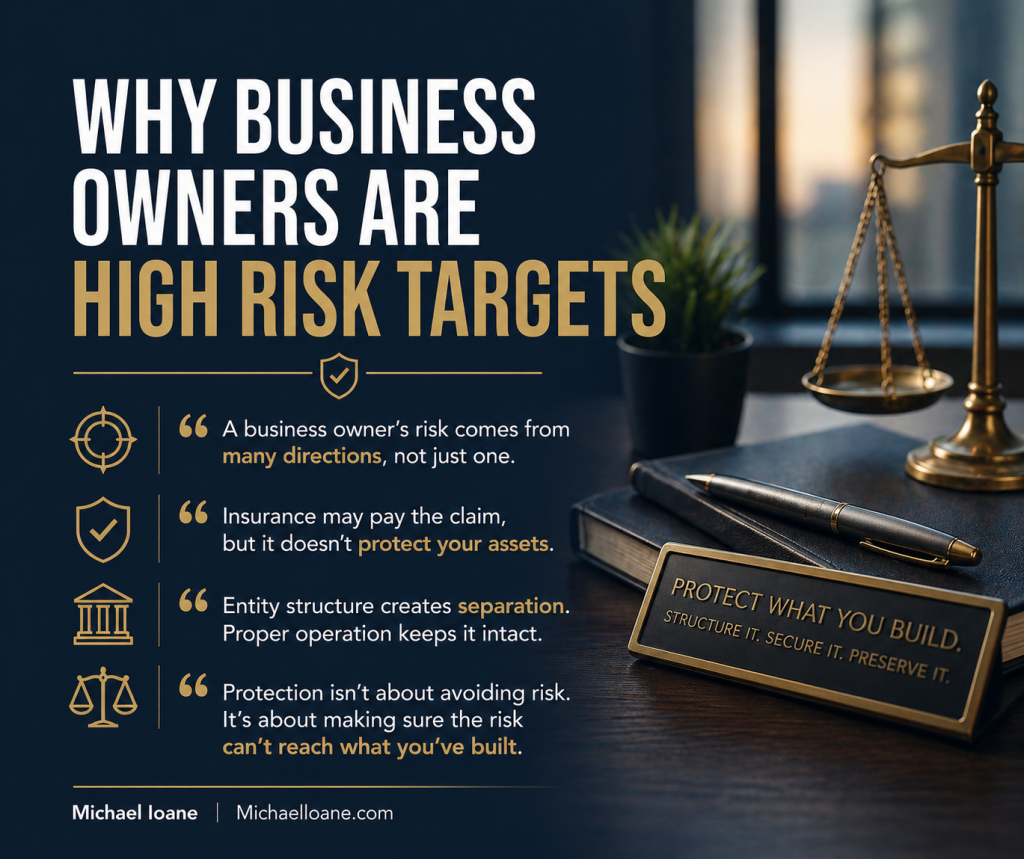
Asset protection for business owners begins with an honest assessment of why they face elevated legal risk compared with employees or passive investors. The answer is structural. A business owner who actively operates their business is simultaneously exposed to commercial creditors, employee or contractor claims, regulatory actions, customer disputes, professional liability, and personal guarantees of business obligations. Each of these exposure categories operates independently, and a judgment in any one of them can reach personal assets if the business owner has not taken deliberate steps to separate their business activities from their personal wealth.
Michael Ioane approaches business owner liability as the starting point for any serious protection discussion, because the risk profile of an active business owner is materially different from that of a passive asset holder, and the structures required to address it must be designed with that difference in mind.
The Scope of Business Owner Exposure
Business owners face liability from multiple directions simultaneously, and the cumulative exposure is often greater than any single category would suggest. On the commercial side, vendors, suppliers, landlords, and lenders all hold claims that can become judgments if obligations are not met. On the operational side, employees and contractors may bring wage, discrimination, or wrongful termination claims. Customers may bring product liability or service failure claims. Regulatory agencies may impose fines and penalties that are not dischargeable in bankruptcy.
Personal guarantees compound this exposure significantly. A business owner who has personally guaranteed a business loan or lease has eliminated the liability protection that the entity structure would otherwise provide for that obligation. The legal risk business owners carry through personal guarantees is often underestimated at the time the guarantee is signed and fully appreciated only when the business encounters financial difficulty.
Why Standard Business Insurance Is Not Sufficient
Many business owners assume that commercial liability insurance adequately addresses their personal exposure. Insurance is an important component of any risk management program, but it has significant limitations as a protection strategy. Policy limits may be insufficient for large claims. Certain categories of liability, including intentional acts, contractual liability, and some forms of professional error, may be excluded from coverage. Insurers may dispute coverage, delay payment, or deny claims. And insurance addresses the claim after it arises; it does not prevent the judgment from attaching to personal assets if coverage is disputed or denied.
A complete protection approach for business owners integrates insurance with structural protection: entity design that creates a genuine separation between business activities and personal assets, careful attention to personal-guarantee exposure, and a plan that addresses what happens to personal wealth when a business claim exceeds or bypasses available coverage.
The Role of Entity Structure in Business Owner Protection
The entity through which a business owner operates is the primary structural tool for managing business owner liability. A properly formed and maintained LLC or corporation creates a legal separation between the owner and the business: the entity is responsible for its own obligations, and the owner’s personal assets are not directly accessible to business creditors, provided the entity is treated as a separate legal person.
The conditions required to maintain this separation are specific and must be actively maintained. The entity must be adequately capitalized for the activities it conducts. Business finances must be kept strictly separate from personal finances. The entity must be operated in accordance with its governing documents. Decisions must be made through appropriate governance processes and documented. When these conditions are met consistently, business structure protection operates as designed. When they are not, courts may pierce the corporate veil and hold the owner personally liable for the entity’s obligations, eliminating the protection the structure was designed to provide.
Planning That Addresses the Full Exposure Profile
Effective asset protection for business owners addresses the full exposure profile, not just the most visible risk categories. This means evaluating not only the operating entity structure but also how personal assets are held, what exemptions are available under applicable state law, how intellectual property and key assets are titled, and whether additional structural layers are appropriate given the owner’s specific risk profile.
Michael Ioane designs protection strategies for business owners that account for the interaction between business risk and personal asset exposure. The goal is a structure in which the business can operate effectively while the owner’s personal wealth is held in a position as difficult as possible for business creditors to access. Strategic business structuring and asset protection foundations must be addressed together, because a gap in either dimension creates vulnerability across both.
Business owners face greater legal risk than almost any other category of individuals. The structure that addresses that risk must be as deliberate and comprehensive as the business itself.
The information in this article reflects general structural principles and practical observations from consulting experience and is provided for educational purposes only. It should not be interpreted as individualized legal or tax advice.
Michael Ioane | MichaelIoane.com
Continue Learning with Michael Ioane
Build your understanding of asset protection and business planning with the Asset Protection Manual . Explore taxation and private trust planning in Boston Tea Party . Both books are available on Amazon.