Michael Ioane
Article IV
SUMMARY GUIDE ARTICLE
Guide: Timing Strategies in Structuring
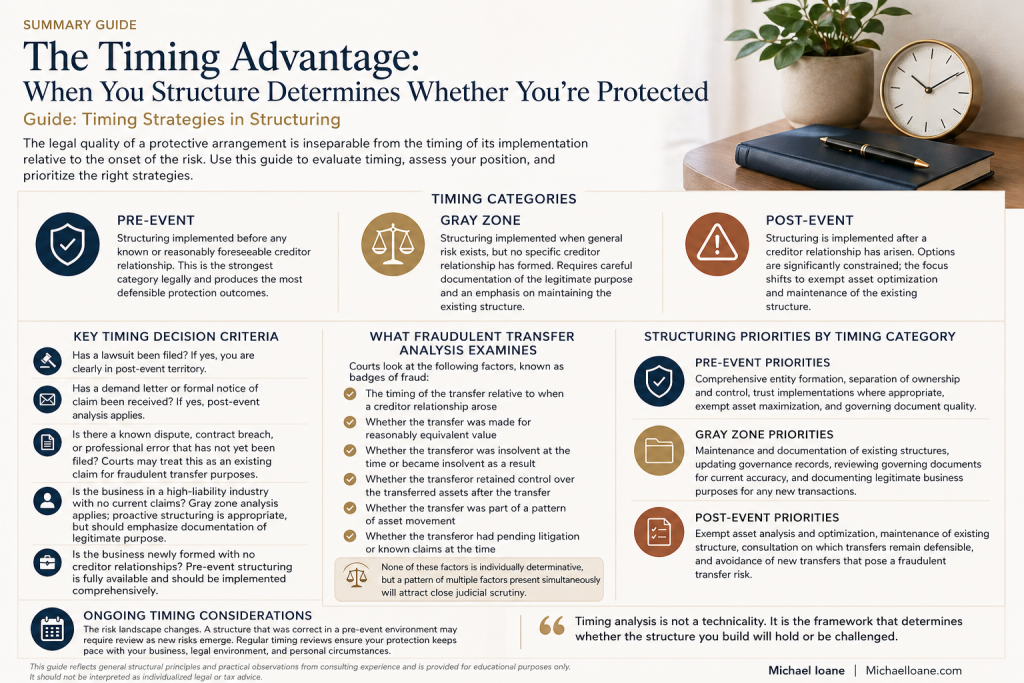
This guide provides a practical reference for evaluating asset protection timing and structuring a timing strategy. The frameworks here reflect Michael Ioane’s approach to timing analysis in structuring engagements, where the legal quality of a protective arrangement is inseparable from the timing of its implementation relative to the onset of the risk.
Timing Categories
Pre-event: structuring implemented before any known or reasonably foreseeable creditor relationship. This is the strongest category legally and produces the most defensible protection outcomes.
Gray zone: structuring implemented when general risk exists, but no specific creditor relationship has formed. Requires careful documentation of the legitimate purpose and an emphasis on maintaining the existing structure.
Post-event: structuring is implemented after a creditor relationship has arisen. Options are significantly constrained; the focus shifts to exempt asset optimization and maintenance of the existing structure.
Key Timing Decision Criteria
Use these criteria to evaluate where a structuring situation falls on the timing spectrum:
• Has a lawsuit been filed? If yes, you are clearly in post-event territory.
• Has a demand letter or formal notice of claim been received? If yes, post-event analysis applies.
• Is there a known dispute, contract breach, or professional error that has not yet been filed? Courts may treat this as an existing claim for fraudulent transfer purposes.
• Is the business in a high-liability industry with no current claims? Gray zone analysis applies; proactive structuring is appropriate, but should emphasize documentation of legitimate purpose.
• Is the business newly formed with no creditor relationships? Pre-event structuring is fully available and should be implemented comprehensively.
What Fraudulent Transfer Analysis Examines
When courts evaluate whether a transfer is fraudulent, they consider the following factors, which are referred to as badges of fraud in fraudulent transfer law:
• The timing of the transfer relative to when a creditor relationship arose
• Whether the transfer was made for reasonably equivalent value
• Whether the transferor was insolvent at the time or became insolvent as a result
• Whether the transferor retained control over the transferred assets after the transfer
• Whether the transfer was part of a pattern of asset movement
• Whether the transferor had pending litigation or known claims at the time
None of these factors is individually determinative, but a pattern of multiple factors present simultaneously will attract close judicial scrutiny.
Structuring Priorities by Timing Category
Pre-event priorities: comprehensive entity formation, separation of ownership and control, trust implementations where appropriate, exempt asset maximization, and governing document quality.
Gray zone priorities: maintenance and documentation of existing structures, updating governance records, reviewing governing documents for current accuracy, and documenting legitimate business purposes for any new transactions.
Post-event priorities: exempt asset analysis and optimization, maintenance of existing structure, consultation on which transfers remain defensible, and avoidance of new transfers that pose a fraudulent transfer risk.
Ongoing Timing Considerations
Asset protection timing is not a one-time analysis. The risk landscape changes as businesses evolve, litigation environments shift, and personal circumstances change. A structure that was correctly implemented in a pre-event environment may require review and updating as new risks emerge.
Michael Ioane addresses timing as a recurring review item in long-term planning relationships, rather than a threshold question answered once and then set aside. The protection available to a business owner who regularly reviews and keeps their structure current is substantially greater than that available to someone whose structure was well-designed at inception but has not been evaluated since. Risk management for entrepreneurs must include timing review as a standing component of protection planning.
Timing analysis is not a technicality. It is the framework that determines whether the structure you build will hold or be challenged. Understanding where you stand on the timing spectrum is the starting point for every serious protection strategy.
The information in this article reflects general structural principles and practical observations from consulting experience and is provided for educational purposes only. It should not be interpreted as individualized legal or tax advice.
Michael Ioane | MichaelIoane.com
Continue Learning with Michael Ioane
Build your understanding of asset protection and business planning with the Asset Protection Manual . Explore taxation and private trust planning in Boston Tea Party . Both books are available on Amazon.