Michael Ioane
Article III
Practical Article
Practical Application of Law Enforcement
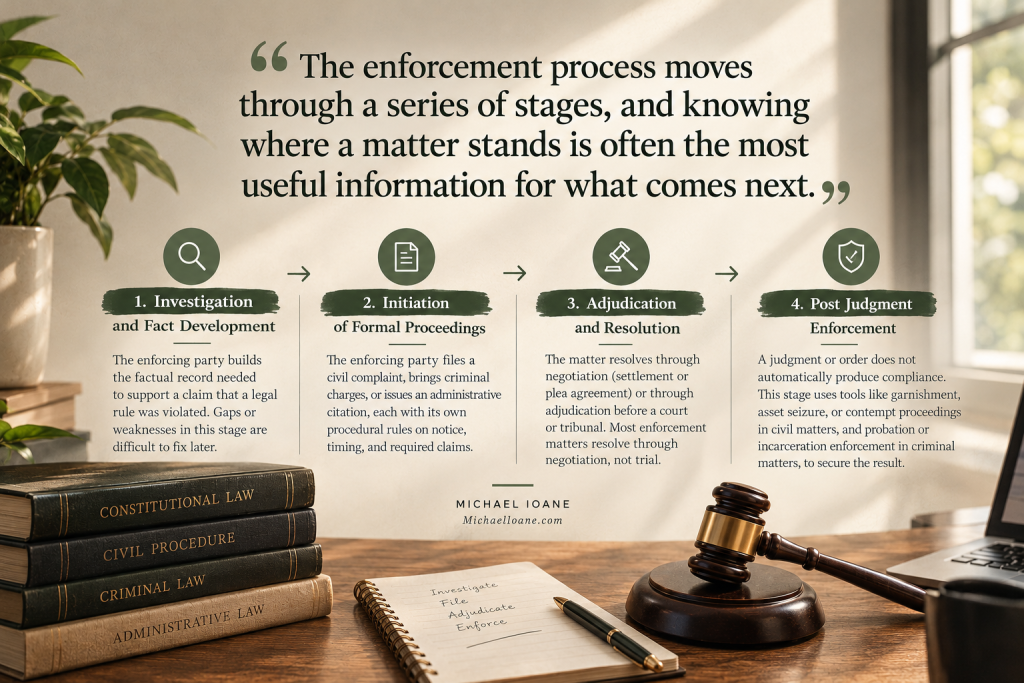
A law enforcement process moves through a series of identifiable stages regardless of whether the underlying matter is civil, criminal, or administrative, and understanding this common structure makes it possible to assess where a specific enforcement matter currently stands.
Michael Ioane treats the enforcement process as a practical sequence worth mapping explicitly, since knowing which stage a given matter has reached is often the most useful information available for anticipating what happens next.
Investigation and Fact Development
Every enforcement matter begins with an investigative stage in which the enforcing party, whether a private litigant, a prosecutor, or an agency, develops the factual record needed to support a claim that a legal rule was violated. This stage in the legal system often determines the ultimate strength of an enforcement action, since gaps or weaknesses in the factual record identified during investigation are difficult to correct once formal proceedings begin.
Initiation of Formal Proceedings
Once an investigation supports a viable claim, the enforcing party initiates formal proceedings, filing a civil complaint, bringing criminal charges, or issuing an administrative citation, each governed by its own procedural rules regarding notice, timing, and the specific claims that must be stated. The enforcement structure applicable at this stage varies significantly depending on which track the matter proceeds through, making the choice of track itself a significant strategic decision for the enforcing party.
Adjudication and Resolution
Formal proceedings typically resolve either through negotiated resolution, a settlement in civil matters or a plea agreement in criminal matters, or through adjudication before a court or administrative tribunal that issues a binding decision. The overwhelming majority of enforcement matters resolve through negotiated resolution rather than full adjudication, reflecting both the cost of formal proceedings and the practical incentives both sides typically have to avoid the uncertainty of a contested outcome.
Post Judgment Enforcement
A favorable judgment or order does not automatically produce compliance, and the enforcement process frequently requires a distinct post judgment stage, garnishment, asset seizure, or contempt proceedings in civil matters, and probation or incarceration enforcement in criminal matters, to actually secure the practical result the underlying proceeding established. This final stage is where the enforcement mechanism’s practical effectiveness is ultimately tested, since a judgment that cannot be enforced provides limited practical value regardless of how clearly it establishes the underlying legal right.
Conclusion
Practical application of law enforcement moves through investigation, initiation of formal proceedings, adjudication or negotiated resolution, and post judgment enforcement, with each stage presenting its own distinct considerations. Bringing this practical process together with the enforcement mechanisms and authority covered elsewhere in this cluster is addressed in Guide: Legal Enforcement Systems.
The information in this article reflects general constitutional and legal principles and is provided for educational purposes only. It should not be interpreted as individualized legal advice.
Michael Ioane | MichaelIoane.com
Continue Learning with Michael Ioane
Build your understanding of asset protection and business planning with the Asset Protection Manual . Explore taxation and private trust planning in Boston Tea Party . Both books are available on Amazon.