Michael Ioane
Article III
Practical Article
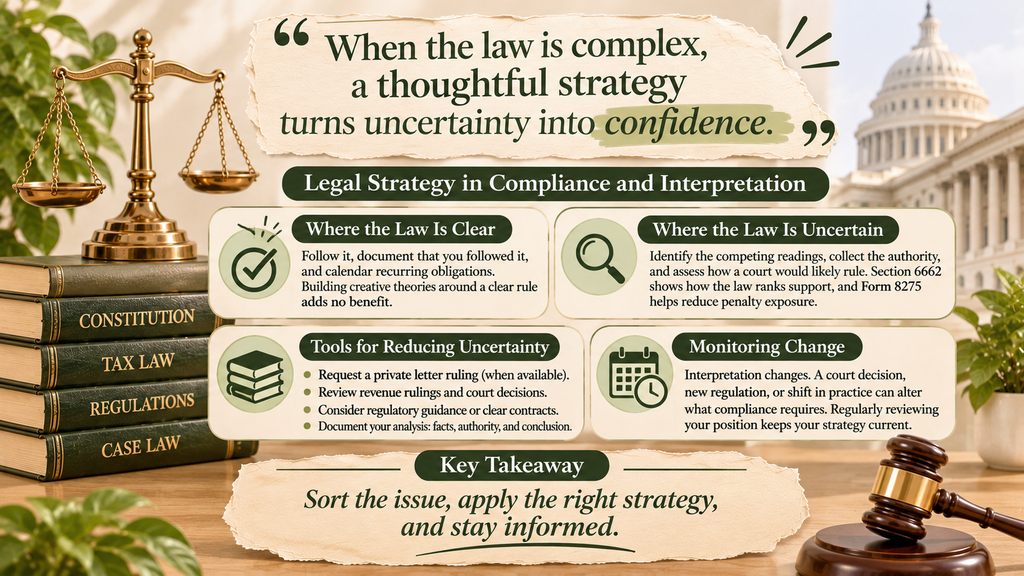
Legal Strategy in Compliance and Interpretation
Legal planning must account for two separate problems. The first is compliance, meeting clear requirements. The second is interpretation, which arises when a requirement is unclear or contested. A sound strategy sorts each issue into the correct category and responds accordingly.
Where the Law Is Clear
When the text is plain and authority is consistent, the strategy is simple. Follow it, document that you followed it, and calendar recurring obligations. Building creative theories around a clear rule offers no benefit. Doing so adds risk and cost without protection.
Where the Law Is Uncertain
Uncertainty calls for deliberate analysis. Identify the competing readings, collect the authority for each, and assess how a court would likely resolve the question. In federal tax, Section 6662 illustrates how the law ranks levels of support. An item with substantial authority, or a reasonable basis disclosed on Form 8275, carries less penalty exposure than a position without that support. An accuracy-related penalty is generally 20 percent of the underpayment attributable to the error.
Section 6664(c) provides that the penalty does not apply to the portion of an underpayment for which the taxpayer shows reasonable cause and good faith. Courts consider reliance on competent professional advice, based on full and accurate facts, as one factor.
Tools for Reducing Uncertainty
Several tools exist. A taxpayer may request a private letter ruling from the IRS on a prospective transaction, though the IRS declines to rule in certain areas. Published revenue rulings and court decisions show how the agency and the courts have treated similar facts. Outside of tax, regulators may issue advisory opinions or no action letters, and contracts can include clear definitions that limit later disputes about meaning.
Whatever the field, the written analysis should state the facts relied on, the authority considered, and the conclusion reached. That record is useful if the position is later questioned.
Monitoring Change
Interpretation changes. A court decision, a new regulation, or a shift in agency practice can alter what compliance requires. Regularly reviewing key positions keeps strategy current and reduces the risk of continuing practice after the law has changed.
This article is provided for general educational purposes and reflects the author’s understanding of the law at the time of writing. It is not legal, tax, or financial advice, and it does not create a professional relationship. Laws change and individual circumstances differ, so consult a licensed professional about your specific situation.
Continue Learning with Michael Ioane
Build your understanding of asset protection and business planning with the Asset Protection Manual . Explore taxation and private trust planning in Boston Tea Party . Both books are available on Amazon.