Michael Ioane
Article I
Authority Article
Division of Power Between Federal and State Governments
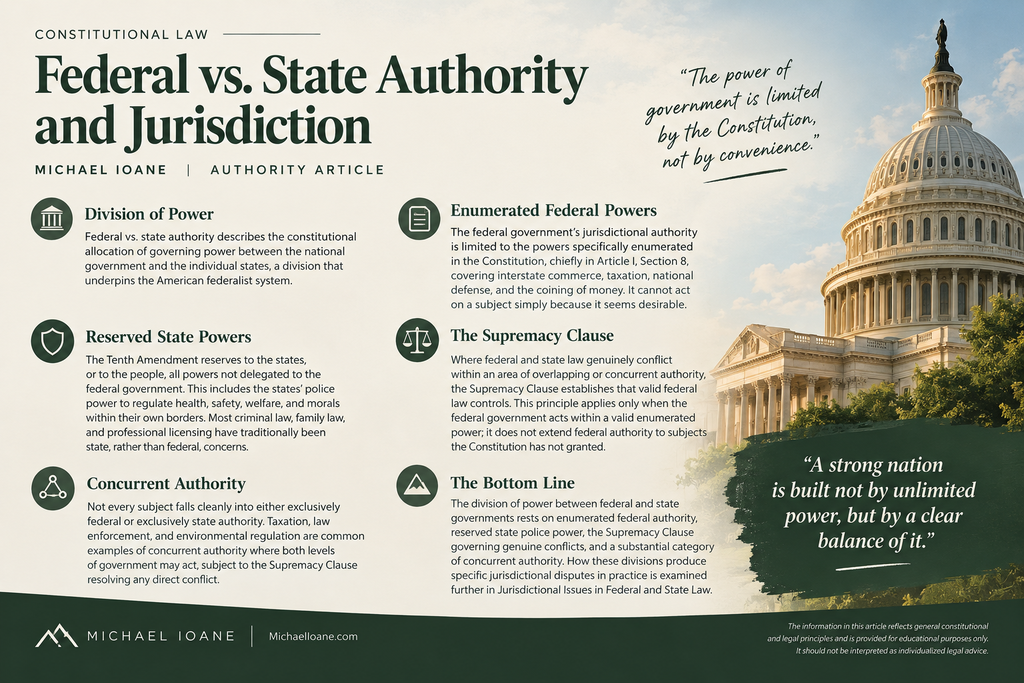
Federal vs. state authority describes the constitutional allocation of governing power between the national government and the individual states, a division that underpins the American federalist system rather than a simple grant of unlimited power to either level of government.
Michael Ioane treats this division as a structural principle deserving its own attention, since much constitutional litigation ultimately reduces to a dispute over which level of government, federal or state, has authority over a specific subject matter.
Enumerated Federal Powers
The federal government’s jurisdictional authority is limited to the powers specifically enumerated in the Constitution, chiefly in Article I, Section 8, covering subjects such as interstate commerce, taxation, national defense, and the coining of money. This enumerated structure means the federal government cannot act on a subject simply because doing so seems desirable; it must identify a specific constitutional grant of power authorizing the action.
Reserved State Powers
The Tenth Amendment reserves to the states, or to the people, all powers not delegated to the federal government, establishing what is generally described as the states’ police power, broad authority to regulate health, safety, welfare, and morals within their own borders. This reserved government structure is why matters such as most criminal law, family law, and professional licensing have traditionally been treated as primarily state, rather than federal, concerns.
The Supremacy Clause and Conflicts of Authority
Where federal and state law genuinely conflict within an area of overlapping or concurrent authority, the Supremacy Clause establishes that valid federal law controls, a principle confirmed early in constitutional history and discussed further in Jurisdictional Issues in Federal and State Law. This supremacy principle applies only when the federal government acts within a valid enumerated power; it does not extend federal authority to subjects the Constitution has not granted to the federal government.
Areas of Concurrent Authority
Not every subject falls cleanly into either exclusively federal or exclusively state authority; taxation, law enforcement, and environmental regulation are common examples of concurrent authority where both levels of government may act, subject to the Supremacy Clause resolving any direct conflict that arises. Understanding which subjects fall into this concurrent category, rather than assuming every regulatory question belongs exclusively to one level of government, is essential to correctly analyzing federal vs state authority questions.
Conclusion
The division of power between federal and state governments rests on enumerated federal authority, reserved state police power, the Supremacy Clause governing genuine conflicts, and a substantial category of concurrent authority in which both levels of government may act. How these divisions produce specific jurisdictional disputes in practice is examined further in Jurisdictional Issues in Federal and State Law.
The information in this article reflects general constitutional and legal principles and is provided for educational purposes only. It should not be interpreted as individualized legal advice.
Michael Ioane | MichaelIoane.com
Continue Learning with Michael Ioane
Build your understanding of asset protection and business planning with the Asset Protection Manual . Explore taxation and private trust planning in Boston Tea Party . Both books are available on Amazon.