Michael Ioane
Article IV
Summary Guide Article
Guide: Individual Rights and Government Authority
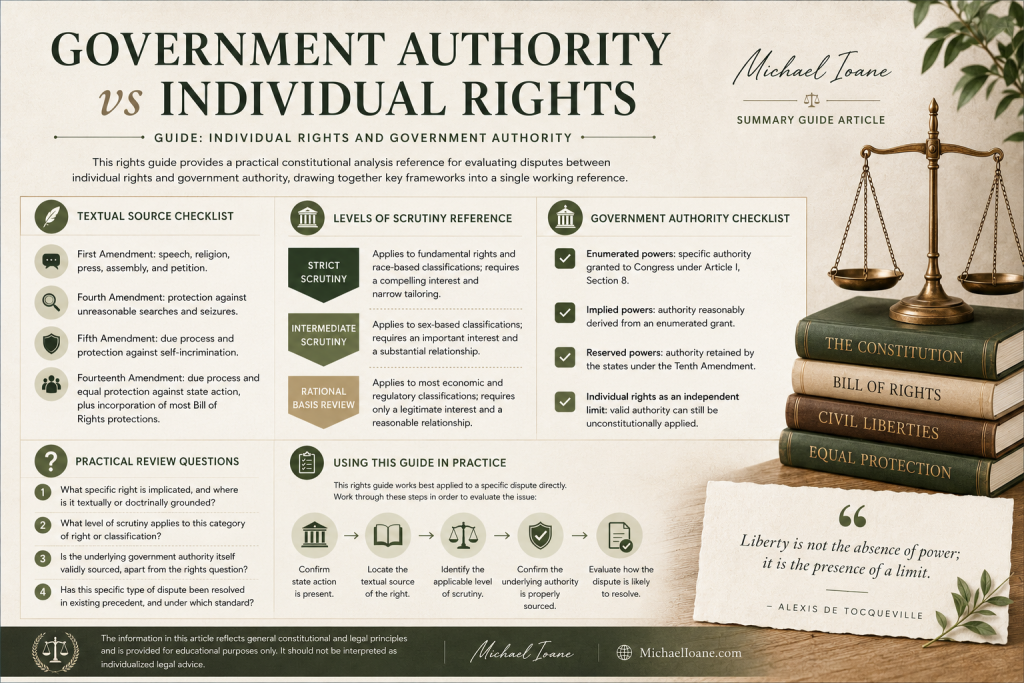
This rights guide provides a practical constitutional analysis reference for evaluating disputes between individual rights and government authority, drawing together the frameworks covered in Balance of Power Between Government and Individuals, Rights vs Government Authority, and Legal Framework of Individual Rights into a single working reference.
Michael Ioane structured this guide as a checklist for working through a specific rights question systematically, rather than as a full narrative explanation of each underlying concept.
Textual Source Checklist
- First Amendment: speech, religion, press, assembly, and petition
- Fourth Amendment: protection against unreasonable searches and seizures
- Fifth Amendment: due process and protection against self-incrimination
- Fourteenth Amendment: due process and equal protection against state action, plus incorporation of most Bill of Rights protections
Levels of Scrutiny Reference
- Strict scrutiny: applies to fundamental rights and race-based classifications; requires a compelling interest and narrow tailoring
- Intermediate scrutiny: applies to sex-based classifications; requires an important interest and a substantial relationship
- Rational basis review: applies to most economic and regulatory classifications; requires only a legitimate interest and a reasonable relationship
Government Authority Checklist
- Enumerated powers: specific authority granted to Congress under Article I, Section 8
- Implied powers: authority reasonably derived from an enumerated grant
- Reserved powers: authority retained by the states under the Tenth Amendment
- Individual rights as an independent limit: valid authority can still be unconstitutionally applied
Practical Review Questions
- What specific right is implicated, and where is it textually or doctrinally grounded
- What level of scrutiny applies to this category of right or classification
- Is the underlying government authority itself validly sourced, apart from the rights question
- Has this specific type of dispute been resolved in existing precedent, and under which standard
Using This Guide in Practice
This rights guide works best applied to a specific dispute directly: confirm state action is present, locate the textual source of the right, identify the applicable level of scrutiny, and separately confirm the underlying government authority is properly sourced, before reaching a conclusion about how the dispute is likely to resolve.
Michael Ioane applies this same layered review whenever a rights question arises alongside broader structural or entity analysis, treating the authority question and the rights question as related but distinct lines of inquiry that both need to be worked through rather than collapsed into a single, general impression.
Conclusion
Individual rights and government authority operate as two distinct, interacting constitutional mechanisms: authority that must be properly sourced, and rights that impose an independent limit on even validly sourced authority. This rights guide is intended as a working reference for tracing any specific dispute through both mechanisms systematically rather than resolving it through general impression alone.
The information in this article reflects general constitutional and legal principles and is provided for educational purposes only. It should not be interpreted as individualized legal advice.
Michael Ioane | MichaelIoane.com
Continue Learning with Michael Ioane
Build your understanding of asset protection and business planning with the Asset Protection Manual . Explore taxation and private trust planning in Boston Tea Party . Both books are available on Amazon.