Michael Ioane
Article III
Practical Article
Legal Framework of Individual Rights
Constitutional rights law is organized around a specific legal framework built primarily from the Bill of Rights, the post-Civil War amendments, and more than a century of judicial interpretation applying them to new circumstances. Understanding this framework practically requires knowing not just which rights exist, but where each one is textually grounded and how it has been interpreted and applied over time.
Michael Ioane approaches this framework the same way he approaches any structured body of law: by tracing each specific right back to its textual source and the body of precedent that has since defined its actual scope.
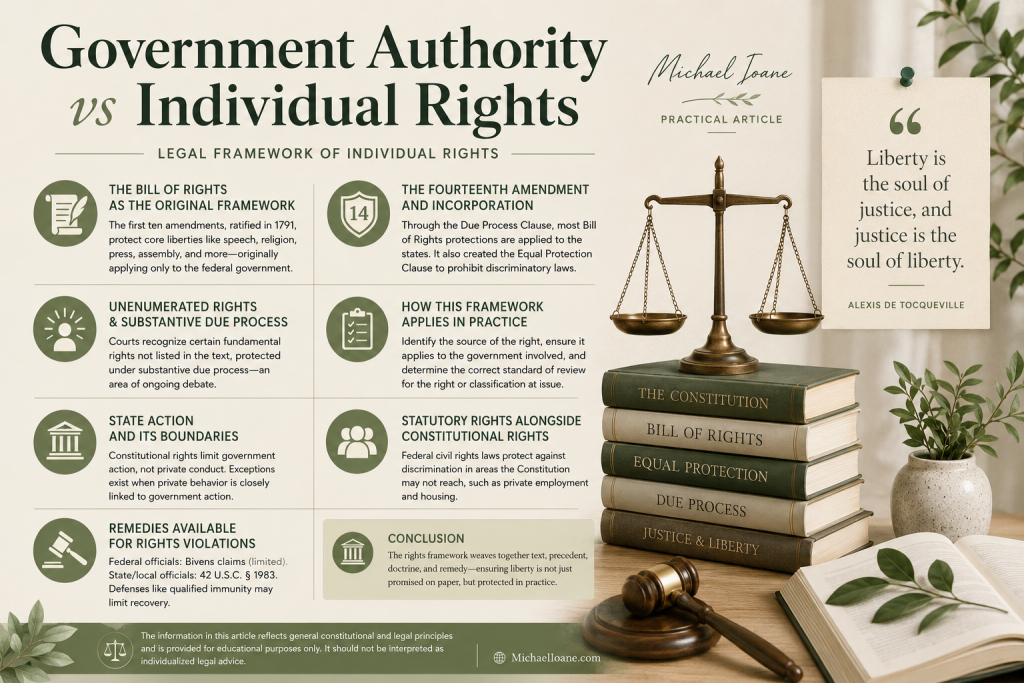
The Bill of Rights as the Original Framework
The first ten amendments, ratified in 1791, established the original core of individual rights protected against federal action: freedom of speech, religion, press, assembly, and petition under the First Amendment; protection against unreasonable searches and seizures under the Fourth; the right against self-incrimination and to due process under the Fifth; and further criminal procedure protections under the Sixth and Eighth. These provisions initially applied only to the federal government, not to the states.
The Fourteenth Amendment and Incorporation
Ratified in 1868, the Fourteenth Amendment’s Due Process Clause has been interpreted by the Supreme Court, through the doctrine of incorporation, to apply most of the Bill of Rights’ protections against state governments as well, a process that unfolded gradually over the twentieth century rather than all at once. The Fourteenth Amendment also independently established the Equal Protection Clause, which has become the primary textual basis for challenging discriminatory government classifications.
Unenumerated Rights and Substantive Due Process
Beyond the rights explicitly listed in the constitutional text, courts have recognized certain unenumerated rights as protected under the doctrine of substantive due process, reasoning that the liberty protected by the Due Process Clause extends to certain fundamental interests not specifically named in the text. This category of rights has generated significant and ongoing legal and scholarly debate over how courts should identify which unenumerated interests qualify as sufficiently fundamental to warrant this protection.
How This Framework Applies in Practice
Applying this legal framework to a specific dispute requires identifying the precise textual or doctrinal source of the right at issue, confirming whether and how it applies against the level of government actually involved, and determining the appropriate standard of review based on the category of right and any classification involved. Skipping any of these steps typically produces an incomplete or inaccurate assessment of how a specific rights claim is likely to fare.
State Action and Its Boundaries
Nearly all individual rights protections in the Constitution limit government action specifically, not the conduct of private individuals or organizations, a principle known as the state action doctrine. A private employer restricting an employee’s speech, for instance, does not raise a First Amendment issue in the way a government restriction would, because the constitutional protection applies against government, not private, action. Courts have recognized narrow exceptions where private conduct is sufficiently entangled with government action to be treated as state action, but these exceptions remain limited, and correctly identifying whether state action is present is a threshold question in nearly every rights case.
Statutory Rights Alongside Constitutional Rights
Constitutional rights law operates alongside a separate body of statutory civil rights protections, enacted by Congress under its own constitutional authority, including protections against discrimination in employment, housing, and public accommodations that in some respects extend further than the constitutional floor by reaching private conduct the Constitution itself does not directly reach. Understanding the legal framework of individual rights in practice often requires tracing both the constitutional and statutory sources of a given protection together, since they frequently overlap but are not identical in scope.
Remedies Available for Rights Violations
Establishing that a right has been violated is only part of the practical legal framework; the available remedy matters just as much. Constitutional violations by federal officials may support a claim under the doctrine established in Bivens v. Six Unknown Named Agents (1971), though the Supreme Court has narrowed that doctrine’s application significantly in recent decades, while violations by state and local officials are typically pursued under the federal civil rights statute codified at 42 U.S.C. Section 1983. Understanding which remedy applies, and what defenses such as qualified immunity may limit it, is a necessary final step in the practical framework.
Conclusion
The legal framework of individual rights rests on the original Bill of Rights, extended and supplemented by the Fourteenth Amendment’s incorporation doctrine and Equal Protection Clause, bounded by the state action doctrine, reinforced by statutory civil rights protection, and enforced through remedies like Bivens claims and Section 1983 actions, with an additional, more contested category of unenumerated rights recognized through substantive due process. Tracing any specific rights claim through this framework, from textual source through applicable precedent and remedy, is what allows a claim to be evaluated accurately rather than asserted in the abstract.
The information in this article reflects general constitutional and legal principles and is provided for educational purposes only. It should not be interpreted as individualized legal advice.
Michael Ioane | MichaelIoane.com
Continue Learning with Michael Ioane
Build your understanding of asset protection and business planning with the Asset Protection Manual . Explore taxation and private trust planning in Boston Tea Party . Both books are available on Amazon.