Michael Ioane
Article II
Deep Topic Article
Rights vs Government Authority
Authority vs rights disputes arise whenever a government action, otherwise within its proper constitutional authority, is challenged as violating a specific individual protection. Resolving these disputes requires identifying exactly which right is at stake, how directly the government action burdens it, and what level of judicial scrutiny applies to that particular category of right.
Michael Ioane treats this analytical structure as essential to any serious rights dispute: a claim that a right has been violated is only the starting point, not the conclusion, and the outcome typically turns on how the applicable legal standard is actually applied to the specific facts.
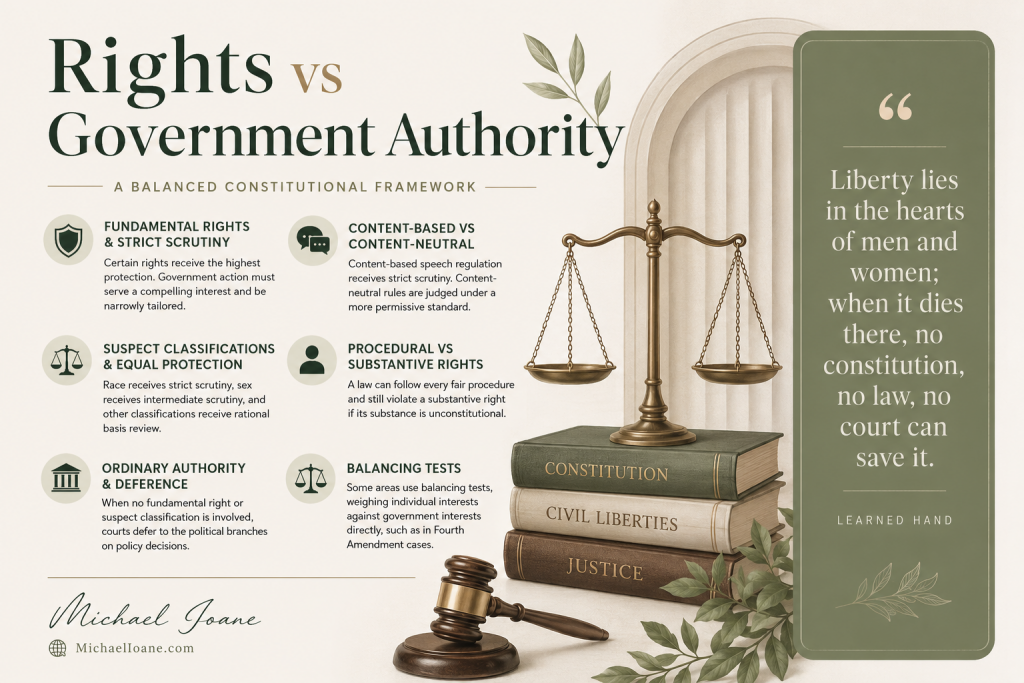
Fundamental Rights and Strict Scrutiny
Certain rights, including those explicitly enumerated in the Bill of Rights and others the Supreme Court has recognized as fundamental, receive the highest level of judicial protection, known as strict scrutiny. Under this standard, government action burdening the right must serve a compelling government interest and must be narrowly tailored to that interest, with no less restrictive alternative reasonably available. This is a demanding standard, and government action reviewed under it is frequently struck down.
Suspect Classifications and Equal Protection
Beyond specific enumerated rights, the Equal Protection Clause applies heightened scrutiny to government classifications based on characteristics the Supreme Court has identified as suspect, most notably race, which receives strict scrutiny, and, to a lesser degree, sex, which receives intermediate scrutiny. Classifications that do not implicate a suspect category, such as most economic and regulatory distinctions, receive rational basis review, a far more deferential standard under which the government need only show a legitimate interest and a reasonable relationship between the classification and that interest.
Ordinary Government Authority and Deference
Where no fundamental right or suspect classification is implicated, courts generally defer substantially to the political branches, recognizing that legislatures and executive agencies, not courts, are primarily responsible for economic and social policy. This deference reflects a considered judgment that authority vs rights disputes should not be resolved by converting every policy disagreement into a constitutional rights claim, reserving heightened judicial scrutiny for the categories of government action historically most prone to abuse.
Understanding which standard applies to a given dispute, strict scrutiny, intermediate scrutiny, or rational basis, is often more determinative of the outcome than the underlying facts themselves. For a closer look at how these standards are codified into a broader legal framework, see Legal Framework of Individual Rights.
Content-Based Versus Content-Neutral Regulation
Within First Amendment doctrine specifically, courts draw a further distinction between content-based regulation, which restricts speech because of its subject matter or viewpoint and receives strict scrutiny, and content-neutral regulation, such as reasonable time, place, and manner restrictions applied regardless of message, which receives a more permissive intermediate standard. This distinction illustrates how the general levels-of-scrutiny framework is further refined within specific rights categories to address the particular ways government authority can burden that right.
Procedural Versus Substantive Protections
Authority vs rights disputes also divide along a different axis: procedural rights, which govern the fair process government must follow before depriving someone of life, liberty, or property, and substantive rights, which limit what government may do at all, regardless of the process followed. A law can satisfy every procedural requirement, notice, hearing, appeal, and still violate a substantive right if its underlying substance is constitutionally impermissible. Distinguishing which type of protection is at stake is often necessary before the correct standard of review can even be identified.
The Role of Balancing Tests
In some areas of rights doctrine, courts apply an explicit balancing test rather than a fixed tier of scrutiny, weighing the strength of the individual interest against the strength of the government interest directly. Fourth Amendment reasonableness analysis often works this way, assessing the intrusiveness of a search or seizure against the government’s justification for it, rather than applying a single predetermined standard across every factual scenario. This flexibility allows the rights framework to adapt to a wide range of factual circumstances, though it can also make outcomes harder to predict in advance than under a fixed scrutiny tier.
Conclusion
Rights vs government authority disputes are resolved through a structured, calibrated system of judicial review, refined further by distinctions like content-based versus content-neutral regulation, procedural versus substantive protection, and, in some doctrines, direct balancing tests, rather than through a categorical preference for either government power or individual protection. Identifying which right is implicated, and which level of scrutiny applies to it, is the necessary first step in evaluating how any specific dispute between authority and rights is likely to be resolved.
The information in this article reflects general constitutional and legal principles and is provided for educational purposes only. It should not be interpreted as individualized legal advice.
Michael Ioane | MichaelIoane.com
Continue Learning with Michael Ioane
Build your understanding of asset protection and business planning with the Asset Protection Manual . Explore taxation and private trust planning in Boston Tea Party . Both books are available on Amazon.