Michael Ioane
Article IV
Summary Guide Article
Guide: Legal Risk Forecasting
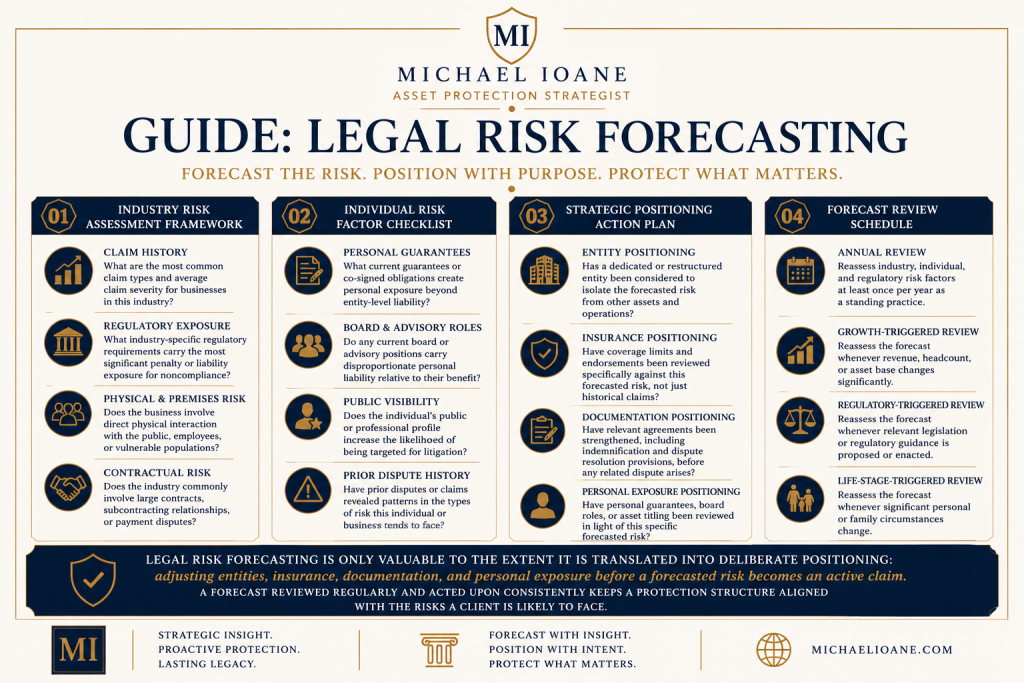
This guide provides a practical reference for forecasting legal risk and translating that forecast into concrete positioning decisions. The frameworks here reflect Michael Ioane’s approach to identifying industry, individual, and regulatory risk factors and to using that forecast to shape entity structure, insurance, and documentation before a forecasted risk becomes an active claim.
Industry Risk Assessment Framework
Evaluate the following industry-specific risk factors:
- Claim history: what are the most common claim types and average claim severity for businesses in this industry
- Regulatory exposure: what industry-specific regulatory requirements carry the most significant penalty or liability exposure for noncompliance
- Physical and premises risk: Does the business involve direct physical interaction with the public, employees, or vulnerable populations
- Contractual risk: Does the industry commonly involve large contracts, subcontracting relationships, or payment disputes that create elevated liability
Individual Risk Factor Checklist
Assess the following individual-specific risk factors:
- Personal guarantees: what current guarantees or co-signed obligations create personal exposure beyond entity-level liability
- Board and advisory roles: Do any current board or advisory positions carry disproportionate personal liability relative to their benefit
- Public visibility: Does the individual’s public or professional profile increase the likelihood of being targeted for litigation
- Prior dispute history: have prior disputes or claims revealed patterns in the types of risk this individual or business tends to face
Strategic Positioning Action Plan
For each significant forecasted risk identified, confirm the following positioning steps:
- Entity positioning: has a dedicated or restructured entity been considered to isolate the forecasted risk from other assets and operations
- Insurance positioning: have coverage limits and endorsements been reviewed specifically against this forecasted risk, not just historical claims
- Documentation positioning: Have relevant agreements been strengthened, including indemnification and dispute resolution provisions, before any related dispute arises
- Personal exposure positioning: Have personal guarantees, board roles, or asset titling been reviewed in light of this specific forecasted risk
Forecast Review Schedule
Revisit the risk forecast on the following schedule and triggers:
- Annual review: reassess industry, individual, and regulatory risk factors at least once per year as a standing practice
- Growth-triggered review: reassess the forecast whenever revenue, headcount, or asset base changes significantly
- Regulatory-triggered review: reassess the forecast whenever relevant legislation or regulatory guidance is proposed or enacted
- Life-stage-triggered review: reassess the forecast whenever significant personal or family circumstances change
Legal risk forecasting is only valuable to the extent it is translated into deliberate positioning: adjusting entities, insurance, documentation, and personal exposure before a forecasted risk becomes an active claim. A forecast reviewed regularly and acted upon consistently keeps a protection structure aligned with the risks a client is likely to face.
The information in this article reflects general structural principles and practical observations from consulting experience and is provided for educational purposes only. It should not be interpreted as individualized legal or tax advice.
Michael Ioane | MichaelIoane.com
Continue Learning with Michael Ioane
Build your understanding of asset protection and business planning with the Asset Protection Manual . Explore taxation and private trust planning in Boston Tea Party . Both books are available on Amazon.