Michael Ioane
Article IV
Summary Guide Article
Guide: Compliance and Strategic Protection
This guide provides a practical reference for distinguishing legal compliance obligations from strategic asset protection planning, and for evaluating whether an existing structure has addressed both. The frameworks here reflect Michael Ioane’s approach to auditing a business’s or an individual’s current position against both the compliance and protection standards and identifying gaps between the two.
Compliance Obligation Checklist
Confirm the following compliance obligations are fully satisfied:
- Business licensing: all required state, county, and municipal business licenses are current and properly filed
- Tax registration and filing: all applicable federal, state, and local tax filings are current, including entity-level and payroll tax obligations
- Corporate formalities: annual reports, registered agent designations, and required governance filings are current for every entity
- Beneficial ownership reporting: Corporate Transparency Act filings are current for all applicable domestic entities
- Minimum insurance: all legally required insurance coverages, including workers’ compensation and any lender or landlord requirements, are in place
Strategic Protection Gap Assessment
Separately evaluate whether the following strategic protections are in place, independent of compliance status:
- Entity separation: are high-risk operating activities separated from passive assets and from each other along functional lines
- Jurisdiction selection: are entities and trusts formed or administered in jurisdictions with strong charging order, veil-piercing, or asset protection trust statutes
- Trust design: do any existing trusts provide genuine creditor protection, or are they limited to probate avoidance with full settlor control and access
- Insurance adequacy: Do coverage limits and umbrella policies reflect the actual risk profile of the business and assets, beyond the legal minimum
- Personal guarantee exposure: have outstanding personal guarantees been identified and evaluated for their effect on entity-level protection
Two-Question Framework for New Decisions
Apply both questions separately to every new asset, activity, or transaction:
- Compliance question: What licensing, tax, disclosure, or regulatory obligations does this new activity or asset trigger, and have each been satisfied
- Protection question: if a creditor obtains a judgment arising from this activity or asset, what specifically would that creditor be able to reach under the current ownership and entity structure
- Structural fit: Does the appropriate entity, jurisdiction, and ownership arrangement already exist to hold this new activity or asset, or does the structure need to be expanded
- Documentation: has the compliance and protection analysis for this specific addition been documented, rather than assumed to be covered by prior planning
Closing the Gap Between Compliance and Protection
Where the assessment above reveals a gap, prioritize closing it in the following order:
- Address any active compliance deficiencies first, since these carry immediate regulatory and penalty exposure
- Separate the highest-risk activities and assets into appropriately structured entities before addressing lower-risk categories
- Select or reform jurisdiction and trust arrangements for any structure currently formed or administered in a jurisdiction with weak protective statutes
- Review and adjust insurance coverage to reflect actual risk exposure, not merely the legal minimum
- Revisit the full assessment periodically, since new activities, new assets, and changes in applicable law can reopen gaps between compliance and protection over time
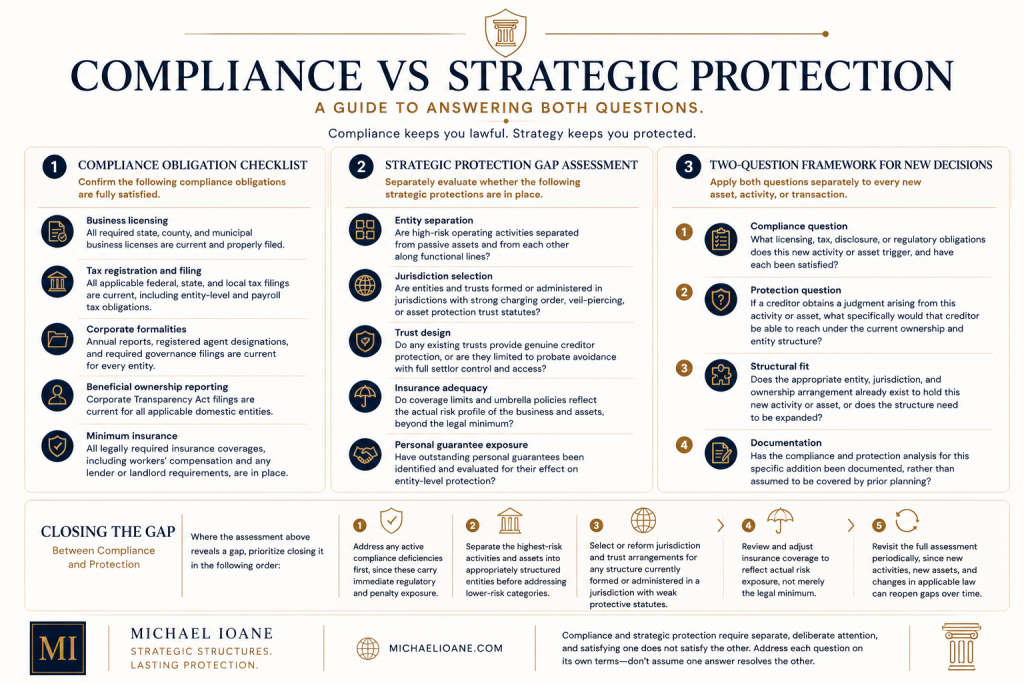
Compliance and strategic protection require separate, deliberate attention, and satisfying one does not satisfy the other. A structure that is both fully compliant and strategically protected is the product of addressing each question on its own terms, not of assuming that resolving one automatically resolves the other.
The information in this article reflects general structural principles and practical observations from consulting experience and is provided for educational purposes only. It should not be interpreted as individualized legal or tax advice.
Michael Ioane | MichaelIoane.com
Continue Learning with Michael Ioane
Build your understanding of asset protection and business planning with the Asset Protection Manual . Explore taxation and private trust planning in Boston Tea Party . Both books are available on Amazon.