Michael Ioane
Article IV
Summary Guide Article
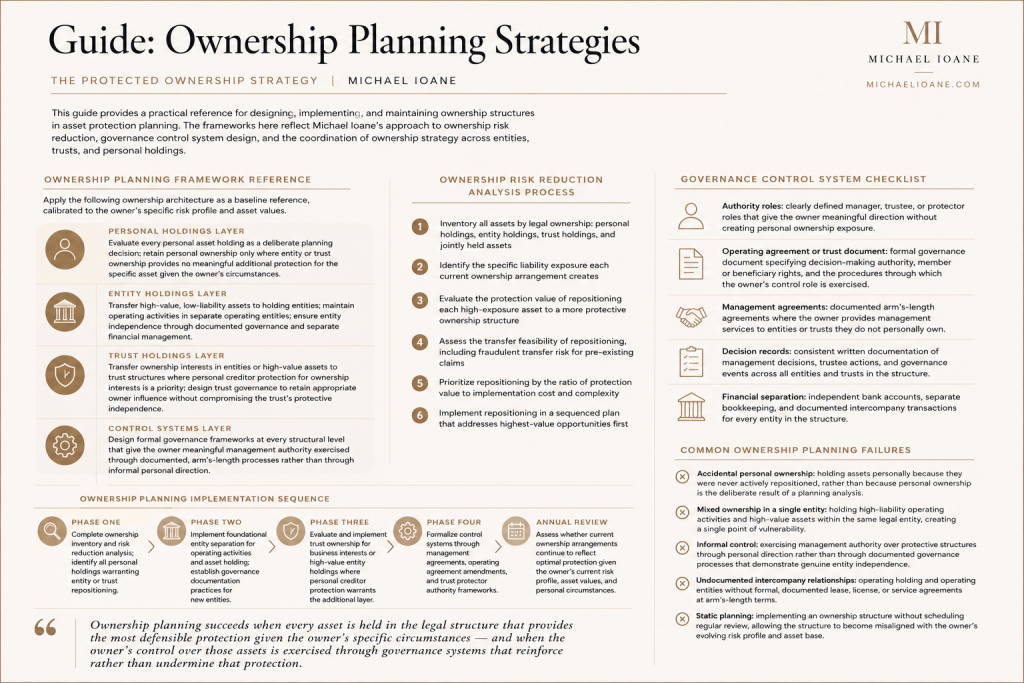
Guide: Ownership Planning Strategies
This guide provides a practical reference for designing, implementing, and maintaining ownership structures in asset protection planning. The frameworks here reflect Michael Ioane’s approach to ownership risk reduction, governance control system design, and the coordination of ownership strategy across entities, trusts, and personal holdings.
Ownership Planning Framework Reference
Apply the following ownership architecture as a baseline reference, calibrated to the owner’s specific risk profile and asset values:
Personal holdings layer: evaluate every personal asset holding as a deliberate planning decision; retain personal ownership only where entity or trust ownership provides no meaningful additional protection for the specific asset given the owner’s circumstances.
Entity holdings layer: transfer high-value, low-liability assets to holding entities; maintain operating activities in separate operating entities; ensure entity independence through documented governance and separate financial management.
Trust holdings layer: transfer ownership interests in entities or high-value assets to trust structures where personal creditor protection for ownership interests is a priority; design trust governance to retain appropriate owner influence without compromising the trust’s protective independence.
Control systems layer: design formal governance frameworks at every structural level that give the owner meaningful management authority exercised through documented, arm’s-length processes rather than through informal personal direction.
Ownership Risk Reduction Analysis Process
Conduct an ownership risk reduction analysis using the following process:
• Inventory all assets by legal ownership: personal holdings, entity holdings, trust holdings, and jointly held assets
• Identify the specific liability exposure each current ownership arrangement creates
• Evaluate the protection value of repositioning each high-exposure asset to a more protective ownership structure
• Assess the transfer feasibility of repositioning, including fraudulent transfer risk for pre-existing claims
• Prioritize repositioning by the ratio of protection value to implementation cost and complexity
• Implement repositioning in a sequenced plan that addresses highest-value opportunities first
Governance Control System Checklist
For each protective structure in the ownership plan, verify the following governance control components:
• Authority roles: clearly defined manager, trustee, or protector roles that give the owner meaningful direction without creating personal ownership exposure
• Operating agreement or trust document: formal governance document specifying decision-making authority, member or beneficiary rights, and the procedures through which the owner’s control role is exercised
• Management agreements: documented arm’s-length agreements where the owner provides management services to entities or trusts they do not personally own
• Decision records: consistent written documentation of management decisions, trustee actions, and governance events across all entities and trusts in the structure
• Financial separation: independent bank accounts, separate bookkeeping, and documented intercompany transactions for every entity in the structure
Ownership Planning Implementation Sequence
Implement ownership planning structures using the following phased sequence:
• Phase one: complete ownership inventory and risk reduction analysis; identify all personal holdings warranting entity or trust repositioning
• Phase two: implement foundational entity separation for operating activities and asset holding; establish governance documentation practices for new entities
• Phase three: evaluate and implement trust ownership for business interests or high-value entity holdings where personal creditor protection warrants the additional layer
• Phase four: formalize control systems through management agreements, operating agreement amendments, and trust protector authority frameworks
• Annual review: assess whether current ownership arrangements continue to reflect optimal protection given the owner’s current risk profile, asset values, and personal circumstances
Common Ownership Planning Failures
Avoid the following ownership planning failures that reduce or eliminate the protection of an otherwise well-designed structure:
• Accidental personal ownership: holding assets personally because they were never actively repositioned, rather than because personal ownership is the deliberate result of a planning analysis
• Mixed ownership in a single entity: holding high-liability operating activities and high-value assets within the same legal entity, creating a single point of vulnerability
• Informal control: exercising management authority over protective structures through personal direction rather than through documented governance processes that demonstrate genuine entity independence
• Undocumented intercompany relationships: operating holding and operating entities without formal, documented lease, license, or service agreements at arm’s-length terms
• Static planning: implementing an ownership structure without scheduling regular review, allowing the structure to become misaligned with the owner’s evolving risk profile and asset base
“Ownership planning succeeds when every asset is held in the legal structure that provides the most defensible protection given the owner’s specific circumstances — and when the owner’s control over those assets is exercised through governance systems that reinforce rather than undermine that protection.”
The information in this article reflects general structural principles and practical observations from consulting experience and is provided for educational purposes only. It should not be interpreted as individualized legal or tax advice.
Michael Ioane | MichaelIoane.com
Continue Learning with Michael Ioane
Build your understanding of asset protection and business planning with the Asset Protection Manual . Explore taxation and private trust planning in Boston Tea Party . Both books are available on Amazon.