Michael Ioane
Article I
Deep Topic Article
Structural Benefits of Corporate Entities
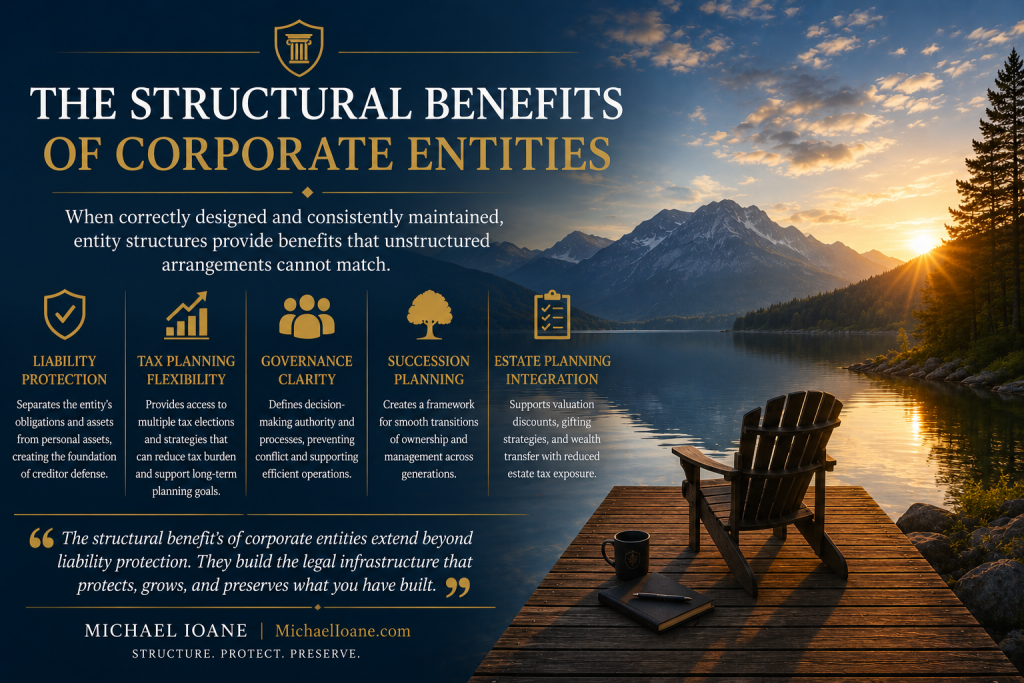
Corporate asset protection and the structural benefits of entity form are most fully realized when the entity structure is designed not just for its immediate protection purpose but for the full range of benefits that a well-maintained entity provides over the arc of a business’s lifetime. An entity that provides liability protection, tax planning flexibility, governance clarity, and succession planning infrastructure simultaneously is a more valuable business asset than one designed only for a single purpose, and the investment in designing it comprehensively from the outset is repaid across all of these dimensions.
Michael Ioane addresses the full range of structural benefits in entity design engagements because the most durable and valuable entity structures are those that serve multiple planning objectives coherently rather than optimizing for a single objective at the expense of the others.
Liability Protection as the Foundational Benefit
The foundational structural benefit of any corporate entity is the liability protection that separate legal personhood provides. The entity’s obligations are its own; the entity’s assets belong to it. A creditor of the entity cannot automatically reach the owner’s personal assets, and a creditor of the owner cannot automatically reach the entity’s assets. This separation is the starting point for all other structural benefits.
The liability protection benefit is conditional on consistent maintenance of the entity’s separate status. Entity benefits that are realized only at formation but erode through operational neglect are not durable benefits; they are temporary protections that disappear under the pressure of litigation discovery. The entity that provides genuine long-term liability protection is the one whose governance discipline makes the separation real and demonstrable in the evidentiary record.
Tax Planning Benefits of Entity Structure
Entity structure provides significant tax planning flexibility that unstructured business activity cannot access. A single-member LLC or a multi-member LLC can elect to be treated as a corporation for income tax purposes, providing access to the specific tax planning opportunities that corporate tax status offers. An S corporation election may allow business income to be characterized in ways that reduce the owner’s self-employment tax exposure. A C corporation may offer specific tax planning opportunities when accumulating earnings within the entity is advantageous.
The tax planning benefits of entity structure interact with the protection benefits in ways that require coordinated planning. The entity structure that provides the strongest protection may not provide the most favorable tax treatment, and the structure that provides the most favorable tax treatment may create protection complications. Business structure planning that addresses both dimensions simultaneously, rather than optimizing for one and then retrofitting the other, produces entity structures that deliver the maximum combined benefit.
Governance Clarity and Operational Benefits
A well-designed entity structure provides operational benefits beyond protection and tax planning. Clear governance documents that define decision-making authority, specify how significant decisions are made, and establish the processes for resolving disputes between owners provide a framework for managing the business that prevents the governance conflicts that frequently arise in unstructured or poorly structured business arrangements.
The governance clarity benefit is particularly significant for businesses with multiple owners, where the absence of clear governance documents can lead to ambiguous authority, generating conflicts that damage both the business’s operations and the owners’ relationships. An operating agreement or shareholders’ agreement that clearly defines each owner’s rights, responsibilities, and authority creates a stable governance framework that supports the business’s operations while simultaneously providing the documented governance structure that entity protection requires.
Succession Planning Benefits
Entity structures that include explicit succession provisions offer significant succession planning benefits that unstructured asset holding cannot. A business held through an LLC or corporation whose governing documents address what happens to the owner’s interest at death, how management authority transfers, and how buyout obligations are calculated and funded can be transitioned to the next generation, co-owners, or third-party buyers with minimal disruption to operations.
The succession-planning benefits of entity structure are most valuable when incorporated into the entity’s design from the outset rather than added reactively when succession becomes imminent. Governing documents that address succession clearly, buy-sell agreements that define the terms on which interests transfer, and governance structures that do not depend on any single individual’s continued participation create entities that are assets across multiple generations rather than dependencies that terminate with the founding owner.
Estate Planning Integration
Entity structures offer significant opportunities to align with estate planning objectives, particularly for business owners with substantial accumulated wealth. LLC membership interests and corporate shares may qualify for valuation discounts for lack of marketability and lack of control for estate tax purposes, reducing the taxable value of the owner’s estate while the full economic value of the business remains within the family. These valuation discount strategies require genuine governance restrictions that make the discounts defensible under IRS scrutiny.
Michael Ioane designs entity structures with estate planning integration as a standing design consideration, because the entity whose governance documents support valuation discounts, facilitate the transfer of interests to the next generation through gifting programs, and maintain the family’s management control through the transfer period is delivering estate planning benefits simultaneously with its protection and operational benefits.
The structural benefits of corporate entities extend beyond liability protection. When correctly designed and consistently maintained, they provide a legal framework for operational efficiency, governance clarity, estate planning, and creditor defense that no unstructured arrangement can match.
The information in this article reflects general structural principles and practical observations from consulting experience and is provided for educational purposes only. It should not be interpreted as individualized legal or tax advice.
Michael Ioane | MichaelIoane.com
Continue Learning with Michael Ioane
Build your understanding of asset protection and business planning with the Asset Protection Manual . Explore taxation and private trust planning in Boston Tea Party . Both books are available on Amazon.