Michael Ioane
Article IV
Summary Guide Article
Guide: Risk Layering Strategies
This guide provides a practical reference for designing and maintaining layered asset protection strategies. The frameworks here reflect Michael Ioane’s approach to multi-layer defense design, layer interaction management, and the governance discipline required to maintain strategic depth over time.
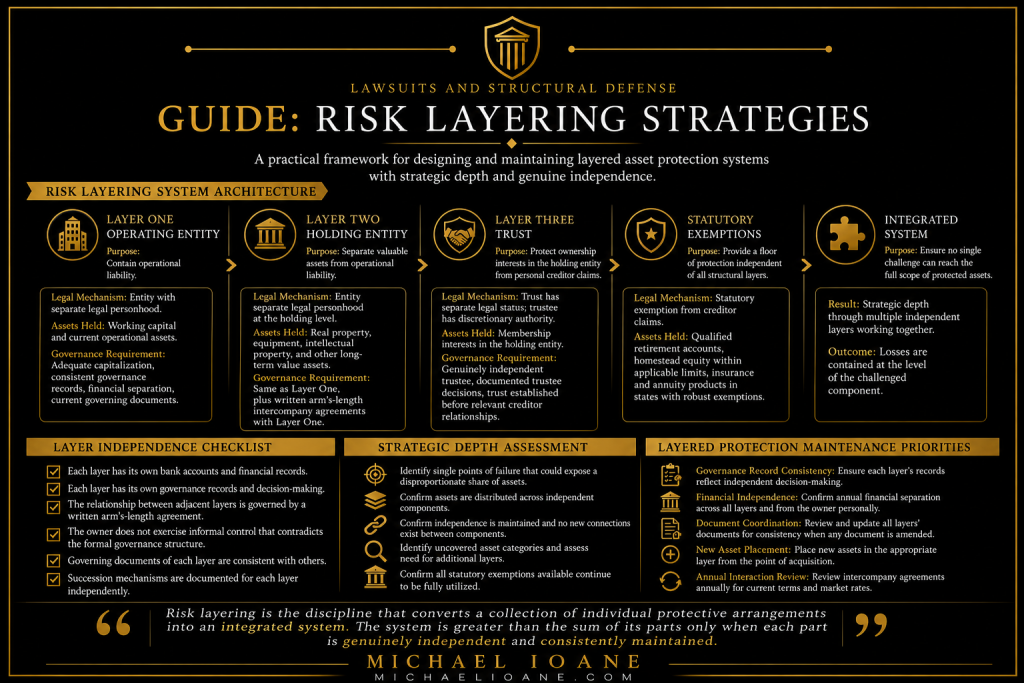
Risk Layering System Architecture
Design the layered protection system using the following architecture as a baseline, calibrating the number of layers to the owner’s specific risk profile and administrative capacity:
- Layer One: Operating entity. Purpose: contain operational liability. Legal mechanism: entity with separate legal personhood. Assets held: working capital and current operational assets only. Governance requirement: adequate capitalization, consistent governance records, financial separation, current governing documents.
- Layer Two: Holding entity. Purpose: separate valuable assets from operational liability. Legal mechanism: entity separate legal personhood at the holding level. Assets held: real property, equipment, intellectual property, and other long-term value assets. Governance requirement: same as Layer One, plus written arm’s-length intercompany agreements with Layer One.
- Layer Three: Trust. Purpose: protect the ownership interests in the holding entity from personal creditor claims. Legal mechanism: trust has a separate legal status, and the trustee has discretionary authority. Assets held: membership interests in the holding entity. Governance requirement: genuinely independent trustee, documented trustee decisions, trust established before relevant creditor relationships.
- Statutory exemptions: purpose: provide a floor of protection independent of all structural layers. Legal mechanism: statutory exemption from creditor claims. Assets held: qualified retirement account assets, homestead equity within applicable limits, insurance and annuity products in states with robust exemptions.
Layer Independence Checklist
Confirm genuine independence between each pair of adjacent layers through the following checklist:
- Each layer has its own bank accounts and financial records that reflect only that layer’s financial activity
- Each layer has its own governance records documenting decisions made through that layer’s specific governance process
- The relationship between each pair of adjacent layers is governed by a written arm’s-length agreement
- The owner does not exercise informal control over any layer in ways that contradict the formal governance structure of that layer
- The governing documents of each layer are consistent with the governing documents of the other layers
- Succession mechanisms are documented for the governance roles in each layer independently
Strategic Depth Assessment
Conduct the following strategic depth assessment at each annual review:
- Identify any single points of failure in the current structure: components whose defeat would expose a disproportionate share of the owner’s protected assets
- Confirm that valuable assets are distributed across independent components so that no single legal challenge can reach the full portfolio
- Confirm that the independence between all components has been maintained and that no connections have developed between components that would allow a claim against one to reach the assets of another
- Identify any asset categories that are not covered by the layered structure and assess whether additional layers are warranted
- Confirm that all statutory exemptions available in the relevant jurisdiction continue to be fully utilized
Layered Protection Maintenance Priorities
Maintain the layered protection system through the following prioritized practices:
- Governance record consistency: ensure that the governance records of each layer reflect that layer’s independent decision-making rather than showing the same person making all decisions across all layers in the same informal manner
- Financial independence: confirm annually that each layer’s financial records reflect genuine financial separation from all other layers and from the owner personally
- Document coordination: whenever any layer’s governing documents are amended, review all other layers’ documents for consistency and update as needed
- New asset placement: establish a protocol for placing newly acquired assets in the appropriate layer of the structure from the point of acquisition rather than acquiring them personally and transferring them later
- Annual interaction review: review the intercompany agreements between adjacent layers annually to confirm that they reflect current asset use arrangements and current market rate terms
Risk layering is the discipline that converts a collection of individual protective arrangements into an integrated system. The system is greater than the sum of its parts only when each part is genuinely independent and consistently maintained.
The information in this article reflects general structural principles and practical observations from consulting experience and is provided for educational purposes only. It should not be interpreted as individualized legal or tax advice.
Michael Ioane | MichaelIoane.com
Continue Learning with Michael Ioane
Build your understanding of asset protection and business planning with the Asset Protection Manual . Explore taxation and private trust planning in Boston Tea Party . Both books are available on Amazon.