Michael Ioane
Article IV
Summary Guide Article
Guide: Liability Protection Strategy
This guide provides a practical reference for designing and maintaining a comprehensive liability protection strategy. The frameworks here reflect Michael Ioane’s approach to structural containment, barrier design, operational risk reduction, and ongoing maintenance as integrated components of a complete liability protection system.
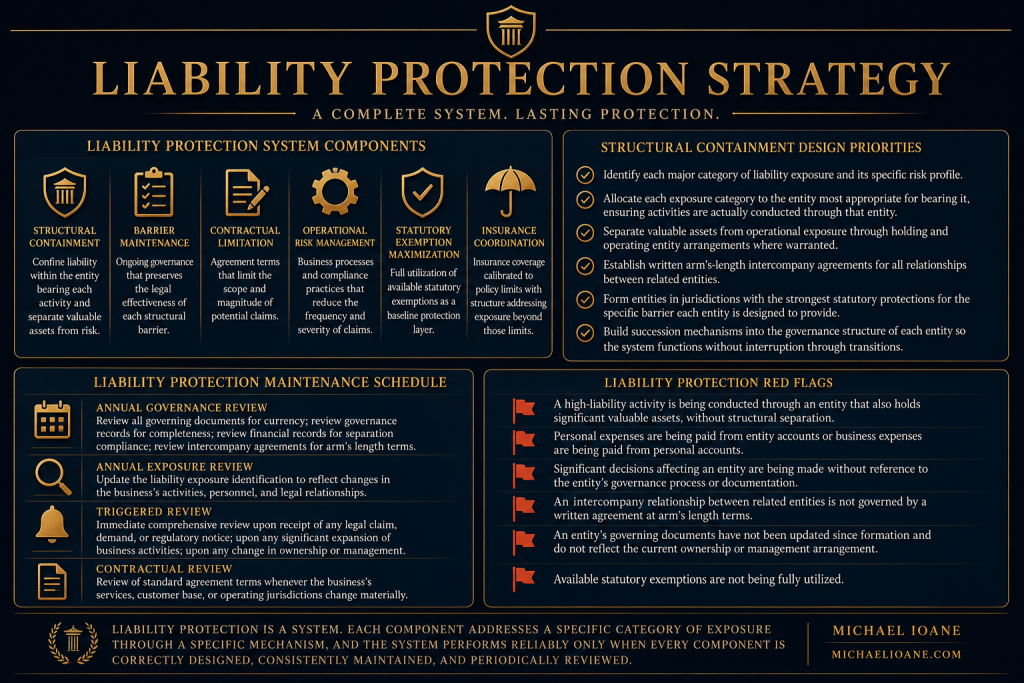
Liability Protection System Components
A complete liability protection strategy addresses each of the following system components:
• Structural containment: entity and trust structures that confine liability within the entity bearing each activity category, and that separate valuable assets from liability-generating operations
• Barrier maintenance: ongoing governance practices that preserve the legal effectiveness of each structural barrier, including consistent entity governance, financial separation, and current governing documents
• Contractual limitation: agreement terms that limit the scope and magnitude of potential claims in each major category of business relationship
• Operational risk management: business processes and compliance practices that reduce the frequency and severity of events that give rise to claims
• Statutory exemption maximization: full utilization of available statutory exemptions in the relevant jurisdiction as a baseline protection layer
• Insurance coordination: insurance coverage calibrated to cover claims within policy limits, with structural defense addressing exposure beyond insurance limits
Structural Containment Design Priorities
Design the structural containment system using the following priorities:
• Identify each major category of the business’s liability exposure and its specific risk profile
• Allocate each exposure category to the entity most appropriate for bearing it, ensuring that the activities generating that exposure are actually conducted through that entity
• Separate valuable assets from operational exposure through holding and operating entity arrangements where the asset value warrants the administrative cost
• Establish written arm’s-length intercompany agreements for all relationships between related entities
• Form entities in jurisdictions with the strongest statutory protections for the specific barrier each entity is designed to provide
• Build succession mechanisms into the governance structure of each entity so that the containment system functions without interruption through personnel transitions
Liability Protection Maintenance Schedule
Maintain the effectiveness of the liability protection system through the following scheduled activities:
• Annual governance review: review all governing documents for currency; review governance records for completeness; review financial records for separation compliance; review intercompany agreements for arm’s length terms
• Annual exposure review: update the liability exposure identification to reflect changes in the business’s activities, personnel, and legal relationships
• Triggered review: immediate comprehensive review upon receipt of any legal claim, demand, or regulatory notice; upon any significant expansion of business activities; upon any change in ownership or management
• Contractual review: review of standard agreement terms whenever the business’s services, customer base, or operating jurisdictions change materially
Liability Protection Red Flags
Address the following red flags immediately when identified in the liability protection system:
• A high-liability activity is being conducted through an entity that also holds significant valuable assets, without structural separation between the activity and the assets
• Personal expenses are being paid from entity accounts or business expenses are being paid from personal accounts
• Significant decisions affecting an entity are being made without reference to the entity’s governance process or documentation
• An intercompany relationship between related entities is not governed by a written agreement at arm’s length terms
• An entity’s governing documents have not been updated since formation and do not reflect the current ownership or management arrangement
• Available statutory exemptions are not being fully utilized
Liability protection is a system. Each component addresses a specific category of exposure through a specific mechanism, and the system performs reliably only when every component is correctly designed, consistently maintained, and periodically reviewed.
The information in this article reflects general structural principles and practical observations from consulting experience and is provided for educational purposes only. It should not be interpreted as individualized legal or tax advice.
Michael Ioane | MichaelIoane.com
Continue Learning with Michael Ioane
Build your understanding of asset protection and business planning with the Asset Protection Manual . Explore taxation and private trust planning in Boston Tea Party . Both books are available on Amazon.