Michael Ioane
Article III
Practical Article
Strategic Defense in Asset Protection
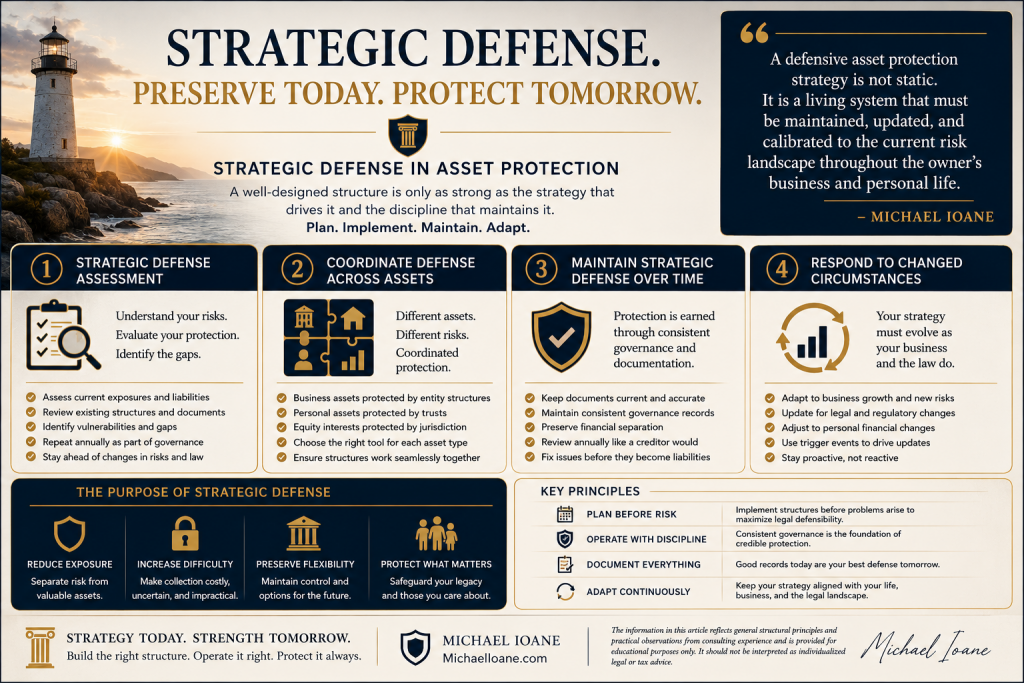
Asset defense strategy is the practical implementation of the structural and positioning principles of asset protection into a coherent plan that addresses the specific risks a business owner faces through the structural mechanisms best suited to those risks, and is maintained with the operational discipline required to preserve the plan’s legal effectiveness over time. It is a system rather than a document, because the protection it provides depends not on what the plan says but on how it is operated.
Michael Ioane designs asset defense strategies as integrated systems that coordinate the structural elements, the governance requirements, and the ongoing maintenance practices into a coherent whole. The strategy that is coherently designed at implementation and consistently maintained over time is the strategy that delivers its intended protection when claims actually arise.
The Strategic Defense Assessment
Every effective asset defense strategy begins with an assessment of the current structural arrangements, the current exposure profile, and the gaps between the protection the current structures provide and the protection the current exposure profile requires. This assessment asks: what risks does the owner currently face, what protections are currently in place, and where are the vulnerabilities that need to be addressed?
The assessment should be conducted at the outset of any new planning engagement and repeated annually as a component of the governance review process. Legal defense planning that was adequate for the owner’s risk profile three years ago may no longer be adequate today if the business has grown, new activities have been added, new obligations have been assumed, or the legal environment in the relevant jurisdictions has changed. The strategic defense assessment is the mechanism for identifying and correcting these gaps before they are exploited.
Coordinating Defense Across Asset Categories
An effective asset defense strategy addresses different asset categories through the mechanisms best suited to protecting each. Business assets, including the operating business, its equipment, and its intellectual property, are best protected through entity structures that separate operational liability from asset value. Personal assets, including personal financial accounts, real property, and investments, are best protected through a combination of trust structures and statutory exemptions. Business equity interests are best protected through entity structures with strong charging order protection in favorable jurisdictions.
The coordination between these mechanisms requires attention to the interaction between them: a trust that holds LLC membership interests must be designed so that the trust’s provisions are consistent with the LLC’s operating agreement, and the combined structure must be analyzed for any legal vulnerabilities that arise from the interaction rather than from either component individually. Asset protection tactics that address each category independently, without accounting for interactions, produce structures with gaps at exactly the boundaries between categories.
Maintaining Strategic Defense Over Time
The most carefully designed strategic defense loses its effectiveness if it is not maintained with the governance discipline required by the law. Governing documents that are not updated when circumstances change describe a structure that no longer exists. Governance records that are not maintained consistently provide the evidentiary ammunition for veil-piercing claims. Financial records that show commingling undermine the financial separation that entity law requires. Each of these maintenance failures, allowed to accumulate over time, transforms a well-designed defensive structure into a liability.
Legal defense planning and maintenance require an annual review that examines the current state of the governing documents, governance records, financial separation practices, and intercompany agreements between related entities. The review should ask the same questions that a creditor’s attorney would ask in discovery: do the documents describe the structure as it actually operates, do the records demonstrate consistent governance discipline, and is there any evidentiary basis for challenging the structure’s legitimacy? Identifying and correcting the answers to those questions before a creditor finds them is the purpose of strategic defense maintenance.
Responding to Changed Circumstances
Strategic defense requires adaptation as the owner’s circumstances change. A business that expands into new activities acquires new liability exposure that the existing structure may not address. A change in the owner’s personal financial situation may affect the adequacy of the existing personal asset protection arrangements. A change in applicable law may affect the effectiveness of specific structural elements that relied on particular statutory provisions.
Michael Ioane treats strategic defense as a dynamic system that must be updated in response to material changes in the owner’s circumstances, the legal landscape, and the risk environment. The update process is most efficient when it is triggered by defined events, including business expansions, new obligations, significant asset acquisitions, and changes in applicable law, and conducted through the annual governance review process for changes that do not warrant an immediate response.
A defensive asset protection strategy is not static. It is a living system that must be maintained, updated, and calibrated to the current risk landscape throughout the owner’s business and personal financial life.
The information in this article reflects general structural principles and practical observations from consulting experience and is provided for educational purposes only. It should not be interpreted as individualized legal or tax advice.
Michael Ioane | MichaelIoane.com
Continue Learning with Michael Ioane
Build your understanding of asset protection and business planning with the Asset Protection Manual . Explore taxation and private trust planning in Boston Tea Party . Both books are available on Amazon.