Michael Ioane
Article I
AUTHORITY ARTICLE
Planning Beyond Immediate Risk
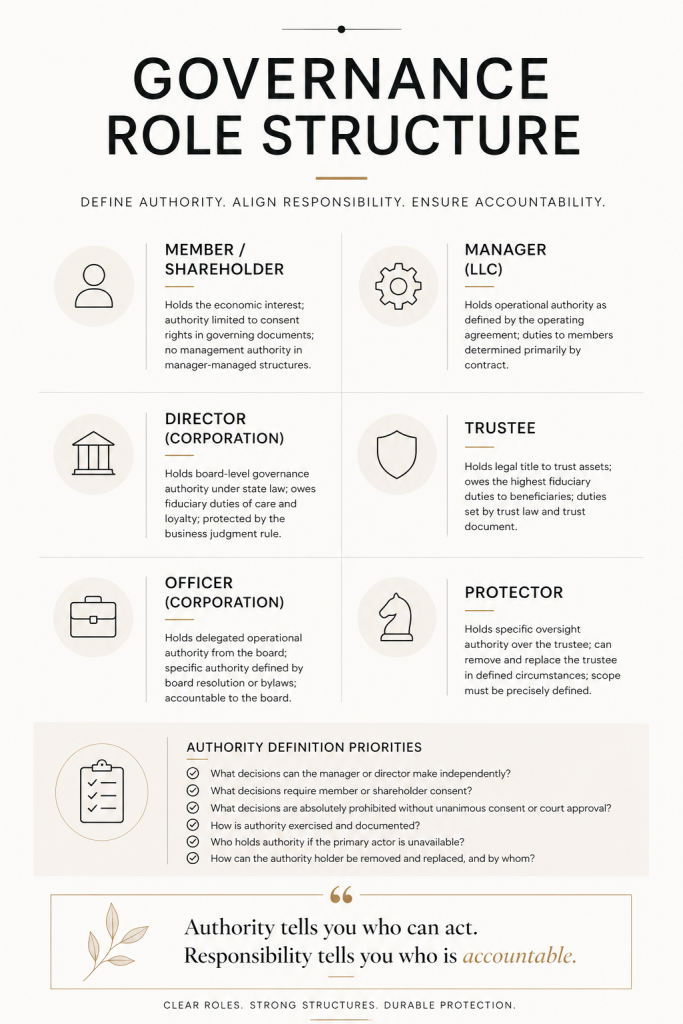
Long-term strategic planning in business and asset protection differs from reactive planning in its time horizon and design logic. Reactive planning addresses the immediate risk: the pending claim, the approaching transaction, the identified vulnerability that needs correction. Strategic planning addresses the full range of risks, transitions, and objectives that a business owner or family will encounter over years or decades, and designs structures that remain effective through those changes rather than requiring reconstruction each time circumstances shift.
Michael Ioane approaches long-term planning as a fundamentally different discipline from transactional structuring. The structures designed for long-term effectiveness must anticipate conditions that cannot be fully predicted, accommodate personnel changes and generational transitions, and remain legally sound through changes in law, jurisdiction, and personal circumstances. This requires a different kind of design logic than addressing an immediate and specific problem.
The Limitations of Short-Term Structuring
Short-term structuring, meaning arrangements designed to address a specific current need without broader consideration of what comes next, produces structures that solve the immediate problem but create predictable future complications. An entity formed specifically to hold a single asset being acquired, without consideration of how that asset will be managed over time, how it will be transferred, or what will happen to it in the event of the owner’s incapacity or death, is a structure that will require reactive intervention at each of those future transition points.
The cumulative cost of repeated reactive structuring is substantially higher than the cost of designing a comprehensive long-term structure from the outset. Each reactive intervention carries its own legal and administrative costs, its own timing vulnerabilities, and its own risk of being implemented under conditions that constrain the available options. Planning beyond immediate risk eliminates or substantially reduces these costs by addressing the foreseeable transition points before they become emergent problems.
Identifying the Planning Horizon
Effective long-term strategic planning begins with a clear identification of the relevant planning horizon: how far into the future the structure needs to remain effective, what major transitions are foreseeable within that horizon, and what conditions might change in ways that would affect the structure’s design requirements.
For a business owner in the growth phase, the planning horizon typically extends through the business’s maturity, a potential sale or transition, and the owner’s personal estate planning. For a family with significant multigenerational assets, the planning horizon extends across generations and must account for governance succession, changing family compositions, and the evolving legal landscape in the relevant jurisdictions. The planning horizon is not determined by the client’s preference; it is determined by the structure’s purpose and the realistic timeframe over which that purpose must be served.
Structures Designed for Duration
Structures designed for long-term effectiveness share several characteristics that distinguish them from those designed for immediate purposes. They include explicit succession mechanisms for every governance role, so that the departure of any individual does not create a governance vacuum. They include provisions for periodic review and updating to ensure the governing documents remain accurate as circumstances change. They include dispute-resolution mechanisms that do not require litigation to resolve governance conflicts. And they are designed with awareness of how the relevant legal landscape might change, including changes in tax law, trust law, and jurisdictional regulations that could affect the structure’s design requirements over its intended lifespan.
Michael Ioane designs long-term structures with these characteristics as baseline requirements, not optional enhancements. A structure that lacks succession planning, governance review mechanisms, and dispute resolution provisions is not a long-term structure; it is a short-term structure with an optimistic assumption about how long it will function without intervention.
Integrating Protection With Long-Term Objectives
The most effective long-term planning integrates asset protection with the client’s broader objectives across business, estate, and personal financial planning. Protection structures that are designed in isolation from estate planning objectives create conflicts at transition points. Estate plans that do not account for existing protection structures may require significant restructuring to implement effectively. Tax planning that is not coordinated with protection and estate planning may optimize one dimension while creating problems in another.
Integrated long-term planning treats these dimensions as components of a single coherent design rather than separate exercises conducted by different advisors. The structure that serves protection, estate planning, and tax planning objectives simultaneously, without requiring reconstruction whenever one dimension changes, is the one that provides the most durable value over its intended lifespan. The principles of long-term strategy guides consistently identify this integration as the defining characteristic of superior planning.
A structure designed for today’s problem is solved for today. A structure designed for the full planning horizon is an asset that compounds in value over time.
The information in this article reflects general structural principles and practical observations from consulting experience and is provided for educational purposes only. It should not be interpreted as individualized legal or tax advice.
Michael Ioane | MichaelIoane.com
Continue Learning with Michael Ioane
Build your understanding of asset protection and business planning with the Asset Protection Manual . Explore taxation and private trust planning in Boston Tea Party . Both books are available on Amazon.