Michael Ioane
Article IV
SUMMARY GUIDE ARTICLE
Guide: Governance Role Structure
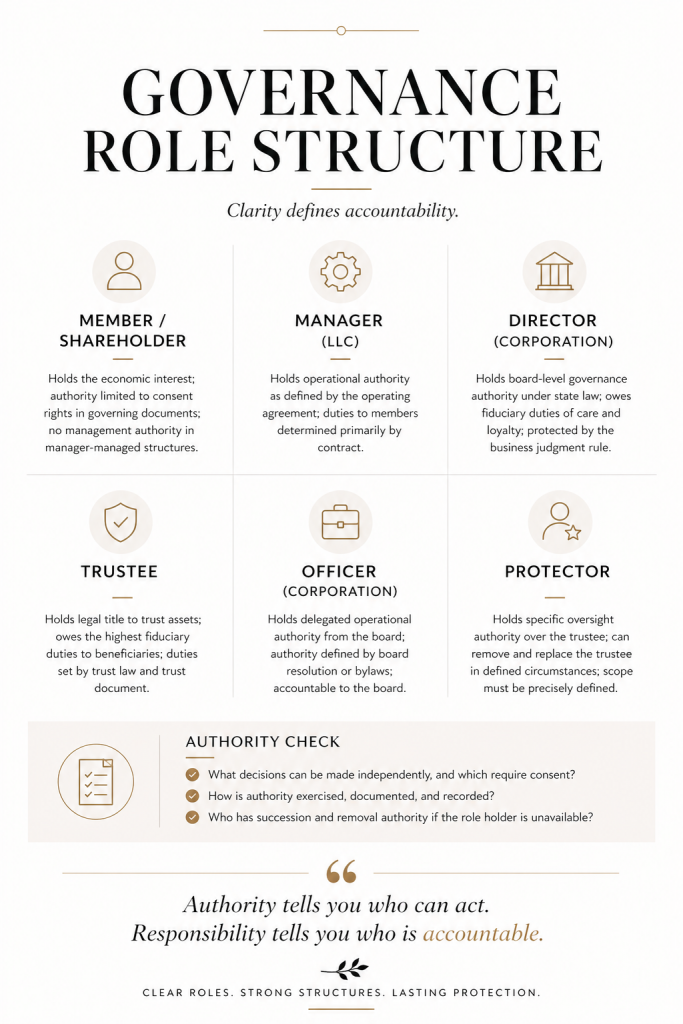
This guide provides a practical reference for understanding and designing governance role structures across entity and trust arrangements. The frameworks here reflect Michael Ioane’s approach to defining authority, responsibility, and accountability in governance design. Clear role structure is the foundation of a governance arrangement that functions under pressure and provides durable protection.
Core Governance Roles and Their Legal Basis
Member or Shareholder: holds the economic interest; authority limited to consent rights defined in governing documents; does not hold management authority in a manager-managed structure.
Manager (LLC): holds operational authority as defined by the operating agreement; duties to members determined primarily by contract; can be an individual or a corporate entity.
Director (Corporation): holds board-level governance authority under state corporate law; owes fiduciary duties of care and loyalty to the corporation; protected by the business judgment rule for good-faith decisions.
Trustee: holds legal title to trust assets; owes the highest fiduciary duties in private law to beneficiaries; duties set by trust law and trust document; cannot be significantly modified by contract.
Officer (Corporation): holds delegated operational authority from the board; specific authority defined by board resolution or bylaws; accountable to the board for exercise of delegated authority.
Protector: holds specific oversight authority over the trustee; can remove and replace the trustee in defined circumstances; the scope of authority must be precisely defined to avoid conflicts with trustee authority.
Authority Definition Priorities in Governing Documents
Every governance structure should address the following authority questions explicitly in its governing documents:
• What decisions can the manager or director make independently, without member or shareholder consent?
• What decisions require member or shareholder consent, and what consent threshold applies?
• What decisions are absolutely prohibited without unanimous consent or court approval?
• How is authority exercised: through written resolution, formal meeting, or other documented process?
• Who holds authority when the primary governance actor is unavailable: is there a defined succession mechanism?
• How can the authority holder be removed and replaced, and by whom?
Responsibility Alignment Checklist
Use this checklist to identify authority and responsibility misalignment in existing structures:
• Does the person with formal authority actually exercise that authority in practice?
• Is there a person exercising de facto control who does not hold formal authority?
• Do governance records reflect how decisions were actually made, or only how they were supposed to be made?
• Has delegated authority been followed by adequate oversight of the delegate’s performance?
• Are the accountability mechanisms in the governing documents adequate to address governance actor failure?
• Has the authority structure been updated to reflect changes in the business or personnel?
Governance Role Failure Patterns
The following patterns indicate governance role failure that requires correction:
• The formal authority holder is not making decisions; another party is directing all outcomes informally
• Governing documents have not been updated to reflect current authority holders
• Delegation has occurred without any oversight or accountability mechanism
• Authority boundaries are ambiguous, leading to disputes about who can authorize specific transactions
• Protector provisions exist, but are so vague that the scope of protector authority is contested
• No succession mechanism exists for the primary governance actor
Governance role structure is the framework within which every decision is made. The clarity of that framework determines whether the structure’s decisions will hold up when examined.
The information in this article reflects general structural principles and practical observations from consulting experience and is provided for educational purposes only. It should not be interpreted as individualized legal or tax advice.
Michael Ioane | MichaelIoane.com
Continue Learning with Michael Ioane
Build your understanding of asset protection and business planning with the Asset Protection Manual . Explore taxation and private trust planning in Boston Tea Party . Both books are available on Amazon.