Michael Ioane
Article IV
Summary Guide Article
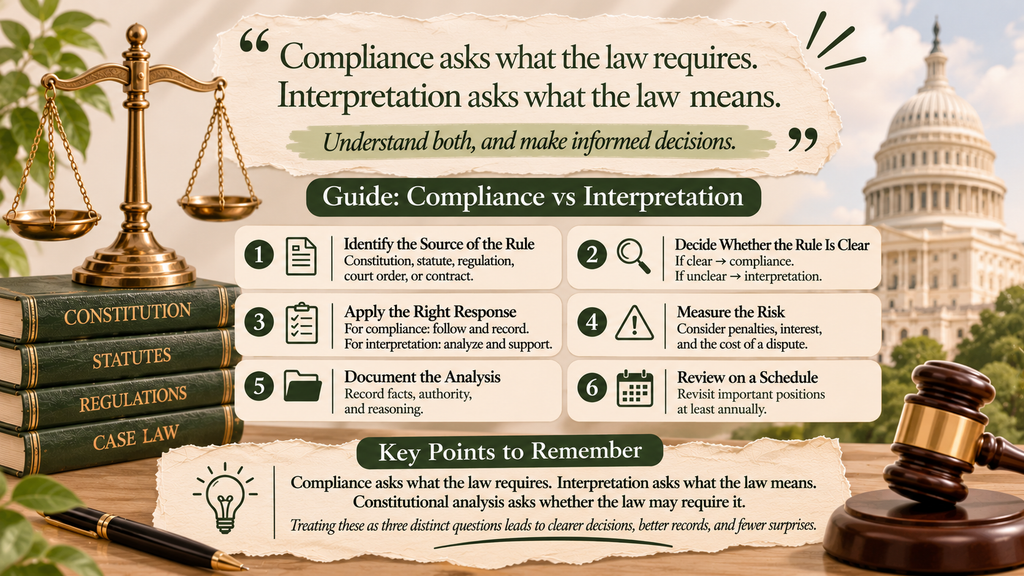
Guide: Compliance vs Interpretation
This guide summarizes how to separate compliance questions from interpretation questions and how to respond to each. It is intended for general education and does not replace review of a specific situation by a licensed professional.
Step One: Identify the Source of the Rule
Determine whether the requirement comes from the Constitution, a federal or state statute, an agency regulation, a court order, or a contract. The source determines its rank, who enforces it, and how disputes are resolved.
Step Two: Decide Whether the Rule Is Clear
Read the text as written and check for definitions. Look for regulations and decisions that apply it. If sources agree and the facts fit, treat the matter as a compliance task. If sources conflict or the text allows more than one reasonable reading, treat it as an interpretation question.
Step Three: Apply the Right Response
For compliance tasks, create a checklist, assign responsibility, and record completion. For interpretation questions, list the competing readings, gather authority for each, and note which interpretive method supports each reading, such as text, purpose, or precedent.
Step Four: Measure the Risk
Estimate the consequences of being wrong. Consider penalties, interest, and cost of a dispute. Where an uncertain position is taken, check what disclosure and support the governing standard requires, and whether professional advice has been obtained on complete facts.
Step Five: Document the Analysis
Write down the facts, the authority reviewed, and the reasoning. Date the memo and keep it with the records it supports.
Step Six: Review of a Schedule
Revisit important positions at least annually and whenever a significant court decision, regulation, or change in facts occurs.
Key Points to Remember
Compliance asks what the law requires. Interpretation asks what the law means. Constitutional analysis asks whether the law may require it. Treating these as three distinct questions produces clearer decisions, better records, and fewer surprises.
This article is provided for general educational purposes and reflects the author’s understanding of the law at the time of writing. It is not legal, tax, or financial advice, and it does not create a professional relationship. Laws change and individual circumstances differ, so consult a licensed professional about your specific situation.
Continue Learning with Michael Ioane
Build your understanding of asset protection and business planning with the Asset Protection Manual . Explore taxation and private trust planning in Boston Tea Party . Both books are available on Amazon.