Michael Ioane
Article I
Authority Article
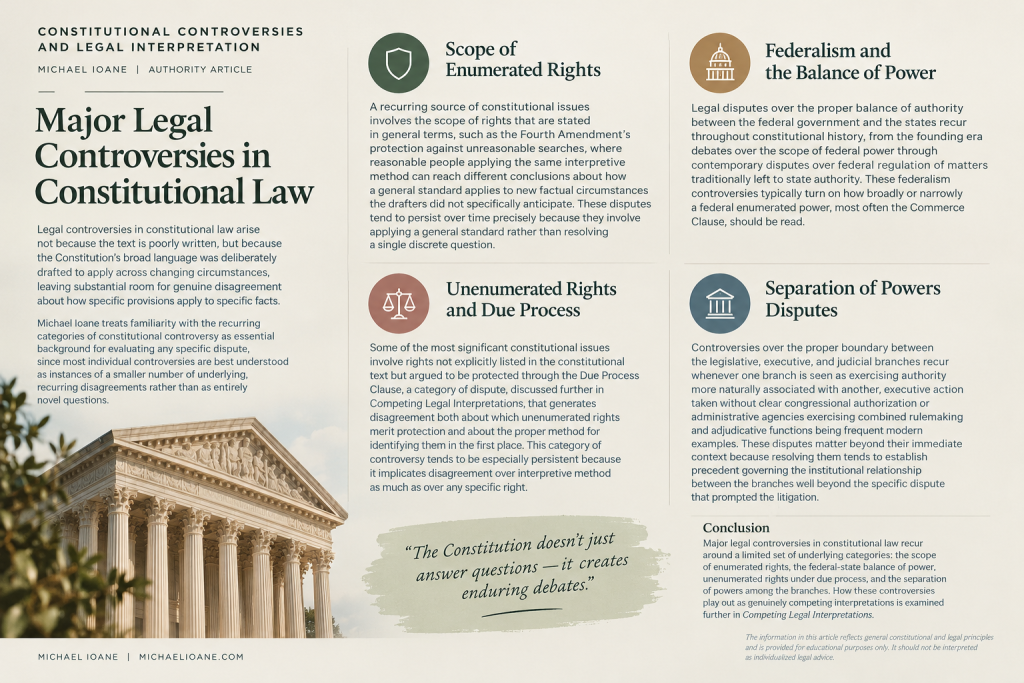
Major Legal Controversies in Constitutional Law
Legal controversies in constitutional law arise not because the text is poorly written, but because the Constitution’s broad language was deliberately drafted to apply across changing circumstances, leaving substantial room for genuine disagreement about how specific provisions apply to specific facts.
Michael Ioane treats familiarity with the recurring categories of constitutional controversy as essential background for evaluating any specific dispute, since most individual controversies are best understood as instances of a smaller number of underlying, recurring disagreements rather than as entirely novel questions.
Scope of Enumerated Rights
A recurring source of constitutional issues involves the scope of rights that are stated in general terms, such as the Fourth Amendment’s protection against unreasonable searches, where reasonable people applying the same interpretive method can reach different conclusions about how a general standard applies to new factual circumstances the drafters did not specifically anticipate. These disputes tend to persist over time precisely because they involve applying a general standard rather than resolving a single discrete question.
Federalism and the Balance of Power
Legal disputes over the proper balance of authority between the federal government and the states recur throughout constitutional history, from the founding era debates over the scope of federal power through contemporary disputes over federal regulation of matters traditionally left to state authority. These federalism controversies typically turn on how broadly or narrowly a federal enumerated power, most often the Commerce Clause, should be read.
Unenumerated Rights and Due Process
Some of the most significant constitutional issues involve rights not explicitly listed in the constitutional text but argued to be protected through the Due Process Clause, a category of dispute, discussed further in Competing Legal Interpretations, that generates disagreement both about which unenumerated rights merit protection and about the proper method for identifying them in the first place. This category of controversy tends to be especially persistent because it implicates disagreement over interpretive method as much as over any specific right.
Separation of Powers Disputes
Controversies over the proper boundary between the legislative, executive, and judicial branches recur whenever one branch is seen as exercising authority more naturally associated with another, executive action taken without clear congressional authorization or administrative agencies exercising combined rulemaking and adjudicative functions being frequent modern examples. These disputes matter beyond their immediate context because resolving them tends to establish precedent governing the institutional relationship between the branches well beyond the specific dispute that prompted the litigation.
Conclusion
Major legal controversies in constitutional law recur around a limited set of underlying categories: the scope of enumerated rights, the federal-state balance of power, unenumerated rights under due process, and the separation of powers among the branches. How these controversies play out as genuinely competing interpretations is examined further in Competing Legal Interpretations.
The information in this article reflects general constitutional and legal principles and is provided for educational purposes only. It should not be interpreted as individualized legal advice.
Michael Ioane | MichaelIoane.com
Continue Learning with Michael Ioane
Build your understanding of asset protection and business planning with the Asset Protection Manual . Explore taxation and private trust planning in Boston Tea Party . Both books are available on Amazon.