Michael Ioane
Article I
Authority Article
Underlying Philosophy of the Constitution
Constitutional philosophy examines the ideas that shaped the Constitution before a single clause was drafted, the assumptions about human nature, government, and liberty that the framers carried into the drafting process. Reviewing these underlying commitments provides essential context for understanding why the document is structured the way it is, rather than treating its provisions as arbitrary choices.
Michael Ioane treats the Constitution’s underlying philosophy as inseparable from its text, since provisions that appear purely procedural on the surface, such as the separation of legislative, executive, and judicial power, in fact express a specific and deliberate view about how liberty is best protected.
Natural Rights and Limited Government
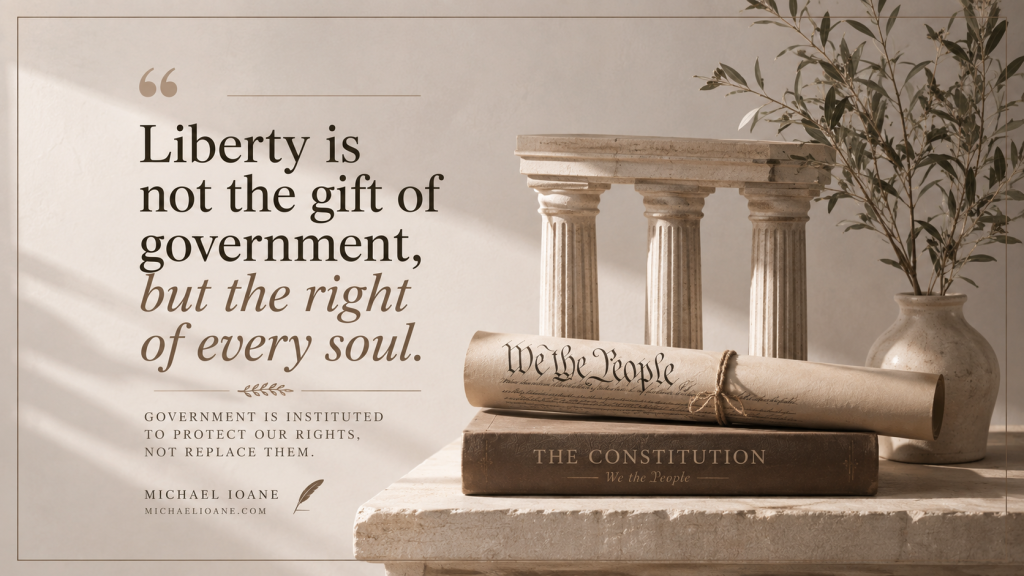
The Constitution rests on a natural rights tradition holding that individuals possess certain rights independent of government, and that government exists to secure those rights rather than to grant them. This premise explains why the document is structured around restraints on federal power rather than a grant of unlimited authority to govern, and why the Bill of Rights was later added to make several of those restraints explicit.
Popular Sovereignty as a Governing Premise
The Constitution’s opening words, establishing that the document proceeds from the people rather than from a monarch or a governing class, reflect the philosophical premise of popular sovereignty, the idea that legitimate governmental authority derives from the consent of the governed. This premise underlies the ratification process itself, which required approval by state conventions rather than by the existing state legislatures alone.
Separation of Powers as Philosophical Principle
Dividing governmental power among three branches reflects a specific philosophical judgment, discussed further in Legal Intent Behind Constitutional Design, that concentrated power poses an inherent risk to liberty regardless of who holds it or how well intentioned that holder may be. The framers drew on Montesquieu’s writing on this point directly, treating structural division of power as a safeguard independent of any particular officeholder’s character.
Skepticism of Concentrated Power
A recurring theme running through the Constitution’s structure is skepticism toward concentrated power in any single institution, a skepticism grounded in the framers’ direct experience with both unchecked monarchy and, closer to the drafting itself, the perceived weaknesses of an overly decentralized government under the Articles of Confederation. The resulting document reflects an attempt to balance these two concerns rather than resolve entirely in favor of either one.
Conclusion
The Constitution’s underlying philosophy, natural rights as the basis for legitimate government, popular sovereignty as the source of governmental authority, and a deliberate skepticism of concentrated power expressed through structural division, together explain why the document takes the specific form it does. How these philosophical commitments translate into the framers’ actual intent behind specific provisions is examined further in Legal Intent Behind Constitutional Design.
The information in this article reflects general constitutional and legal principles and is provided for educational purposes only. It should not be interpreted as individualized legal advice.
Michael Ioane | MichaelIoane.com
Continue Learning with Michael Ioane
Build your understanding of asset protection and business planning with the Asset Protection Manual . Explore taxation and private trust planning in Boston Tea Party . Both books are available on Amazon.