Michael Ioane
Article II
Deep Topic Article
Supporting Evidence in Legal Arguments
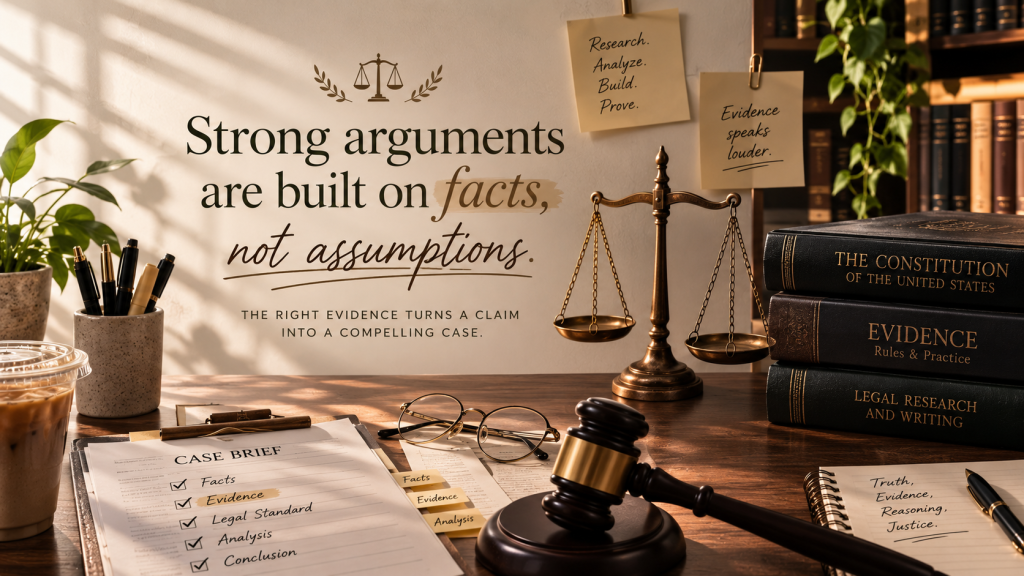
Legal evidence arguments require pairing every substantive legal claim with the specific factual or documentary support needed to establish it. A legal argument is only as strong as the evidence supporting its factual premises, and even a legally sound theory will fail if the underlying facts cannot actually be established through admissible, credible evidence.
Michael Ioane treats evidentiary support as a distinct discipline running alongside legal argument itself: identifying what legal theory applies is one step, but confirming that the facts needed to satisfy that theory can actually be proven is an equally necessary, separate step.
Types of Supporting Evidence
Legal arguments typically draw on several categories of evidence: documentary evidence, including contracts, correspondence, and business records; testimonial evidence, including witness statements and expert opinions; and demonstrative evidence, including photographs, diagrams, and other materials illustrating a specific fact. Selecting the strongest available category of evidence for each specific factual claim, rather than relying on a single evidentiary source throughout, generally produces a more resilient argument.
Matching Evidence to Legal Elements
Effective argument development requires mapping specific evidence directly to each element of the governing legal rule, rather than presenting evidence generally and leaving the reader to infer which evidence supports which element. An argument that clearly shows which specific document, testimony, or record establishes each particular element of the applicable rule is considerably more persuasive, and more resistant to challenge, than one that presents evidence in an undifferentiated block.
Addressing Evidentiary Gaps
Where evidence supporting a specific element is weak or incomplete, an effective argument acknowledges this directly rather than overstating what the available evidence actually shows, and explains why the remaining evidence, taken as a whole, still satisfies the applicable standard. Overstating weak evidence tends to undermine credibility across the entire argument, not merely the specific claim the weak evidence was meant to support.
These evidentiary considerations work together with the logical structure discussed in Logical Structure in Legal Reasoning: strong evidence poorly organized, or well-organized reasoning built on weak evidence, both produce a less persuasive argument than the combination of strong evidence and sound logical structure together.
Authentication and Admissibility Considerations
Beyond simply gathering supporting evidence, an effective legal argument accounts for whether that evidence can actually be authenticated and admitted under the applicable rules of evidence, since evidence that cannot be properly authenticated or that falls within an evidentiary exclusion, such as hearsay without an applicable exception, may be unavailable to support the argument regardless of how directly relevant it appears. Confirming admissibility early in argument development avoids building a position around evidence that ultimately cannot be used.
Corroboration and Weight of Evidence
Where possible, effective argument development corroborates a key factual claim with more than one independent source of evidence, since corroborated evidence generally carries greater persuasive weight than a single uncorroborated source, particularly where that source’s credibility might otherwise be contested. Identifying which claims are supported by only a single source, and seeking additional corroboration where available, is a practical way to strengthen an argument’s evidentiary foundation before it is relied upon.
Conclusion
Supporting evidence in legal arguments requires selecting the strongest available evidence for each specific claim, mapping that evidence directly to the applicable legal elements, confirming admissibility and authentication, seeking corroboration where available, and addressing evidentiary gaps honestly rather than overstating what the record actually shows. This evidentiary discipline is what gives a legal argument’s factual premises the same rigor as its legal analysis.
The information in this article reflects general constitutional and legal principles and is provided for educational purposes only. It should not be interpreted as individualized legal advice.
Michael Ioane | MichaelIoane.com
Continue Learning with Michael Ioane
Build your understanding of asset protection and business planning with the Asset Protection Manual . Explore taxation and private trust planning in Boston Tea Party . Both books are available on Amazon.