Michael Ioane
Article IV
Summary Guide Article
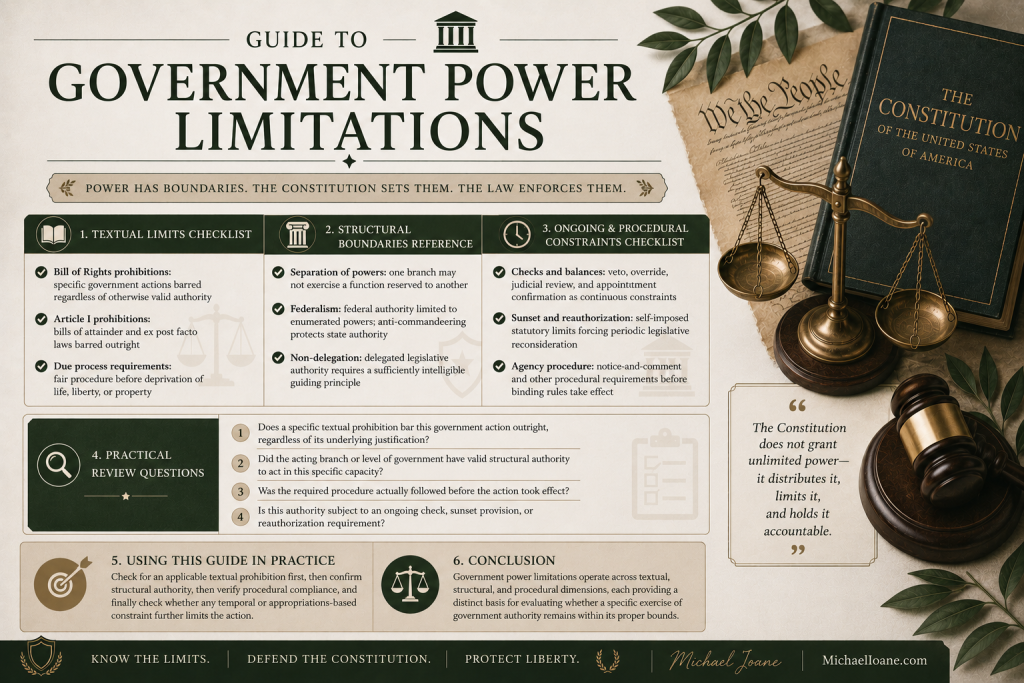
Guide: Government Power Limitations
This government limits guide provides a practical constitutional authority and legal boundaries reference, drawing together the frameworks covered in Limits of Government Authority, Legal Constraints on Government Power, and Structural Boundaries of Government Power into a single working reference.
Michael Ioane structured this guide as a checklist for tracing a specific exercise of government power through its applicable textual, structural, and procedural limits.
Textual Limits Checklist
- Bill of Rights prohibitions: specific government actions barred regardless of otherwise valid authority
- Article I prohibitions: bills of attainder and ex post facto laws barred outright
- Due process requirements: fair procedure before deprivation of life, liberty, or property
Structural Boundaries Reference
- Separation of powers: one branch may not exercise a function reserved to another
- Federalism: federal authority limited to enumerated powers; anti-commandeering protects state authority
- Non-delegation: delegated legislative authority requires a sufficiently intelligible guiding principle
Ongoing and Procedural Constraints Checklist
- Checks and balances: veto, override, judicial review, and appointment confirmation as continuous constraints
- Sunset and reauthorization: self-imposed statutory limits forcing periodic legislative reconsideration
- Agency procedure: notice-and-comment and other procedural requirements before binding rules take effect
Practical Review Questions
- Does a specific textual prohibition bar this government action outright, regardless of its underlying justification
- Did the acting branch or level of government have valid structural authority to act in this specific capacity?
- Was the required procedure actually followed before the action took effect?
- Is this authority subject to an ongoing check, sunset provision, or reauthorization requirement
Using This Guide in Practice
This government limits guide works best applied directly to a specific action: check for an applicable textual prohibition first, then confirm structural authority, then verify procedural compliance, and finally check whether any temporal or appropriations-based constraint further limits the action.
Michael Ioane applies this same layered sequence to every question of government authority reviewed, treating each dimension as a distinct check rather than assuming that satisfying one dimension is sufficient on its own.
Conclusion
Government power limitations operate across textual, structural, and procedural dimensions, each providing a distinct basis for evaluating whether a specific exercise of government authority remains within its proper bounds. This guide is intended as a working reference for tracing any specific government action through all three dimensions systematically.
The information in this article reflects general constitutional and legal principles and is provided for educational purposes only. It should not be interpreted as individualized legal advice.
Michael Ioane | MichaelIoane.com
Continue Learning with Michael Ioane
Build your understanding of asset protection and business planning with the Asset Protection Manual . Explore taxation and private trust planning in Boston Tea Party . Both books are available on Amazon.